

Along with improving corporate governance, using energy efficiently and effectively is a crucial solution that helps businesses reduce production costs and increase their competitive advantage. This is also a solution that creates conditions for businesses to move towards green and sustainable production goals.

Gemmy Wood Joint Stock Company (Tan Phu Industrial Cluster, Tan Son District) built its factory to maximize natural light and ventilation, saving on electricity consumption.
Reduce costs, increase efficiency.
In the context of ever-increasing energy demand for production and daily life, continuously high electricity load growth, dwindling coal, oil, and gas resources, and heavy reliance on imports, using energy efficiently and effectively is a practical solution that significantly contributes to ensuring energy security and promoting economic development linked to green production.
Vietnam is seriously implementing a green transformation across its entire economy, aiming for net-zero emissions by 2050. In this journey, many businesses have been actively practicing electricity conservation and using clean energy in production. Solutions for efficient energy use implemented by businesses include: Scientifically structuring production processes to reduce energy losses; improving machinery and technology to enhance operational efficiency; applying technological improvements and rationalizing fuel combustion, heating, cooling, and heat energy conversion processes; reducing heat and energy losses during transmission, distribution, and consumption; and recovering energy from waste cycles for reuse.
Viet Tri Paper Joint Stock Company specializes in the production of packaging paper, with an output of over 140,000 tons of product per year. Mr. Tran Van Manh, Head of the Company's Administrative and Organizational Department, stated: “The company focuses on investing in technology, operational processes, and maintenance of machinery and equipment to improve efficiency; using motors with appropriate power for each piece of equipment, and establishing suitable operating modes to reduce peak-hour load. Currently, the company uses waste paper as a raw material for production, with recycled paper margins accounting for 90% of the raw materials used in packaging paper production. This contributes to reducing the consumption of raw materials, fuel, and energy for production. The company also stopped using coal to fuel its boilers in 2014 and switched to using wood by-products.”
There is still significant potential for energy savings, especially in the industrial and construction sectors (which account for over 60% of the province's electricity consumption), as many businesses have outdated machinery, production lines, and technology, resulting in low energy efficiency and effectiveness.
Implementing energy-saving solutions flexibly and synchronously with a clear strategy will help businesses achieve high efficiency in saving energy costs, maximize business profits, and increase their ability to integrate into the international economy.
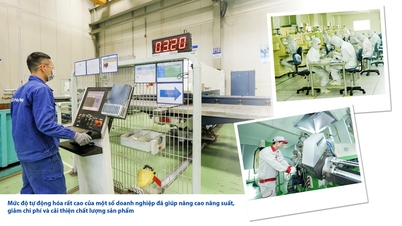
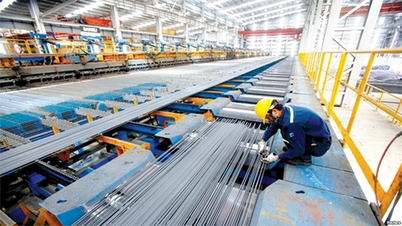
Many businesses have adopted technical measures and constructed factories efficiently to maximize the effectiveness of lighting, ventilation, and cooling systems; modern automation technologies such as industrial robots, automatic control systems, and smart production lines have been put into operation.
CMC Joint Stock Company (Thuy Van Industrial Park, Viet Tri City) operates in the field of manufacturing ceramic tiles and glazed roof tiles, with an annual output of approximately 20 million m2. The company established an Innovation Committee to conduct research and optimize various stages of the production process to save fuel, raw materials, and operating costs. In 2023, Kaizen productivity and quality improvement programs and activities helped the company save nearly 30 billion VND in production costs.
Ms. Vu Thi Loan, Deputy General Director of the company, stated: “To give our products a competitive advantage and meet quality and aesthetic requirements, the company focuses on investing in a modern production line system with advanced technology and machinery, which is highly automated. This helps minimize errors, ensures stable operation, and uses energy efficiently.”
For businesses, implementing energy-efficient solutions not only brings direct economic benefits but also contributes to reducing energy imports, saving resources, and reducing greenhouse gas emissions. It is also a way for businesses to proactively fulfill their responsibilities to society and the community.

CMC Corporation (Thuy Van Industrial Park, Viet Tri City) is actively innovating technology and automating production, helping to reduce raw materials and energy consumption.
Partnering with businesses
Currently, the provincial authorities are actively supporting businesses in applying, transferring, mastering, and developing technologies for energy saving and efficiency; integrating energy saving and efficiency into scientific research and technology development programs; advising and supporting businesses with solutions for electricity and energy saving; building energy management models; and supporting energy audits.
From 2018 to the present, with programs supporting small and medium-sized enterprises (SMEs) in technological innovation, more than 60 technology innovation projects in the province have received support with a total budget of over 20 billion VND. Through technological innovation activities, dozens of technologies and processes have been transferred, absorbed, and mastered by businesses; applying smart manufacturing technologies, minimizing waste in the production process, and saving on manpower, time, raw materials, fuel, and energy.
Plan No. 3085/KH-UBND, dated August 11, 2023, of the Provincial People's Committee on implementing Directive No. 20/CT-TTg, dated June 8, 2023, of the Prime Minister on strengthening electricity saving in the period 2023-2025 and subsequent years, sets a target of saving at least 2% of total electricity consumption annually throughout the province. With synchronized solutions in electricity saving, in 2023, the total electricity saved throughout the province reached 83.78 million kWh, corresponding to an electricity saving rate of 2.21%, of which the electricity saved for business and service purposes was 2.7 million kWh, reaching 2.85%. Electricity savings for industrial production amounted to 48.97 million kWh, reaching 2.05%... Regarding the development of renewable energy sources, the province is currently constructing a waste treatment and power generation plant with a total capacity of 18 MW, and developing 210 rooftop solar power systems with a capacity of over 3,100 kWp.
Mr. Pham Van Chuc, Deputy Director of Phu Tho Power Company, said: “Along with implementing technical solutions and accelerating the progress of investment projects for the construction and renovation of the power grid, the efficient and economical use of electricity plays an important role in ensuring stable electricity supply, especially for key electricity users. In 2024, the company signed load adjustment agreements with 230 out of 230 customers with electricity consumption of 1 million kWh/year or more. We are strengthening communication efforts and urging businesses to develop and implement solutions for efficient and economical electricity use; ensuring the correct use of capacity and load profiles; implementing reasonable production plans; and minimizing the use of equipment and machinery with high electricity consumption during peak hours.”
In the context of Vietnam's deep integration into the global economy, the demands of importing countries' markets for goods, such as carbon labeling and energy consumption control, are increasingly being intensified. To improve energy efficiency, in the coming period, it is necessary to continue mobilizing resources to promote energy saving and efficiency through the synchronized implementation of state management tasks and solutions, technical support, scientific and technological research and product development, and human resource training and development. Businesses also need to proactively improve technology, especially in energy-intensive industries, eliminate outdated production capacity, and enhance energy efficiency through investment in energy-saving projects.
Nguyen Hue
In implementing Resolution No. 04-NQ/HU, dated January 8, 2021, of the Lam Thao District Party Committee on the development of commercial agricultural production near urban areas in the period 2020-2025, Lam Thao town has concretized it into specific programs and plans, suitable to the practical situation, to effectively achieve the set goals and tasks.

The green onion product of the Dat To Seed Agricultural Cooperative in Ngoc Tinh area has been recognized as meeting OCOP standards at level 3 stars.
Due to rapid urbanization, agricultural land is shrinking, creating a need for the Party Committee and government of Lam Thao town to develop peri-urban agriculture in a specialized, concentrated manner, focusing on producing marketable products and rapidly increasing value per unit area.
With the goal of effectively exploiting and utilizing agricultural land while changing farmers' perceptions and promoting their role as key players in production development, the town is focusing on reviewing land resources, researching, and developing a plan to implement the resolution in accordance with the principle of linking agricultural production planning with the district's overall planning, including planning concentrated production areas for products with potential and advantages to develop in a commercial direction.
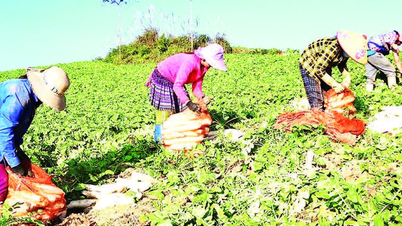
To enhance product value, the town encourages the application of science and technology in crop care and pest control, the use of high-quality, high-yield varieties, and the widespread adoption of safe production processes within the community. This includes crop rotation, increasing the number of harvests, converting inefficient agricultural land and garden areas to cultivate high-value crops suitable for the soil, and making full and efficient use of land and water resources. Priority is given to developing the region's strengths, particularly green vegetables, and planning large-scale specialized vegetable production zones.
Thanks to favorable soil conditions, production experience, and convenient transportation links, serving as a gateway for trade with major consumer markets such as Viet Tri, Hanoi, and Yen Bai, the town's vegetable production industry has developed extensively. Currently, many households in Son Thinh, Ngoc Tinh, and Thang Loi areas earn hundreds of millions of VND per year from growing vegetables.
In 2023, the town had green onions that achieved OCOP 3-star certification. The locality is also actively coordinating to complete the application for planting area codes for 2 hectares of green vegetables in Phuong Lai area, and finalizing the application for OCOP 3-star certification for its exported dried bananas.
In livestock farming, the town focuses on enhancing the value of local advantageous products, promoting the development of livestock herds in a concentrated, farm-scale manner, ensuring biosafety and environmental hygiene, while also strengthening propaganda, implementing vaccination, and disinfecting livestock.
Currently, the town has a total herd of 107 cattle, over 1,400 pigs, and more than 14,600 poultry... At the same time, the town encourages the development of aquaculture in an intensive, industrial direction, converting low-lying, inefficiently cultivated areas to high-value crops combined with aquaculture... To date, the average value of products from cultivated land and aquaculture in the town has reached 160 million VND/hectare/year.
In the coming period, Lam Thao town will continue to focus resources on investing in the renovation and upgrading of the irrigation system in the area; promote mechanization in production; effectively implement the plan to encourage and support the development of agriculture towards near-urban commodity production, high-tech agriculture, and linked to the consumer market; innovate the forms of production organization and service provision in the locality; continue to direct the development of OCOP products in the area; encourage the establishment of new enterprises, cooperatives, production groups, and production and business households... to participate in cooperation and linkage in production, processing, and consumption of products associated with building distinctive local products.
Phuong Thao
Source: https://baophutho.vn/toi-uu-hoa-su-dung-nang-luong-217827.htm


















![[INFOGRAPHICS] Phase 2 of the First Session of the 16th National Assembly: Considering and deciding on many important issues](https://vphoto.vietnam.vn/thumb/402x226/vietnam/resource/IMAGE/2026/04/20/1776678933182_20-4-anhquochoi2004.jpeg)


![[Infographic Series] Red Addresses of Dong Nai: Headquarters of the Southern Vietnam Liberation Army, Tan Hiep Prison Relic](https://vphoto.vietnam.vn/thumb/402x226/vietnam/resource/IMAGE/2025/9/26/1331532306fb4ad18e4a849e5c64202a)























































Comment (0)