Amid a rapid increase in measles cases and the deaths of three children due to the disease, the Ho Chi Minh City Department of Health has proposed to the Ho Chi Minh City People's Committee to declare a measles epidemic and issue a proactive measles response plan for the city.
Three children died from measles.
According to the Ho Chi Minh City Center for Disease Control (HCDC), three children have died from measles in Ho Chi Minh City since June.
Accordingly, the number of measles cases in Ho Chi Minh City has been increasing since the end of May, and in the most recent week, there have been 60 cases of fever and rash suspected to be measles. The three districts with the highest number of measles cases are Binh Tan District, Binh Chanh District, and Hoc Mon District.
 |
| Illustrative image. |
According to reports from hospitals in Ho Chi Minh City, as of August 4th, there have been 505 cases of fever and rash suspected to be measles, of which 262 tested positive. More than 50% of these cases were patients from other provinces and cities who came to the city for examination and treatment.
In Ho Chi Minh City alone, there were 201 cases of measles-like rash, of which 116 tested positive. In contrast, from 2021 to 2023, the entire city only had one positive test result.
Currently, 48 wards and communes across 14 districts in the city have confirmed measles cases; 8 districts have two or more wards or communes with cases.
Of the 116 confirmed cases, 27.6% were children under 9 months old, and 78.4% were children under 5 years old. 66% of the patients were unvaccinated or had not received both doses of the measles vaccine, and 30% had an unknown vaccination history.
Health experts consider measles a global threat because the measles virus, belonging to the Paramyxoviridae family, spreads rapidly through the respiratory tract from sick people to healthy people in the community or even across borders.
Measles is dangerous because it not only causes acute symptoms but also puts patients at risk of nervous system infections, musculoskeletal disorders, multi-organ damage, and can leave many severe and long-lasting complications, even lifelong ones, such as encephalitis, meningitis, otitis media, pneumonia, diarrhea, corneal ulcers, and blindness.
In addition, measles is particularly dangerous because it can erase immune memory, destroying an average of about 40 types of antibodies that fight off pathogens.
In children, a 2019 study by geneticist Stephen Elledge at Harvard University showed that measles eliminates between 11% and 73% of protective antibodies in children.
In other words, when a person contracts measles, their immune system is destroyed and resets to its initial, immature, and underdeveloped state, like that of a newborn baby.
To minimize risks and prevent the resurgence of measles, the WHO emphasizes that vaccination is the only way to protect children and adults from this potentially dangerous disease. Countries worldwide are required to achieve and maintain a coverage rate of over 95% with two doses of the measles vaccine.
Children and adults should proactively get vaccinated against measles fully and on schedule to help the body produce specific antibodies against the measles virus, helping to prevent the risk of contracting measles and severe complications, with an outstanding effectiveness of up to 98%.
In addition, everyone should proactively clean their eyes, nose, and throat with antiseptic solution daily. Limit gatherings in crowded places, avoid close contact with people showing symptoms of measles or suspected of having the disease, and do not share personal items with sick people. Maintain hygiene in your living space and supplement your diet with foods that boost the immune system.
If you experience symptoms of measles (fever, runny nose, dry cough, red eyes, sensitivity to light, rash all over the body), you should quickly go to the nearest medical center or facility for examination and timely treatment.
There have been 8 deaths due to rabies.
According to information from the Binh Thuan CDC, the area has just recorded another death suspected to be due to rabies. This is the eighth death since the beginning of 2024.
Specifically, the patient is a 49-year-old woman (from Ham Hiep commune, Ham Thuan Bac district) who lives alone. Her family is unaware whether she was bitten by a dog or cat; her vaccination history is also unknown.
The patient has a dog at home, and it has been noted that the dog is currently alive and well. On August 3, 2024, family members noticed the patient had a slight fever, panic, and fatigue, but the patient did not take any medication.
On August 5, 2024, the patient experienced shortness of breath, fear of water, fear of wind, and sought refuge in the dark. Therefore, family members took the patient to Binh Thuan Provincial General Hospital. After examination and consultation, doctors there concluded that rabies was suspected and transferred the patient to the Ho Chi Minh City Hospital for Tropical Diseases.


At the Ho Chi Minh City Hospital for Tropical Diseases, a saliva sample was taken from the patient for PCR testing, which came back positive for rabies virus. The patient's condition worsened, and the family requested to take him home. He passed away on August 6, 2024.
There is currently no specific cure for rabies, but it is entirely preventable. To proactively prevent rabies, people should implement the following measures: People who own dogs and cats should ensure they receive all necessary rabies vaccinations and booster shots annually as recommended by the veterinary industry; dogs should be kept on a leash or confined, and must wear a muzzle when taken out in public.
Do not tease or provoke dogs or cats. If bitten by a dog or cat, immediately wash the wound under running water with soap for 15 minutes; if soap is unavailable, rinse the wound with plain water. Afterwards, clean the wound with 70% alcohol or iodine alcohol; avoid bruising the wound and do not bandage it tightly.
Seek prompt medical attention for examination, consultation, and rabies vaccination or anti-rabies serum; absolutely do not self-treat or seek treatment from traditional healers.
Communicate and educate children on how to prevent dog and cat bites and how to immediately inform their parents or relatives after being bitten by a dog or cat.
The Ministry of Health advises people not to hesitate or delay getting vaccinated against rabies if bitten by a dog or other animal. Go immediately to the nearest medical facility for advice and timely treatment.
According to Dr. Nguyen Tuan Hai from the Safpo/Potec vaccination system, people who have the means can get a preventative rabies vaccine before exposure.
Accordingly, if vaccinated preventively, only 3 doses are needed, offering complete flexibility in terms of timing. If bitten by a dog or cat, the vaccination schedule will be simpler, requiring only 2 doses of vaccine without the need for anti-rabies serum, even if the wound is severe, the bite is close to the central nervous system, or an area with a high concentration of nerves.
Meanwhile, if you haven't been vaccinated against rabies before being bitten by a dog or cat, you need five injections at strict intervals of one month. This is especially true in cases of severe wounds or those in critical areas, where serum injections are necessary. This significantly impacts your mental state and daily routine, as well as causing more pain and side effects.
Particularly in remote areas, anti-rabies serum and vaccines are not always readily available, and there are times when shortages cause great anxiety and fear among people bitten by animals.
For children, pre-exposure rabies vaccination is especially important because children often don't notice animal-related injuries while playing with pets and may forget to inform their parents (except in severe cases).
Furthermore, children are shorter, so when bitten by a dog, they are more likely to be bitten on the head, face, and neck than adults. This also allows the rabies virus to travel faster to the central nervous system and cause disease more quickly.
Furthermore, regarding concerns about rabies vaccines having side effects, such as affecting the nervous system and causing memory loss, Dr. Hai stated that older generation vaccines had this problem.
However, modern rabies vaccines are now produced using advanced technology and do not contain nerve cells, so they are harmless and do not affect the health or memory of users.
The new generation rabies vaccine uses fractional centrifugation technology, ensuring low levels of impurities and compliance with the World Health Organization (WHO) quality standards (less than 10 nanograms per dose).
Some types of vaccines do not use the preservative thimerosal (mercury), therefore the new generation rabies vaccine also minimizes local side effects such as swelling, pain, fever, etc., compared to the older generation vaccine which has been discontinued.
Eating raw or undercooked food can be disastrous.
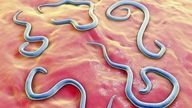
Last July, after the patient visited Duc Giang General Hospital (Hanoi), doctors there discovered he was infected with lung flukes. The patient said that he often went to work, crossed streams, caught live crabs, grilled them, and ate them. The patient has since recovered, been discharged from the hospital, and instructed to return for regular check-ups.
Lung flukes comprise many different species (over 40 species), of which two species are considered the most harmful: Paragonimus heterotremus and Paragonimus westermani.
These lung flukes are often quite large, with adult flukes clearly visible to the naked eye.
According to doctors at Duc Giang General Hospital, in some northern mountainous provinces such as Dien Bien, Lai Chau, and Son La, people have a habit of eating raw shrimp and crab (in salads or undercooked grilled).
When consuming undercooked shrimp or crab containing lung fluke larvae, the larvae enter the stomach and intestines (larvae hatch from cysts in the duodenum), penetrate the wall of the digestive tract into the abdominal cavity, then pass through the diaphragm and pleura into the lung parenchyma and settle there. A small number may reside in the heart, peritoneum, liver, kidneys, under the skin, intestines, brain, etc.
The fluke primarily parasitizes the lungs, forming cysts in the small bronchioles of the lungs of humans or animals. Each cyst usually contains two flukes and reddish pus, surrounded by newly formed blood vessels.
The symptoms of lung fluke infection vary from person to person depending on the stage of the disease and any underlying medical conditions.



Some typical symptoms, such as digestive disorders, are often the initial symptoms of the disease: Immediately after infection with tapeworm larvae through food, patients experience abdominal pain and diarrhea.
When the lung fluke larvae have migrated from the stomach to the lungs, patients may experience symptoms such as pneumothorax or pleural effusion.
Once the parasite has colonized the lungs and reproduced, patients exhibit more pronounced symptoms, particularly affecting the respiratory system: persistent cough, coughing up phlegm with blood, chest pain, mild fever, gradual weakness, and impaired breathing.
In some cases, patients with rather complex symptoms may be misdiagnosed with pulmonary tuberculosis, with lung fluke infection being the cause of the infection.
Recently, doctors at the Central Tropical Diseases Hospital examined and treated a young male patient named T.D.T, residing in Yen Bai. This young man experienced itching all over his body, accompanied by fever, dizziness, and red rashes under the skin.
Even under the skin on the thighs, forearms, abdomen, and back, the wriggling movements of the parasites were clearly visible. T was diagnosed with parasitic worm infection.
To prevent parasitic worm infections, doctors advise people not to eat raw foods such as shrimp and freshwater crabs; and to thoroughly wash their hands and food preparation utensils, especially after contact with raw shrimp, crabs, and fish.
Eating raw or undercooked food is a pathway for parasitic worms to enter the body. When ingested, the parasite larvae can travel through the bloodstream to the brain and muscles, causing disease.
According to Dr. Hoang Dinh Canh, Director of the Central Institute of Malaria, Parasitology, and Entomology, the habit or preference of many people to eat raw pork, raw beef, blood pudding, raw fish salad, and aquatic vegetables is the cause of parasitic and bacterial infections.
In fact, many people who have been diagnosed with tumors, brain cancer, liver cancer, or lung cancer have found that the exact cause is an abscess caused by parasitic worms. When infected with parasites, if not detected and treated promptly, the disease can cause dangerous complications such as: acute cholangitis, liver abscess, cholecystitis, or subcapsular hematoma of the liver…
Source: https://baodautu.vn/tin-moi-y-te-ngay-128-tphcm-kien-nghi-cong-bo-dich-soi-d222201.html