
In 1930, the first World Cup was held in Uruguay. From then on, for the first few decades, World Cup finals used hand-stitched leather balls, sometimes with external laces and inconsistent standards, often manufactured by the host nation. These balls were prone to water absorption, became heavier in wet conditions, and were of uneven quality.
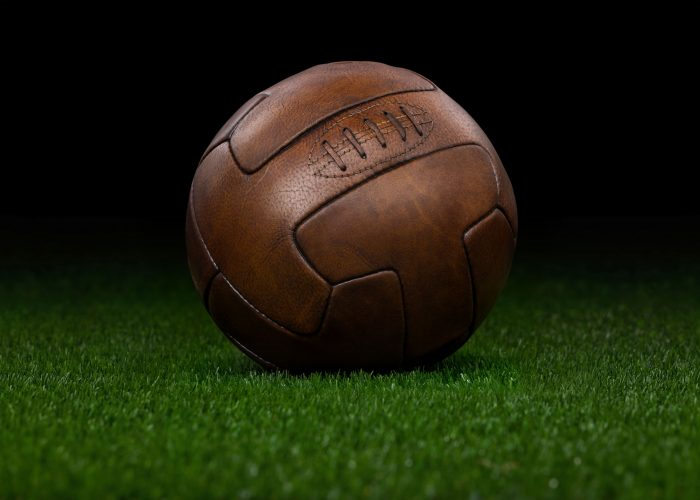
At the inaugural World Cup, a dispute arose over the match ball. Host nation Uruguay and Argentina failed to reach an agreement on the ball for the final. Ultimately, each team was allowed one ball per half. Argentina led 2-1 in the first half with their preferred Tiento ball. After halftime, Uruguay took the lead, winning 4-2 with the T-model ball.
 |
 |
| The T-model and Tiento balls – the two balls used in the first World Cup final. |
At the 1934 World Cup in Italy, the Federale 102 ball, manufactured by the host country, was made from 13 hand-stitched leather panels. The seams were sewn with cotton thread instead of leather, which helped reduce pain when heading the ball.
The Allen ball used at the 1938 World Cup in France was essentially constructed in a similar way.
The Superball Duplo T, used at the 1950 World Cup in Brazil, was the first World Cup ball without external laces. Air was pumped in through a valve, creating a more uniform, round, and airtight surface.
At the 1954 World Cup in Switzerland, the host nation used yellow leather patches to improve visibility. In the final match played in the rain in Bern, the patches still absorbed water and became heavier as West Germany defeated Hungary 3-2.
In 1958, FIFA introduced its first World Cup ball selection process. Over 100 unbranded balls were tested. The result was the Top Star 24-panel ball. This white ball helped the legendary Pele, then not yet 18 years old, score a brace, helping Brazil defeat host nation Sweden 5-2 in the final.
The Mr. Crack ball used at the 1962 World Cup in Chile had more rounded panels compared to previous versions. It was the first World Cup ball to feature a latex valve, which slowed deflation and helped maintain its shape for longer.


The 1966 World Cup in England used the orange Slazenger Challenge 4-Star ball with bold black lettering. This ball became iconic after the final match between England and West Germany, when Geoff Hurst scored the first hat-trick in a World Cup final, helping England win 4-2 in extra time.
In 1970, Adidas revolutionized the World Cup ball by becoming the official supplier and introducing the Telstar ball—one of the most recognizable designs in sports . Its black and white design improved television visibility and became an iconic image of football. The ball was named after a communications satellite that enabled the first live international television broadcasts.
The next two World Cups, 1978 in Argentina and 1982 in Spain, featured ball designs inspired by the Tango dance. The 1978 ball was called Tango Dürlast, with a curved triangular pattern. The 1982 ball, named Tango España, had a similar design, improved with polyurethane material and a protective coating on the seams.
The Adidas Azteca was the official match ball of the 1986 World Cup hosted by Mexico. This was a revolutionary milestone in the history of world football, marking the first time a ball was made entirely of synthetic materials (plastic and polyurethane) instead of real leather. The use of synthetic materials significantly reduced water absorption, increased durability, and helped maintain the ball's round shape better in bad weather conditions. The Azteca was also the first ball with a design directly reflecting the host nation. The patterns on the ball's surface were inspired by the architecture and murals of the ancient Aztec civilization. Despite being made from new materials, the Azteca retained the traditional handcrafted method of piecing together 32 hexagonal and pentagonal leather pieces.
In 1990, the Etrusco Unico model continued Adidas' tradition with a design featuring three open-mouthed lion heads, a motif from the ancient Etruscan civilization of central and northern Italy.
In 1994, the Questra ball retained its familiar flat structure, but the identifying imagery featured the host nation's space exploration program, the United States, with planets and spacecraft.
At the 1998 World Cup in France, the Tricolore was the first multi-colored match ball to be used, consisting of blue, white, and red, along with a stylized rooster. The three colors corresponded to the three-color flag of France, while the rooster is the national symbol of France.
At the 2002 World Cup in South Korea and Japan, the Fevernova became the fastest and most accurate ball ever used, thanks to its groundbreaking design. Unlike previous balls, Adidas inflated the Fevernova's rubber outer shell with a large amount of air bubbles. The manufacturer also used yellow and red to decorate the ball's exterior, symbolizing the desire for victory and the hidden strength of the two co-hosting nations.
The Teamgeist ball, used at the 2006 World Cup in Germany, meaning “team spirit,” marked a structural shift. Teamgeist replaced the hexagons and pentagons with 14 heat-bonded, fan-shaped pieces, achieving a near-perfect circle.
The Jabulani ball at the 2010 World Cup in South Africa means "celebrate" in Zulu. It was the most colorful ball ever used in a World Cup, with 11 colors representing the 11 players on a football team.
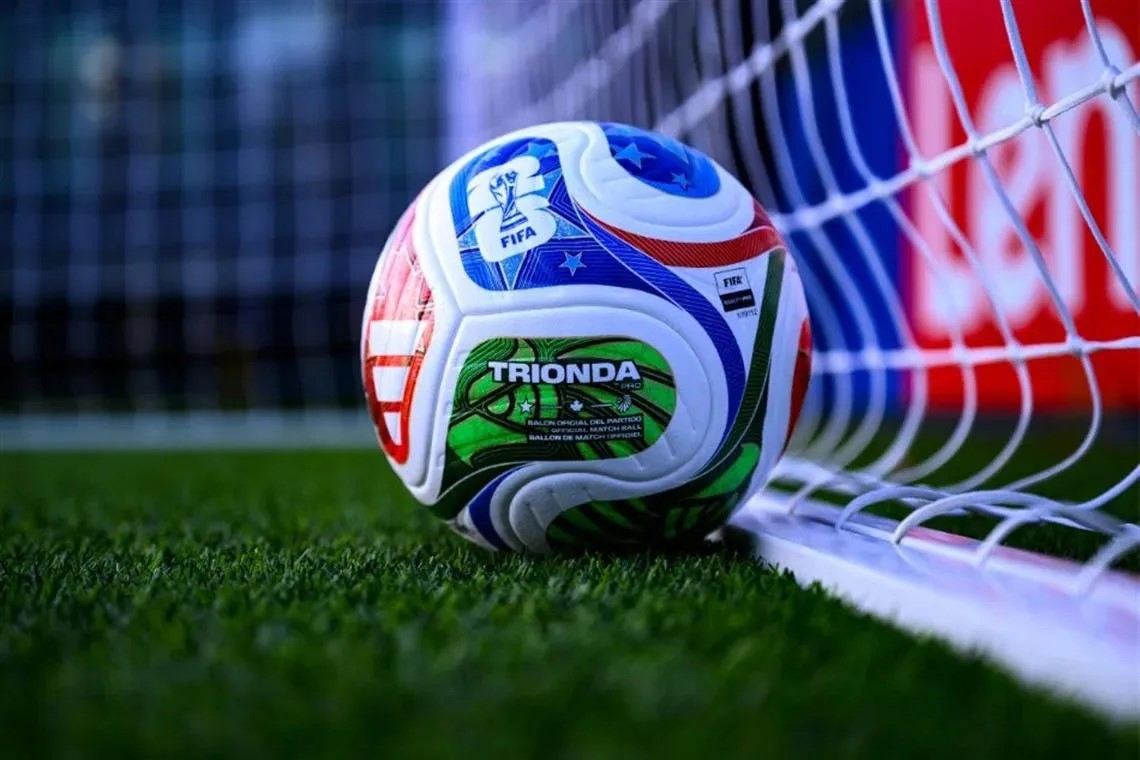 |
| The Trionda 2026 World Cup ball. Photo: Adidas |



Before being used at the 2014 World Cup in Brazil, the Brazuca ball underwent extensive pre-tournament testing involving over 600 professional players, 30 scientists, and laboratory evaluations. The name was chosen through a public vote with over 1 million participants.
At the 2018 World Cup in Russia, the Telstar 18 revived the name and design of Adidas' first World Cup ball. It also marked a technological shift, with an integrated microprocessor chip allowing interaction with smartphones.
The Al Rihla ball used in Qatar in 2022 was designed to fly faster than any ball in previous tournaments, with colors inspired by Qatari culture and the national flag. It was the first World Cup ball to utilize Adidas's connected ball technology, enabling referees to make faster and more accurate decisions.
This year, the 2026 Trionda World Cup ball features a white base with four undulating color panels and red, green, and blue patterns combined with symbols such as maple leaves, eagles, and stars—symbols of the three co-hosting nations: Canada, Mexico, and the United States.
Source: https://www.qdnd.vn/the-thao/worldcup-2026/trai-bong-world-cup-luoc-su-tien-hoa-1045940
















![[Photo] Thousands of people participate in a run to show their support for the campaign "Sharing a common determination to build drug-free communes, wards, and special zones".](https://vphoto.vietnam.vn/thumb/1200x675/vietnam/resource/IMAGE/2026/06/27/1782554475933_0673e2a3df7b5e25076a-8283-jpg.webp)