

Innovation towards a streamlined, practical, and transparent approach is becoming an urgent requirement to improve the quality of works.
Throughout various periods of literary and artistic life, especially during times of national hardship, creative writing camps have played a crucial role. It is from these environments that many works of lasting value have been created. However, the rapid changes in modern life necessitate a re-evaluation of how creative writing camps are organized, aiming to ensure genuine effectiveness and avoid formality and wasted resources.
A readily apparent limitation of most creative writing camps is their lengthy duration, sometimes lasting two to three weeks, or even longer. Meanwhile, the creative impact doesn't match the resources invested. In some camps, the programs are monotonous and lack clear direction; the professional content isn't systematically organized, leading to a dispersion of time dedicated to creative work. In many cases, camp activities mainly revolve around "eating, sleeping, and resting," lacking practical activities, professional exchange, and critical analysis of works.
Notably, the selection of participants in some places revealed shortcomings: invitations were made based on personal connections; some individuals participated in multiple writing camps without producing quality works. This not only affected the overall quality of the camps but also reduced opportunities for potential authors who needed a conducive environment for development. Furthermore, without strict management and organization, prolonged collective activities also harbored potential problems unrelated to professional work.
Based on this reality, the need to innovate the model of creative writing camps towards a streamlined, efficient, open, and transparent approach is becoming urgent. New organizational models with flexible approaches have emerged, initially showing clear effectiveness.
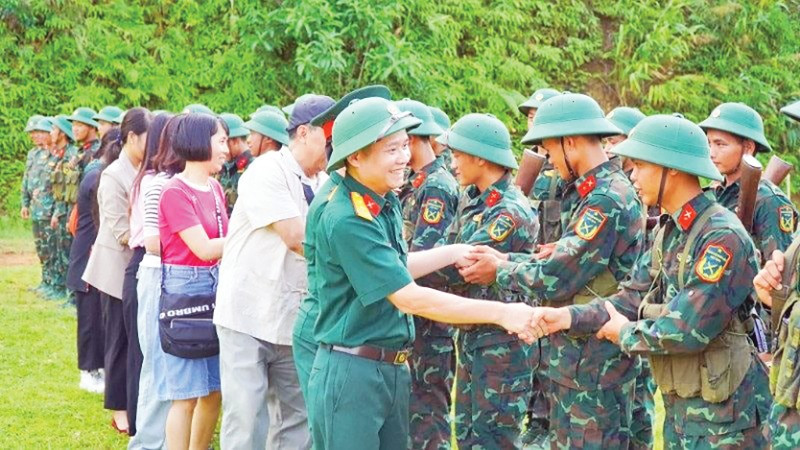
Some writing camps organized by publishers such as Kim Dong and Vietnam Education are short-term, lasting only a few days to a week, but have specific programs focused on specialized skills. Activities are designed to be practical, combining surveys, professional exchanges, and manuscript refinement. As a result, many works are finalized during the camp, significantly shortening the editing and publishing process. Similarly, writing camps organized in collaboration with the Guard Command also demonstrate the effectiveness of the "short-term, high-intensity" model.
Given their focus on themes related to the armed forces, these camps emphasize bringing artists and writers into the field, allowing them to directly interact with officers and soldiers, thereby creating a vibrant source of material for their creative work. Another typical example of an effective, streamlined, and practical creative camp model is the 2025 film script writing camp organized by the People's Army Film Studio in Sa Pa. Lasting less than a week, the camp brought together 15 authors and screenwriters and completed nearly 50 high-quality script outlines. The authors immersed themselves in the reality at Regiment 254, directly observing and learning about the lives and training of officers and soldiers. The combination of professional exchange and practical experience helped the outlines go beyond mere ideas and begin to develop depth in content, emotion, and authenticity.
Based on his years of practical experience participating in and being involved with writing camps, writer Chu Lai believes that to improve effectiveness, a serious "creative discipline" needs to be established in each camp. Accordingly, writing cannot stop at free inspiration, but must be placed within a strict process: Writing, reading, discussing, and editing right at the camp. Only when writers truly work seriously, confront their work, and receive feedback from colleagues, will the manuscript have a chance to be perfected.
Continuing on the proposed solutions, poet Tran Dang Khoa, Vice President of the Vietnam Writers Association , suggested that the organization and selection of participants should be reformed to be more open and transparent, based on their creative portfolios, and that a post-camp evaluation mechanism should be in place. Furthermore, the camp duration should be shortened to increase focus and suitability to current creative work conditions; practical activities should be prioritized, making them the central focus...
Source: https://nhandan.vn/trai-sang-tac-can-tranh-hinh-thuc-lang-phi-post950241.html


![[Photo] Young people of the Dong Thap Border Guard actively participate in "March Border Month" activities.](https://vphoto.vietnam.vn/thumb/1200x675/vietnam/resource/IMAGE/2026/03/23/1774248483508_ndo_tl_dt3-jpg.webp)









![[Photo] Young people of the Dong Thap Border Guard actively participate in "March Border Month" activities.](https://vphoto.vietnam.vn/thumb/402x226/vietnam/resource/IMAGE/2026/03/23/1774248483508_ndo_tl_dt3-jpg.webp)
![[Video] Prime Minister meets with the Vietnamese community in the Russian Federation](https://vphoto.vietnam.vn/thumb/402x226/vietnam/resource/IMAGE/2026/03/23/1774247590989_dung00-12-21-16still004-png.webp)









































Comment (0)