

Dinh Yen has a large mat-making warehouse.
Marrying a man from Dinh means you won't have to worry about where to sleep.

Mat weaving has become a traditional craft, passed down through generations, enduring over 100 years of ups and downs, and continuing to this day. In 2013, the Ministry of Culture, Sports and Tourism recognized Dinh Yen Mat Weaving Village as a National Intangible Cultural Heritage.
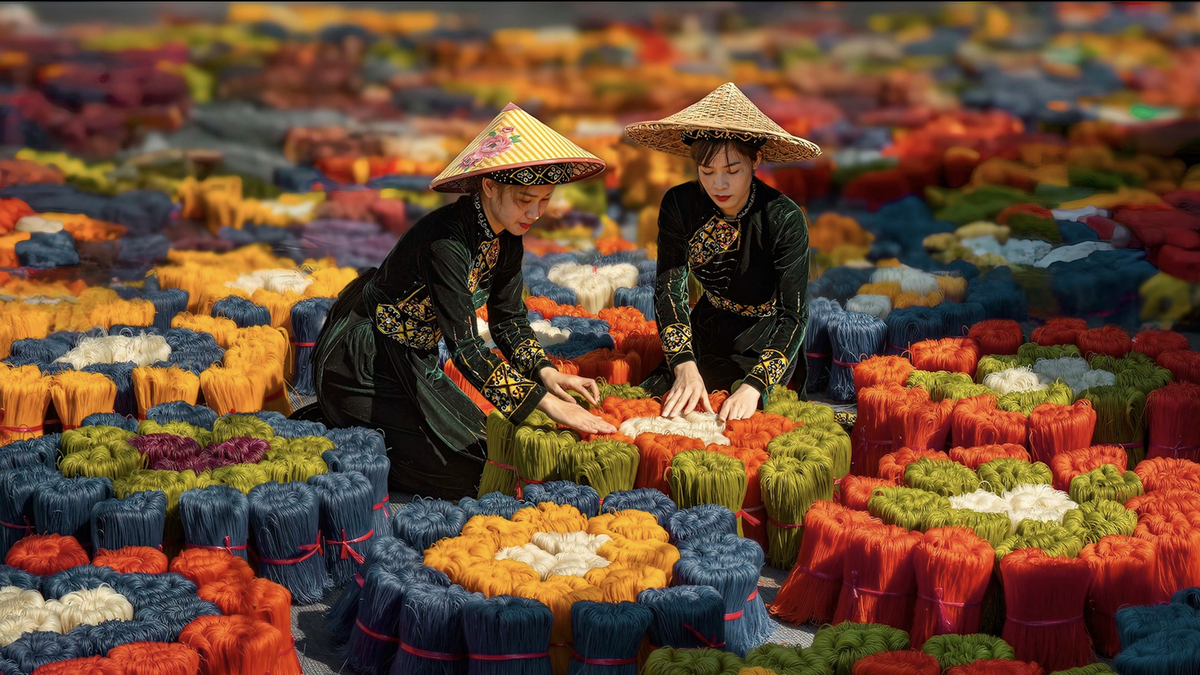
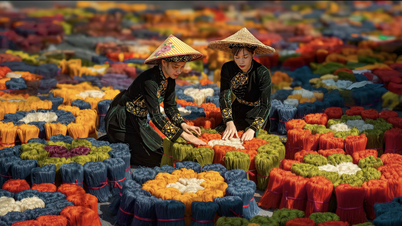
THE MATTRESS IS DYED IN BRIGHT COLORS
From the 1920s onwards, the mat weaving industry in Dinh Yen flourished. Local raw materials were insufficient, so they had to purchase pre-cut reeds from other places. Until before 1954, thanks to their high quality and reasonable prices, Dinh Yen mats were transported and sold by merchant boats throughout the Mekong Delta provinces, even reaching Cambodia.
The Định Yên mat-weaving village is vibrant and preserves the cultural characteristics of a typical craft village in the Mekong Delta. In recent years, with support from the local government in investing in industrial weaving machines to replace manual labor, the Định Yên mat-weaving village has "revived," bringing prosperity to households determined to pursue the mat-weaving craft.
Artisan Le Thi The recounted her experience attending the "ghost market": "The market would open at midnight and close the following morning. Back then, each 'ghost market' session would have nearly a hundred mat traders from all over the provinces coming to select goods. On the shore, a forest of colorful mats blazed brightly; at the dock, boats and canoes were moored closely together, waiting to buy mats. Each mat trader would moor their boat at the riverbank for a few nights, buying about 1,000 mats before setting sail, transporting them to wholesalers and retailers throughout the Mekong Delta and even to Cambodia." |
Ms. Huynh Thi Muoi, who has been weaving mats for over 40 years, shared: “In the past, mats were woven by hand, requiring two people: one to feed the reeds into the sedge and the other to press them down. It was meticulous and slow; even with a fast work schedule, only a few mats could be made each day. Now, mats are woven using industrial machines; only one person needs to sit on a chair and feed each reed into the machine, and the machine can weave more than 10 mats a day.”
What sets Định Yên mats apart is the careful selection of sedge fibers, which are dyed and then sun-dried to a moderate level, making them strong and durable, allowing for long-lasting use. Previously, hand weaving caused the sedge fibers to easily deteriorate; now, machine weaving saves effort and time while producing strong, beautiful mats.
All three generations of Ms. Ha Thi Hieu's family have been involved in mat weaving, and she herself has been dedicated to the craft for over 45 years. "I don't know when mat weaving originated, I only know that my parents, grandparents on both sides have been making mats and passed the craft down. It's unusual for a girl in this craft village to grow up without knowing how to weave mats. Children, even when young, attend school for half a day and then help their parents dry and clean the reeds for the other half, becoming proficient at it. The men do the heavy work of setting up the frames. The women select the reeds, dry them, dye them, and choose the colors. The whole village is always vibrant with color from the reeds dyed in all sorts of colors, being dried in the sun from inside the houses to the streets," Ms. Hieu recounted while working.
Upon arriving at Dinh Yen mat-making village, the first thing that attracts visitors is the bundles of sedge dyed in yellow, red, green, purple, white, etc., drying in the sun, and the fragrant scent of sun-dried sedge filling the air. In the distance, women are busily sorting, dyeing, and drying sedge, creating a vibrant and colorful picture of a traditional craft village returning to its golden age.
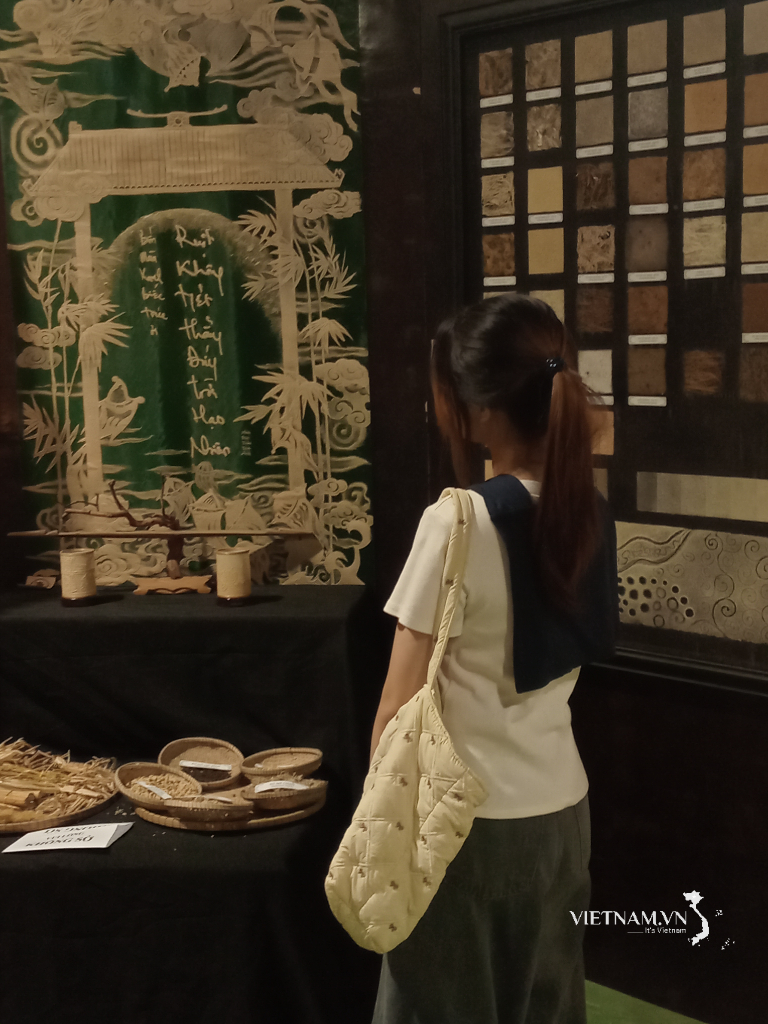
The products of Dinh Yen mat-making village typically include snail-scale mats (thick, sturdy, and durable mats that were popular in the past), cotton mats (including printed and woven cotton), checkerboard mats (with square grids like a chessboard), plain white mats (thin and plain, commonly used in every household), and patterned mats (also known as antique mats). Ms. Le Thi The is the only person in Dinh Yen mat-making village who still weaves antique mats, having been involved in the craft for 50 years. Ms. The said that antique mats usually have a width of 0.5 - 1.5 meters, and the patterns printed on them require skillful weaving of the characters. These mats are used to spread on altars or placed in the middle of the wooden platform to prepare offerings for ancestors on death anniversaries, weddings, and Tet (Lunar New Year).
"GHOST MARKET" - A Glimpse of the Past
With a deep commitment to their traditional craft, the people of Dinh Yen mat-weaving village, along with the local government, proactively sought new directions to "revive" the traditional mat-weaving craft and established a mat-weaving cooperative to expand their market. Currently, their mats are sold to Cambodia, Thailand, South Korea, and other countries.

Traditional mats are a special product of Dinh Yen mat-weaving village. Weaving each mat is very laborious and time-consuming, so few people are willing to weave them. The most difficult part of weaving traditional mats is the technique of embossing the characters so that they appear beautiful and durable, and they are only woven using traditional wooden looms. There was a time when traditional mat weaving couldn't find a market, forcing Ms. Le Thi The to temporarily abandon the craft. However, she later returned to weaving traditional mats to preserve the craft and contribute to the beauty of her hometown, Dinh Yen. “Since I was little, I followed my mother in weaving traditional mats. After she passed away, I continued the craft. Now, my traditional mats sell very well; customers have to order several days in advance. I have passed on the craft to my daughter and granddaughter to continue keeping the tradition alive,” Ms. The shared.
I just visited Dinh Yen Mat Weaving Village, where Ms. Huynh Thi Quen was busy weaving mats and greeted me with two lines of folk poetry: "Dinh Yen has a large mat weaving warehouse/Marrying a man from Dinh Yen means you won't have to worry about sleeping mats." This folk poem, passed down through generations in Dinh Yen Mat Weaving Village, partly testifies to the former prosperity of the mat weaving village, which has existed for over a century.
As a child, my parents told me about the "ghost market," a name that sent shivers down my spine. The "ghost market," also known as the "underworld market," was once a vibrant hub, contributing to the thriving mat-weaving craft. From ancient times, the "ghost market" has been a unique cultural feature found only in Dinh Yen mat-weaving village. Later, I learned from the elders in the village that the "ghost market" was held at midnight, with traders from near and far gathering, illuminated by oil lamps and kerosene to provide light for both buyers and sellers. From then on, many people referred to it as the "ghost market," as it appears in folk legends.
The "ghost market" appears and persists in conjunction with mat weaving, depending on the high and low tides and the daily lives of the local people. During the day, women are busy with tasks to complete the mats, such as spinning, drying, dyeing the reeds, and weaving. At night, they take the mats to the "ghost market" to sell to traders.
Once, I attended a reenactment of a "ghost market" with over 100 mat weavers. Under the flickering oil lamps and torches illuminating the night, a bustling scene of buying and selling mats unfolded. The market revived the once-popular mat-selling scene. Artisan Le Thi The told me that mat sellers, regardless of the time, would rush to the "ghost market" to sell their mats as soon as they finished weaving a few pairs. Sometimes, they would bring their mats to sell at night, carrying dim oil lamps. From that, the nighttime mat market, commonly known as the "ghost market" or "underworld market," was formed.
The mat weaving craft has sustained countless families and is intrinsically linked to the name of the village and the land. Therefore, the people of Dinh Yen Mat Weaving Village all view mat weaving as a responsibility they must be committed to. I believe that the survival of this craft village for over a century is the result of the unity of many generations and families who have joined hands to "revive" Dinh Yen Mat Weaving Village today.
DUONG UT
Source: https://baodongthap.vn/tram-nam-lang-chieu-dinh-yen-a238109.html






























































Comment (0)