|
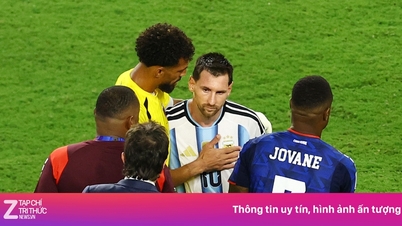
Messi's noticeable swelling was noticeable after the match. |
After a hard-fought 3-2 victory against Cape Verde to secure a place in the quarter-finals of the 2026 World Cup, Lionel Messi not only achieved another historic milestone but also left the field with another "trophy": a large bump on his forehead following a strong collision at the end of the match.
At 39 years old, Messi still played the full 120 minutes, scoring the opening goal to bring his total number of goals in World Cups to 20. This was also his seventh goal of the tournament, helping the Argentina captain continue to lead the race for the Golden Boot.
However, the tense match in Miami also left Messi with an unwanted "achievement." With the score tied 1-1 in injury time of the second half, he dribbled straight into the center and was fouled by a Cape Verde player just outside the penalty area. As he fell, Messi's head hit the knee of an opposing defender, causing his forehead to swell up quickly.
The swelling was clearly visible when Messi gave his post-match interview. The Inter Miami star had to apply an ice pack to his aching head, but still completed the 120 minutes of play before celebrating with Argentina's qualification to the next round of their Jules Rimet Trophy defense.
Putting aside the painful collision, Messi praised his teammates' fighting spirit in a match that was more difficult than expected.
"We need to fix things that aren't good, but we also have to acknowledge that the whole team has done many positive things. This team always fights, and today we fought to the very end once again," he said.


Messi also emphasized that aerial situations continue to be an important weapon for Argentina. "We have many players who are good in the air and we have practiced a lot for that, regardless of whether it ultimately translates into a goal or not," the Argentina captain shared.
However, the 39-year-old superstar did not shy away from pointing out the problems in the team's play. According to Messi, Argentina's pressing was not effective enough, causing the team's formation to be stretched and leaving Cape Verde with too much space in the midfield.
"We weren't pressing well. The distance between the lines was too great whenever we pushed forward to apply pressure. They always had more than one player in the midfield area because we couldn't balance the numbers there. That allowed them to control the ball and forced us to move a lot," Messi analyzed.
Despite playing at the highest level for over two decades and frequently being the target of fouls, Lionel Messi rarely suffers injuries.
According to Sporting News , compared to many attacking stars of the same caliber, he is considered to have a relatively "clean" injury record.
The majority of Messi's more than 900 days out of action due to injury throughout his career were concentrated during his time at Barcelona from 2005 to 2008, when he repeatedly suffered hamstring and thigh muscle tears. These recurring injuries raised concerns that Messi's physique might not be able to withstand the intensity of top-level football.
However, after adjusting his training regimen, nutrition, and exercise management, the situation changed almost completely. For nearly a decade afterward, Messi had very few long periods of time sidelined by injury.
The problems he mainly experienced were adductor muscle strain, hamstring overload, ankle sprains, or collision injuries.
He has never experienced serious injuries such as a torn anterior cruciate ligament (ACL), a torn Achilles tendon, or a severe fracture that would have sidelined him for months or caused him to lose form for an extended period.


Source: https://znews.vn/tran-messi-sung-vu-post1666150.html