

He always regarded poetry as a sacred realm, a realm he was not yet fully qualified for or ready to enter. But in truth, he was already a part of it. And from him, poetry emerged along a different path – the path unique to his life. At this moment, I recall someone's saying: " No one hears the roar of flowers before they burst from the branch ." Thuan Huu lived that way, and his poems were born that way: natural and simple.
Reading his poems, I always picture a person walking on hot sand, walking through rain and wind, walking through all the joys and sorrows of life. As they walk, they speak about their path, about the world they live in, and that person's voice is their poetry, born simply like that.
My village
Backed by the mountain range
Eyes looking straight out towards the open sea.
I am a child of a hilly region.
But they are also children of the sea.
Love for one's country is ingrained in one's very being.
I grew up amidst the sunshine, wind, mountains, and ocean waves.
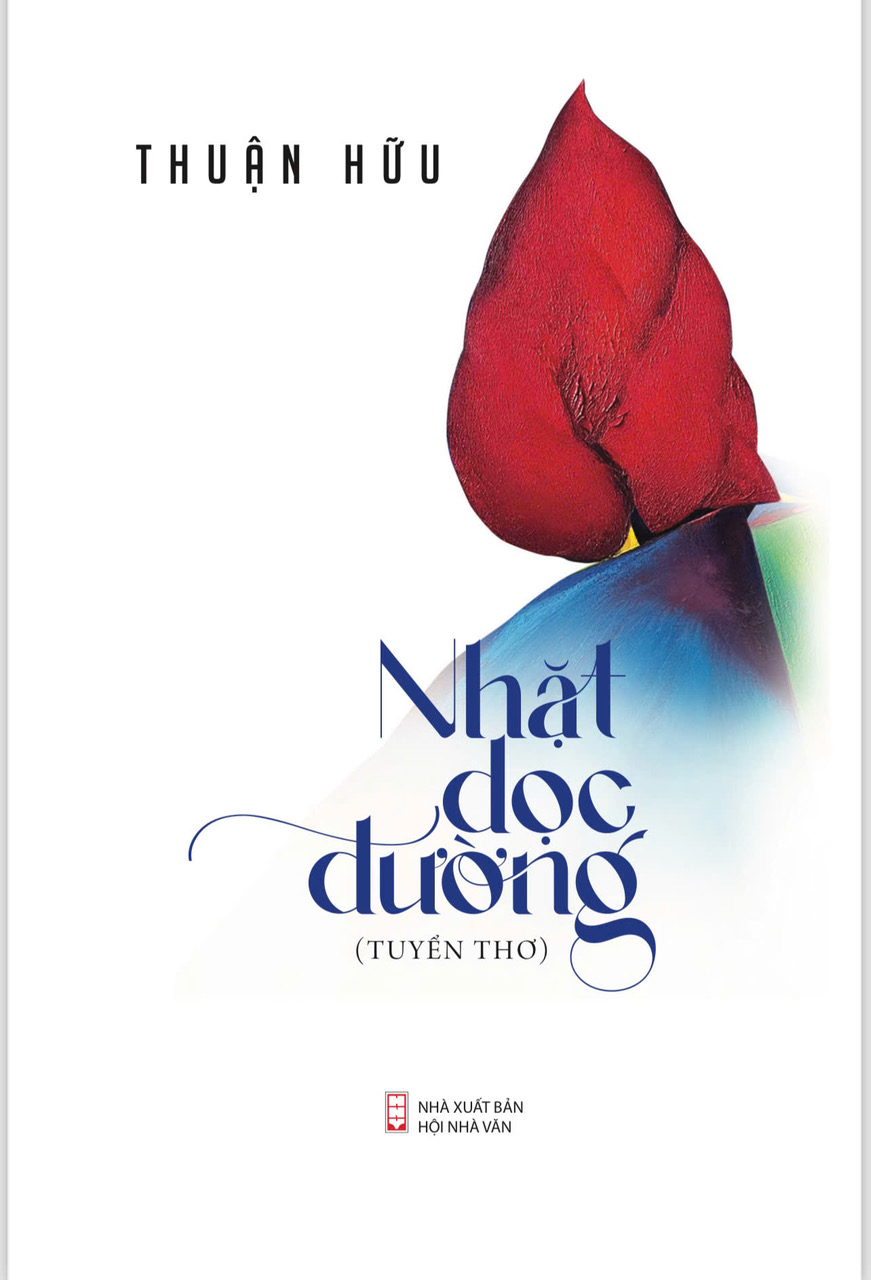
I've read this stanza many times. There's nothing elaborate, nothing unusual, no rhetorical devices, nothing unfamiliar to me or to many others. Everything is simple. And I realize: it's the declaration of a person. That person was born and raised on that land, both affirming their homeland and declaring their origins and their purpose in life: "Love for the country is intertwined with my blood and flesh / I grew up in the sunshine and wind of the mountains and the waves of the ocean. " The line "I grew up in the sunshine and wind of the mountains and the waves of the ocean" is beautiful, moving, challenging, and also full of pride. Thuan Huu didn't consciously write poetry like a poet. The number of poems he wrote is perhaps even more than mine. But unlike me, he wrote in silence, like a self-narrative in the dark spaces of time.
From what he wrote, evident on the page, I see his soul as a bell. That bell moves through life, touching everything in life (both joy and sorrow) and ringing itself. This is the most important and vital aspect of his poetry. I choose the image of a bell and its resonant sound to describe the essence of Thuan Huu's poetry. Because when he writes about sadness, pain, uncertainty, darkness, and anything else, ultimately, beauty, love for humanity, the light of hope, and the pride of being human still transcend everything to resonate.
Over twenty years of bitter and sweet experiences.
We are like the Han River, hiding everything within our hearts.
Amidst the ups and downs of life, the river still flows.
Da Nang still retains the intoxicating scent of a first kiss.
Poetry was his very being. He could hide his sorrows and torments from colleagues, friends, and family. But he couldn't hide his true self in the resonant sounds of his poetry.
He was speechless when he saw the wild flower.
Even amidst the barren landscape, the purple hue still evokes a poignant feeling…
Every land he traveled through resonated in his soul with joys and sorrows. His poems were born from those lands. They were expressions of love, experience, contemplation, and discovery about humanity and the meaning of life, from which beautiful dreams were awakened.
Lying awake late at night listening to the train whistle.
The overwhelming craving made him breathless.
When will you weigh anchor and set sail like that ship?
In which direction do the waves of the vast ocean crash?
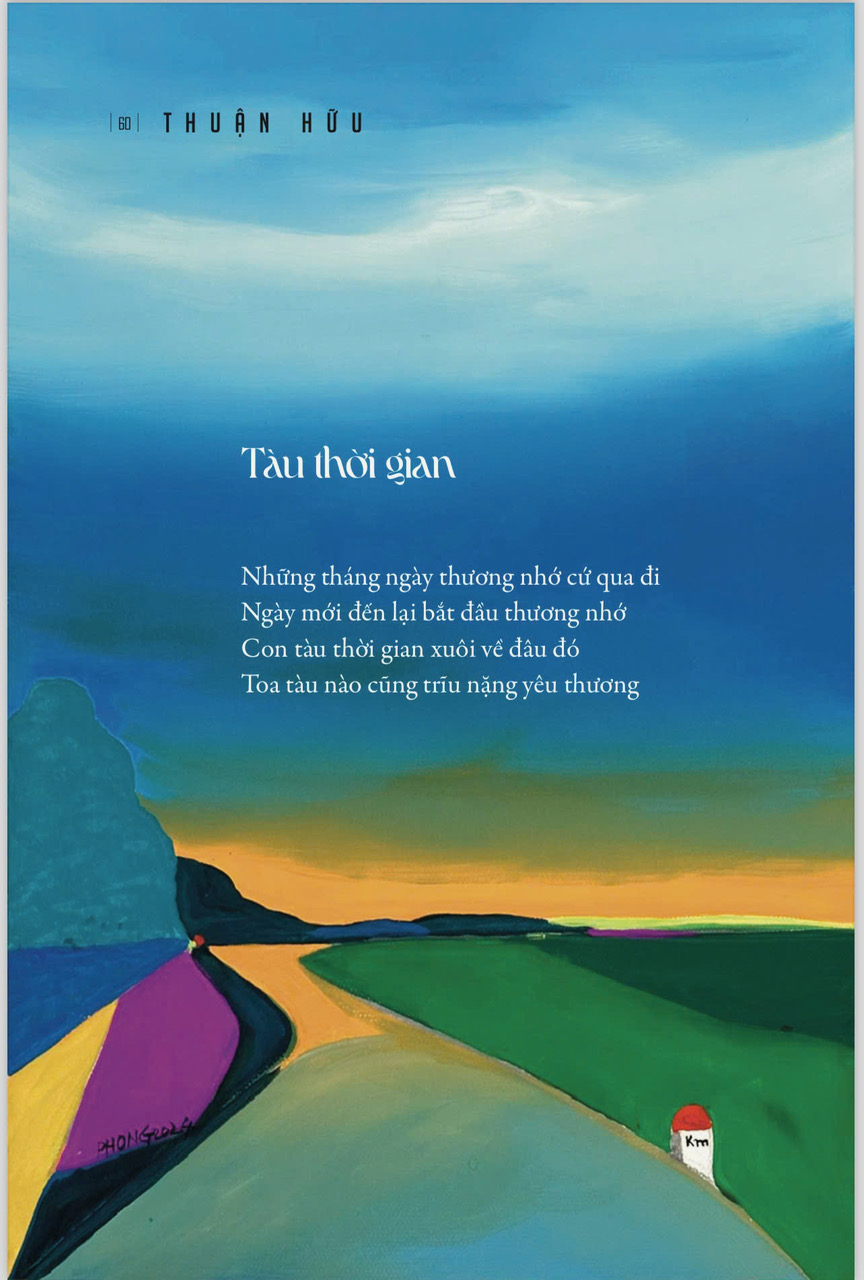
Nothing is simpler than verses like these. It's as if he awoke before the sea and spoke only for the sea to hear. These verses prove that he didn't use any techniques or rhetorical devices in his poetry. He let life sow its seeds in the soil of his being, allowing them to sprout, grow, blossom, and bear fruit in his soul. “When will you set sail like that ship? / To the vast ocean, where will the waves crash?” Resonant, moving, and overflowing with aspiration. Something both magnificent, proud, and far-reaching emanates from those two lines. Reading them, I awoke in the night; I wanted to set sail like that ship, I wanted to overcome the ocean waves of life, I wanted to sing aloud in the face of every challenge…
People have friends and they have God.
As for me, I'm all alone.
Alone, without God, without companionship.
To be a stranger in this world...
Without reading poems like these, I could never truly understand the person named Thuan Huu. Most of his poems were written when he was in a position where people usually hide their honest feelings, thoughts, and perspectives. His willpower may have told him to conceal himself, but his soul had already spread its wings and flown to freedom. I heard that flapping of his soul. Poetry is the most reliable record of the soul and mindset of its writer.
In this vast world, surrounded by so much noise and not a few dazzling lights, he still recognized the loneliness of an exile in his own silent world. That is his "human quality" and also his "poetic quality." It is this that makes readers, or at least I personally, trust his poems. And it is this that gives his poems their "power," the power of truth and simplicity.
Winter is over.
The tree's branches are changing leaves.
The bird from a foreign land
Flying back to the familiar garden.
I want to immerse myself in that garden on a winter day. Only by truly immersing myself in that space, that time, can I perceive the vastness of the poems, the feelings that are rising and resonating in the poet's soul, or more accurately, the feelings that are rising and resonating in this life. We find no anomalies, no abnormalities, and no "emotional exaggeration" in those verses. We only see the wonder of nature brought forth through the poet's profound understanding, listening, and subtle and deep perception. In that scene, I wanted to cry. I received a gift from God, I was given life, I was healed of the brokenness within me, I recognized my misguided steps along life's paths, I rediscovered what I had forgotten, what I had lost. The strange birds flying back to the familiar garden revived many things in me. Immerse yourself in a garden on a winter day and listen to the flapping wings of the returning birds; you will realize a great, albeit vague, feeling enveloping your soul.
Poetry not only brings us new images and new words, but most importantly, it makes us realize new emotions, new perspectives, and new meanings from what we perceive as lost, decayed, or dead. The verses of Thuan Huu that I quote are such verses. One thing that is both clear and truly profound in Thuan Huu's poetry is: He found, felt, and cried out like a child before the magnificent and powerfully captivating nature of life.
Without you, the town becomes sad.
My mother keeps mentioning how empty the house feels.
I followed my husband to a faraway place.
Leave your sorrow behind with Tay Son.
It's still the same. Thuan Huu still doesn't have any "plan" beforehand for his verses, stanzas, and poems like these. He just goes, lives, and reflects on life, a life he both lives in and is a witness to. Reading his poetry gave me that thought. I believe that town wouldn't appear so familiar, so poignant, and so tormented if it were written in a different way. Honesty often risks poetry disappearing, but honesty can also reach the depths of what we want to express. And that town appeared to me. It appeared to the point where I could see every gust of wind blowing through the houses, see the shadow of a girl drying her clothes, drying her hair, and then disappearing as if vanishing. The above poem recreates a space and time that has vanished or changed. If we only focus on the "uniqueness" of the image, the language, the structure... we won't realize that the poem has brought that town back to life. But if we immerse ourselves in the atmosphere that the poems evoke, we will find ourselves living in that real town, not a dream. This is a very distinctive characteristic of Thuan Huu's poetry. More than just a characteristic, it is the spirit in his poetry. More specifically, it is the person of Thuan Huu, the soul of Thuan Huu.
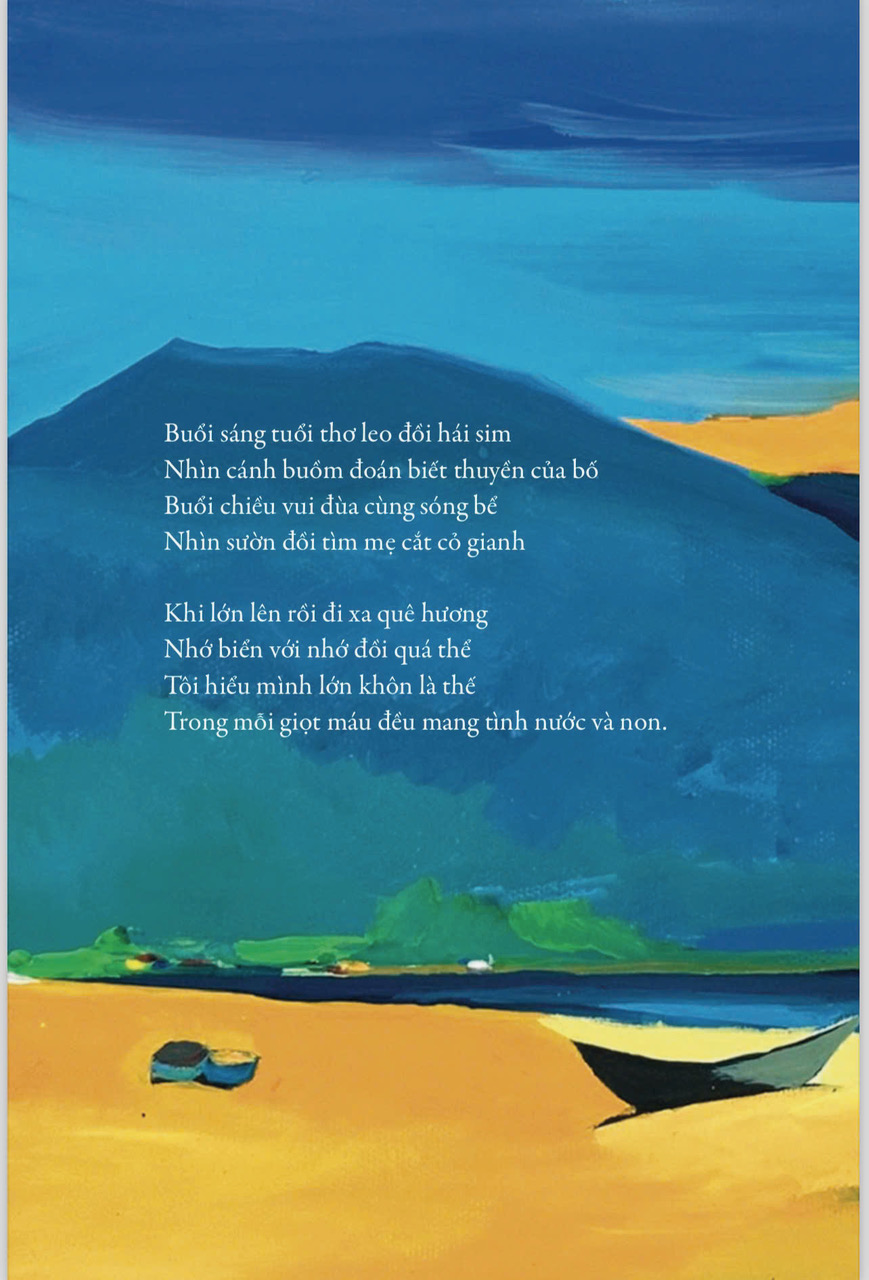
AROUND THE STORY OF A PINE TREE
I passed by here last year.
I feel sorry for the lonely pine tree on the mountaintop.
Standing alone, listening to the wind blow all year round.
I'm coming here again this year.
Looking up towards the mountaintop
The pine tree is gone.
The mountaintop was once eroded by rain, forming a trench.
The pine tree died as if it were a prophecy.
One cannot stand idly by in the face of mountain rain and strong winds.
I have traveled through many bamboo villages.
Through the pine forests, I hear the sea whispering.
Through rolling hills of lush green pine trees stretching as far as the eye can see.
The nature around me always reminds me of...
Trees, like people, must learn to rely on each other…
One thing I realized along Thuan Huu's "poetic journey" is that the beauty and message of life are always hidden around us. When I was young, I read a quote about poetry by the great American poet Walt Witman: "Poetry is right at your feet. Bend down and pick it up ." I didn't understand that quote. I even doubted it. I thought poetry must come from another kingdom, another sacred place. But then life and poetry made me realize the creative truth from that quote. The bamboo groves, the poplar forests, the pine hills of our land send us profound and great messages every day, but not everyone can read the text of those messages.
Many of Thuan Huu's poems are explorations of nature and humanity, from which he conveys messages about life. Poetry doesn't come from a distant planet in this vast universe. Poetry comes from everywhere, from every place, from every life we have lived. Poetry awaits those with loving hearts, profound vision, and beautiful aspirations to step forward, so that it may give them inspiration, words, and thoughts, transforming those simple things into poetry and turning them into poets. Thuan Huu is one such case. And I have the right to call him a poet, even though he always tries to deny it and sometimes even runs away from it. Thuan Huu may run away from what is called poetry. But Thuan Huu cannot run away from life, for in every life, even the darkest and most tragic ones, poetry resides.
On the last afternoon of the year, the girl with the white hair...
Sitting silently beside my mother's green grave.
Just two lines of vivid imagery about a mother speak to the profound loneliness of a child who has lost their mother. They speak of loneliness without using any adjectives to describe it. The white of the hair on the child's head in that space, that time, makes me feel the utter desolation of the heart of the child named Thuan Huu. I once wrote about a similar afternoon before my mother's grave with words and images so complex and elaborate that they failed to touch the truth of my own loneliness after losing my mother. And when I read Thuan Huu's poems about his deceased mother, I felt that at some point I had to write poems about my own mother.
Those two lines of poetry push the son's loneliness to its extreme. The mother has merged with the green grass, with the endless earth. The white hair on the son's head evokes desolation, sorrow, and the soulless emptiness of a child who has lost his mother. A minimalist way of speaking, full of silent pain. If we heard the son's heart-wrenching cries before his mother's grave, we would only feel sorrow and pity, but we could not fully grasp the son's pain and loneliness. But with those utterly simple lines of poetry, the entire truth is revealed.
One day
Amidst the surging tide
The snails were dead, their intestines withered and their livers dried up.
And they transformed into tombstones.
Refusing to be buried in the sand, it proudly displays itself on the beach's edge.
The seashells contain sound within them.
The ocean breeze sings through all four seasons.
Stories of joy and sorrow at the bottom of the deep sea.
Told through magical sounds...
Childhood is gone, and I have moved on.
When I saw snails and clams, I suddenly understood.
The pain is hidden within the flower-strewn stone.
The entire long passage I quoted above is from the poem "Seashells." I truly "cry out" inwardly after reading this poem. It's further evidence of my perspective on Thuan Huu's poetry. Who has seen such seashells on the ocean's sandy beaches? So many have seen them. Of course, I am one of them. And I've picked up those shells many times and thrown them away. I didn't hear anything from them. I just thought of them as shells – dead bodies. Nothing more than that. A crucial quality in creativity is the discovery of beauty, an idea from all things. Thuan Huu possessed that crucial quality. Nothing is without carrying something of this life; A tree in a storm, a bud sprouting on a dark branch, a bird's nest remaining somewhere in the canopy, a raindrop clinging to the windowpane in the morning, an oil lamp in the dead of night, a lonely road running through the fields at sunset, an old comb left by mother in the darkness of the house…
If we pass by indifferently, everything becomes strange and meaningless, even a gold-covered chair, a mansion, or even a great person. But if we approach with love, emotion, and thought, all those things begin to awaken and tell us about their time and history. Those seashells don't contain any stories of the sea; it is the poet's own person that holds them. "Meeting the snails and shells, I suddenly understand / The pains hidden within the flower-strewn rocks." The last two lines of the poem suddenly "light up." It has the power to illuminate the "ocean depths" of fate. From there, it allows me to see the wonders of life, even from the smallest and seemingly insignificant things. That's what poetry is like. To move from those shells (dead bodies) to the shores of beauty and poetry, it takes a period of time, sometimes an entire lifetime, filled with joy and sorrow, gain and loss, black and white, despair and hope.
The poem "Seashells" is a prime example of Thuan Huu's writing style. The preceding lines and concluding stanzas present the reality of life, while the final lines and stanzas resonate with that life, like a flower bursting forth from the rough, gnarled, and dark bark of winter. And that is the essence of art in general, and poetry in particular.
Ha Dong, the cold days of early 2025.
Poet Nguyen Quang Thieu
Source: https://www.congluan.vn/trong-nhung-tieng-ngan-vang-cuoc-doi-post341224.html

![[Image] National Assembly discusses the implementation of the socio-economic development plan.](https://vphoto.vietnam.vn/thumb/1200x675/vietnam/resource/IMAGE/2026/04/20/1776696707422_ndo_br_img-20260420-185419-jpg.webp)
![[Photo] General Secretary and President To Lam meets with National Assembly delegates from ethnic minorities.](https://vphoto.vietnam.vn/thumb/1200x675/vietnam/resource/IMAGE/2026/04/20/1776696701056_a1-bnd-8331-3342-jpg.webp)



























































Comment (0)