Listen to life, speak the truth, and defend the truth.
President Ho Chi Minh – the great revolutionary journalist, the founder and architect of revolutionary journalism in Vietnam – once stated: Revolution is the undertaking of the masses; to make a revolution, it is necessary to propagate, mobilize, guide, gather, and organize the masses, and one of the most effective methods is through and by means of journalistic activities; conversely, journalistic activities always pose demands for innovation, creativity, and effectiveness in revolutionary activities.
Throughout the past 101 years, the revolutionary press of Vietnam, under the leadership of the Party, has fulfilled its mission and played a leading role on the ideological and cultural front, accompanying the revolutionary cause of the Party and the nation. Press agencies have effectively performed their function of disseminating the Party and State's policies and guidelines, acting as a bridge between the people and the Party, and conveying the message of a Vietnam that is building and developing in the new era.

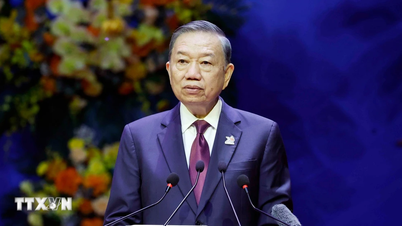
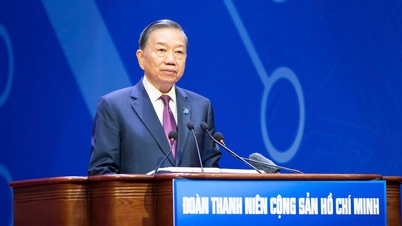
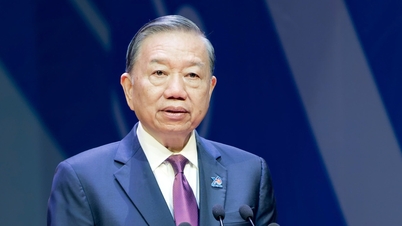
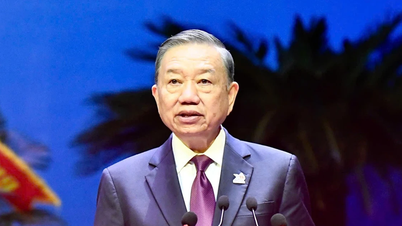
Recently, at a meeting with 101 outstanding journalists who have won the National Journalism Award over the years, General Secretary and President To Lam emphasized that our country is entering a new stage of development. The opportunities are immense, but the demands are also very high. The role of revolutionary journalism is even more important. Journalism must maintain its political integrity, improve the quality of information, listen to life, speak the truth, address the issues directly, and speak with responsibility to the Party, the State, and the people.
Journalistic activities always demand innovation, creativity, and effectiveness in revolutionary work. This is because "the task of journalism is to serve the people, to serve the revolution," a core idea affirmed by President Ho Chi Minh. The current revolution is also different and places journalism in a different role than before. On the occasion of the 101st anniversary of the Vietnamese Revolutionary Press Day (June 21, 1925 - June 21, 2026), in the article "Vietnamese Revolutionary Journalism in the Digital Age," General Secretary and President To Lam also pointed out that "Vietnamese revolutionary journalism is entering a very new and very different period of development in almost all aspects." Journalism must be a place where people turn for reliable confirmation, not a place that blindly follows trends. Society needs a reliable place to understand the truth. People need to know what happened, why it happened, who was affected, who is responsible, and what solutions are well-founded.

Furthermore, according to the General Secretary and President, the digital space also needs journalistic works that are rich in data, diverse in content, varied in expression, and in-depth in policy analysis. Digital journalism is not old journalism placed on a new platform, but rather a new way of organizing in a new context. In the newsroom, each work should be viewed as an information product with a clear objective. All forms of expression must adhere to the same standards: accuracy, humanity, verification, and responsibility. The situation of being serious on the main page but lax on secondary platforms should be avoided. The more multi-platform journalism becomes, the more unified the standards must be.
According to Nguyen Duc Loi, Permanent Vice Chairman of the Vietnam Journalists Association, the guiding messages and directions of General Secretary and President To Lam for Vietnam's revolutionary press help build trust, inspire innovation, and encourage aspirations for development. A strong press must be one that can protect the truth, spread goodness, critique policies constructively, nurture social trust, encourage innovation, and preserve human dignity in the media.

Journalists are not allowed to lag behind; media organizations must be "a solid fortress."
On the occasion of the 96th anniversary of the Party's founding, at the ceremony honoring outstanding Party branch secretaries and announcing and awarding the 10th Golden Hammer and Sickle Award, General Secretary and President To Lam mentioned that information and propaganda work must truly be an inspiring "cannon," a "battle drum" encouraging the entire Party, people, and army to maximize the spirit of "self-reliance, self-confidence, self-sufficiency, self-strength, and national pride," and successfully implement the Resolution of the 14th Party Congress.

The demands placed on the press by the Party and State leaders in the current period present significant requirements and challenges. This is because, in the digital age, the revolutionary Vietnamese press is facing unprecedented and profound changes. In particular, the press is also seriously implementing organizational restructuring to ensure a streamlined, effective, and efficient operation. Currently, the country has 733 media outlets (including 98 newspapers, 597 magazines, and 38 radio and television stations), a reduction of 189 media outlets.
The decline of traditional print media, coupled with the development of the internet, social media, and artificial intelligence, has transformed the way information is produced and consumed. Journalism is no longer simply traditional print publications but has become a multi-platform media ecosystem: online newspapers, videos, podcasts, social media, and digital data. In this context, the mission of journalism remains unchanged: honesty, objectivity, guiding public opinion, and protecting national interests. Given this reality, the methods of fulfilling this mission also require significant innovation.
In this new context, Minister of Culture, Sports and Tourism Lam Thi Phuong Thanh emphasized that, in the context of digital technology, artificial intelligence, and the strong development of social media platforms, the demand for standardization and the integrity of information requires the press to affirm its role as a reliable and authoritative information channel for readers. Therefore, the press needs to continue promoting the application of science and technology, digital transformation, improving the quality of information, and enhancing the quality of human resources in terms of expertise, professional skills, political integrity, and professional ethics.
Specifically, according to Minister Lam Thi Phuong Thanh: The press needs to proactively detect and effectively combat erroneous and hostile viewpoints, fake news, and harmful information, protecting the ideological foundation of the Party; fighting against corruption, waste, and negative phenomena, and actively participating in building a clean and strong Party and political system.
Meeting with leaders of press agencies, National Assembly Chairman Tran Thanh Man emphasized that the press should continue to closely follow and fully and promptly reflect the activities of the National Assembly and the Government; promptly convey the thoughts and aspirations of voters and the people to the National Assembly and the Government, contributing to improving the effectiveness and efficiency of the National Assembly and the Government's operations. In particular, press agencies need to accelerate digital transformation, apply artificial intelligence, build professional, humane, and modern press agencies, maintain information sovereignty in cyberspace, and promote the development of the digital content industry.

Speaking at the 2026 National Press Conference, Mr. Trinh Van Quyet, Member of the Politburo, Secretary of the Central Committee of the Party, and Head of the Central Propaganda and Mass Mobilization Department, stated that each media agency, after streamlining, must be a solid fortress protecting the Party's ideological foundation, sharply combating and refuting erroneous and hostile viewpoints and harmful information. The press must take the lead in bringing the Resolution of the 14th National Congress and other strategic resolutions of the Central Committee into life, transforming the Party's will into action by the entire Party, the entire people, and the entire army.
Amidst the wave of technological revolution, the Head of the Central Propaganda and Mass Mobilization Department affirmed that journalists are not allowed to lag behind. “We must resolutely implement digital transformation in the spirit of Resolution 57, proactively apply artificial intelligence and modern technology, build converged, multi-platform newsrooms, and master the flow of information in cyberspace; mastering technology not only to keep up, but to lead, so that revolutionary journalism can maintain its leading role and guide public opinion right on the digital platform. Artificial intelligence can write words, but it cannot replace the political integrity, conscience, and heart of revolutionary journalists,” said Mr. Trinh Van Quyet.
General Secretary and President To Lam: Journalists are not allowed to compromise their reputation for the sake of increasing viewership.
Journalists in the digital age must know how to work with data, digital tools, social media, open sources, and information security standards. The more tools available, the more courage journalists need. They must avoid publishing without verifying information or letting social media dictate their actions. Journalists must not compromise their credibility for the sake of increased viewership.
Source: https://daidoanket.vn/trong-tran-thoi-ky-moi-3e87b1a9.html





![[Photo] General Secretary and President To Lam attends the 13th National Congress of the Ho Chi Minh Communist Youth Union](https://vphoto.vietnam.vn/thumb/1200x675/vietnam/resource/IMAGE/2026/06/25/1782356968989_ndo_br_1-jpg.webp)


























![[Photo] General Secretary and President To Lam attends the Central Public Security Party Committee Conference](https://vphoto.vietnam.vn/thumb/1200x675/vietnam/resource/IMAGE/2026/06/24/1782302063612_a1-bnd-9302-9166-jpg.webp)