

A group of 12 students sat huddled around old benches, laptops resting on their knees, ready to discuss their work. The next to read poetry was Ira Birch, a poet in black boots and disheveled hair.
After she finished reading, everyone applauded. While chatting, the authors sipped tea from porcelain cups.
It was a scene straight out of any university brainstorming session. However, this particular meeting was taking place in a barren, windswept patch of land in the California desert, about 64 kilometers from the nearest grocery store. The students sat in a small room constructed from plywood and metal frames: a makeshift structure built directly on the sand just months earlier.
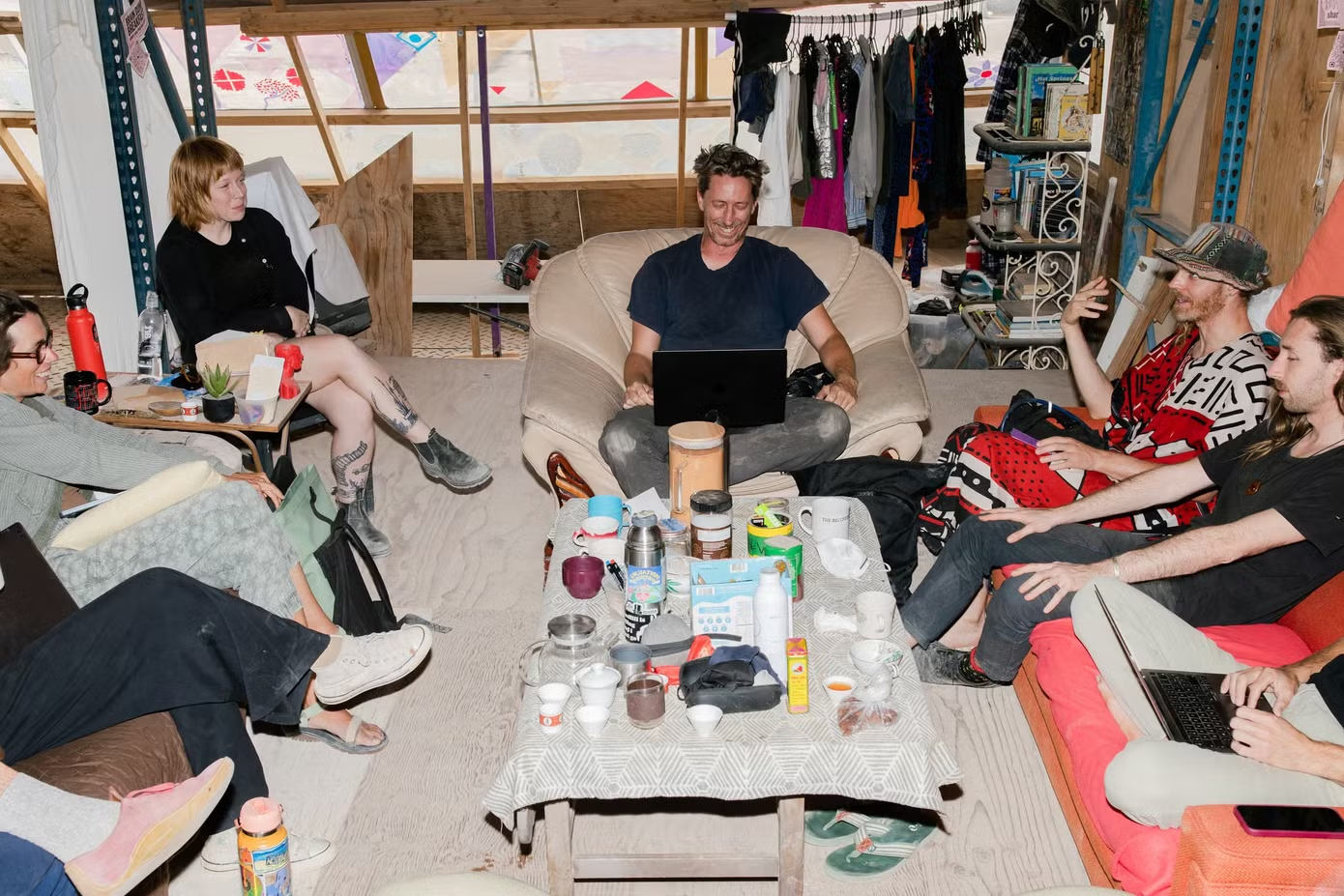
The name of this desolate community is Mars College.
"It's unclear who gave it that nickname," said Gene Kogan, co-founder of Mars College, a programmer and artist. "But it really does look like Mars."
At Mars, unlike a real university, there are no grades, degrees, or mandatory attendance checks. There are no tuition fees, no formally trained professors, and not even public utilities like electricity or running water. Most of the energy for the camp comes from a giant solar panel wall.
But there are still daily classes, ranging from essay writing workshops to mathematical theory, to how to properly install solar panels. All the classes are held in a cluster of plywood and metal structures, built just before the start of the “semester” in January, and then torn down each year in April.
For three months, several dozen "students" of the school lived in trailers, sheds, and tents scattered around the main campus in the desert, and paid a few hundred dollars for shared services such as Wi-Fi, meals, and the use of portable toilets.
Today, those who come to Mars College come from diverse backgrounds: some have advanced degrees, while others haven't even graduated from high school. There are currently around 60 students in total: the largest number the school has ever had. The youngest is 25, the oldest is 60. Students come from Brazil, India, China, various parts of Europe, and every corner of America.
To join Mars, prospective students must submit a formal application, although Kogan acknowledges that the recruitment process is “voluntary” due to the inherent harshness of living in the desert for three months.
The idea for Mars College was conceived years ago at a far more influential event, attended by tens of thousands of people: the Burning Man art festival. It was at this desert festival that a former software engineer and Silicon Valley entrepreneur (who requested to be known only as Freeman) began constructing massive temporary structures from metal scaffolding.
According to its founders, Mars is clearly not a university in the traditional sense; it's more like a low-cost experimental community.
In 2019, he bought an 8-hectare plot of desert land for about $20,000 (526.7 million VND) near Bombay Beach, an area with only a few hundred inhabitants. And if Freeman brought the building materials, Kogan brought the people.
In a 2019 Twitter post, Kogan promoted a “free and incredibly unique trial of living and learning in the desert,” with focus areas such as art, programming, gardening, and construction.
Source: https://tienphong.vn/truong-dai-hoc-mien-phi-giua-sa-mac-post1832871.tpo
![[Photo] Prime Minister Pham Minh Chinh receives the Chinese Ambassador to Vietnam](https://vphoto.vietnam.vn/thumb/1200x675/vietnam/resource/IMAGE/2026/04/05/1775397481797_ndo_br_dsc-5512-jpg.webp)



















































































Comment (0)