(NLĐO) - By utilizing seismic waves to explore the world at the Earth's core, American scientists have gathered startling data.
According to Sci-News, the movement of our planet's inner core has been debated by the scientific community for three decades, with some studies suggesting that Earth's inner core rotates faster than the planet's surface.
A new study, led by Professor John Vidale of the University of Southern California (USA), has revealed drastic changes since around 2010 that Earth's inhabitants were previously unaware of.
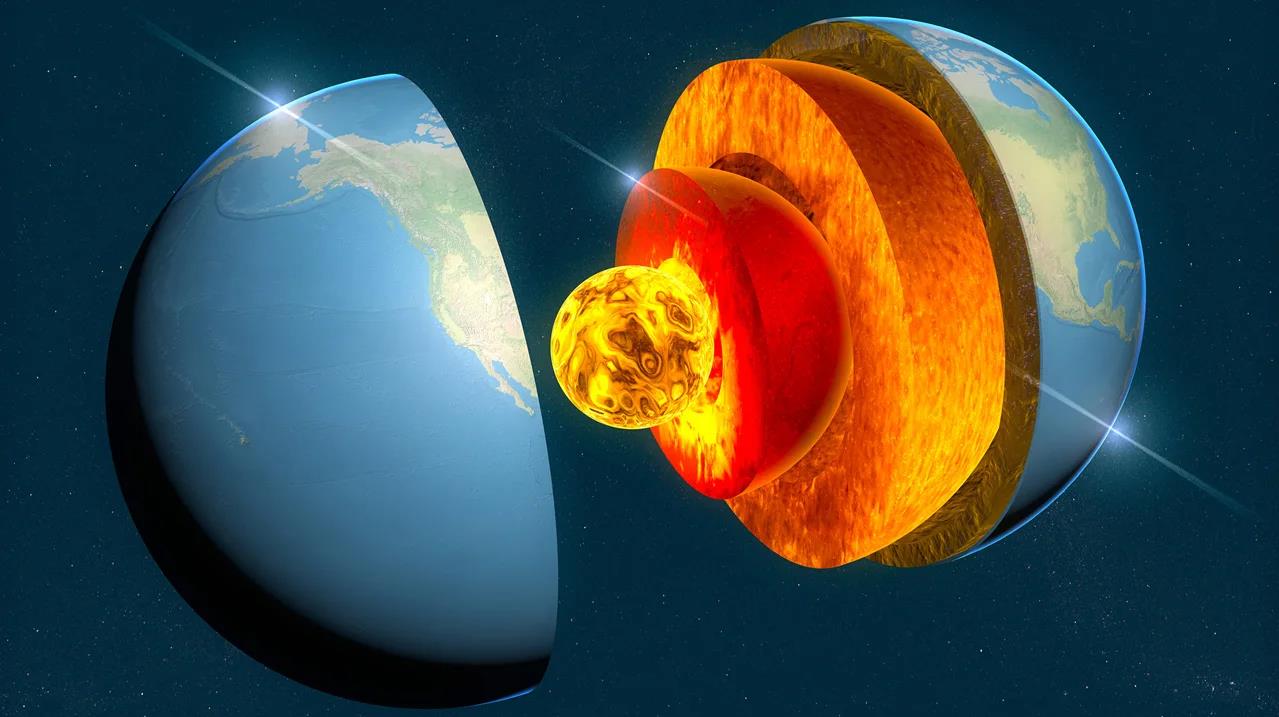
The Earth's structure consists of an inner core of solid metal and an outer core of molten metal - Photo: THE WEATHER NETWORK
A paper published in the scientific journal Nature confirms that the Earth's core has slowed down its rotation. Currently, this core rotates even slower than the outer parts of the Earth.


"When I first saw the seismic records showing this change, I was very puzzled. But when we found more than 20 other observations signaling the same pattern, the result was inevitable," said Professor Vidale.
This is the first time the Earth's core has slowed down in 40 years, even rotating in the opposite direction to the planet's surface.
This core is a solid iron-nickel sphere surrounded by a liquid iron-nickel outer core, roughly the size of the Moon and located more than 4,828 km below our feet.
In the study, they compiled and analyzed seismic data recorded around the South Sandwich Islands from 121 recurring earthquakes that occurred between 1991 and 2023.
They also used data from the Soviet Union's double nuclear tests from 1971-1974, which caused seismic-like tremors, as well as repeated nuclear tests by France and the United States.
They all point to the same result.
Scientists are currently unable to fully assess the changes to the Earth's surface related to the "unusual behavior" of the planet's core.



The only thing we can know is that the actual length of a day has changed. However, you don't need to adjust your watch. These changes only shorten the day by about a thousandth of a second.
Scientists remain suspicious about other potential changes that have been affecting the planet since the core slowed down.
They plan to delve deeper into this area of research, which will not only help predict what will happen in the future, but also provide a deeper understanding of the planet's history.
Source: https://nld.com.vn/tu-ben-trong-trai-dat-thay-doi-soc-tu-nam-2010-196240615092557618.htm