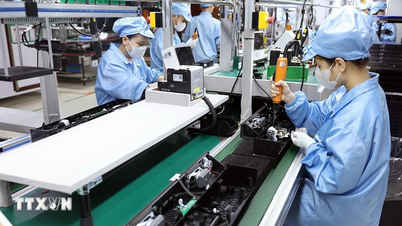
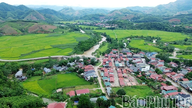
Ba Thien II Industrial Park boasts comprehensively developed infrastructure and ensures sufficient green space in accordance with planning, contributing to improved landscape and creating a friendly production environment. Photo: Le Minh
The new system is closer to the people, understands the people, and serves the people better.
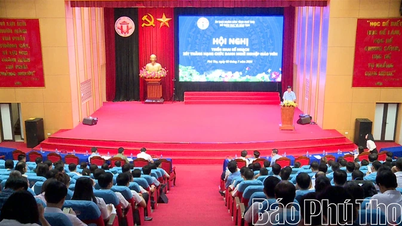
One year of operating the overall model of the political system and the three-tiered government model is a crucial milestone for reviewing initial results and identifying more clearly the challenges arising from practice. This is not just about reorganizing, reducing bureaucracy, and streamlining the apparatus, but more fundamentally, about building a new, more effective, people-oriented, and development-oriented governance model.
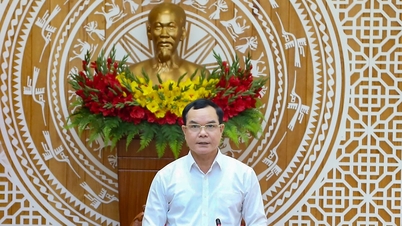
In his speech at the conference, General Secretary and President To Lam conveyed a very clear message: After the initial organizational restructuring phase, the next task is to shift the focus to improving the operational quality, service capacity, and development-creating capacity of the new apparatus. This is a particularly important requirement. Because reforming the apparatus, if it only stops at changing the model, name, or organizational chart, is not enough. Reform is only truly valuable when people feel the change in their daily lives: faster procedures, more responsible officials, a more proactive government, more convenient public services, and more timely resolution of problems at the grassroots level.
For Phu Tho today, that message is even more profoundly meaningful. After the merger, Phu Tho has become a vast development space with a population of over 4 million people, an area of over 9,300 km2, and a rich development structure: it has the ancestral land rich in historical traditions, a dynamic industrial space, a distinctive Muong culture region, mountainous areas, rural areas, urban areas, suburban areas, and areas undergoing strong industrialization and modernization.
Therefore, the measure of success for the new administrative apparatus in Phu Tho cannot simply be whether it is more streamlined, but whether it has the capacity to manage a multi-centered, multi-identity, and multi-need development space. Urban residents need fast, modern, and transparent public services. Rural residents need the government to be closely involved in production, land use, rural development, livelihoods, and social security. People in mountainous areas need more attention to transportation, education, healthcare, culture, poverty reduction, and sustainable livelihoods. Businesses need a stable investment environment, streamlined procedures, clear responsibilities, and transparent data.
Therefore, the requirement that "the new system must create new capabilities" is not a general slogan. It is a very specific requirement for each level, sector, and locality. The provincial level must be stronger in planning, coordinating, allocating resources, connecting regions, and organizing development space. The commune level must be stronger in receiving, processing, and responding to the needs of citizens and businesses; and at the same time, promptly identify issues related to social welfare, land, construction, environment, public order, public services, and emerging risks in the area.
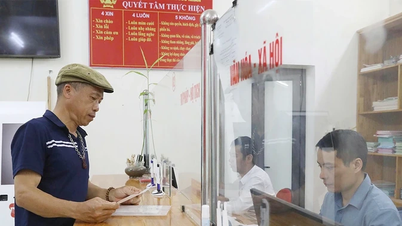
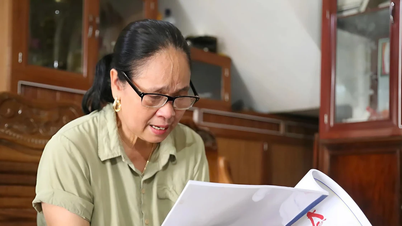
It can be said that the commune level is where reforms are most clearly tested. People rarely come into direct contact with the grand concepts of institutional reform, but they can clearly sense how convenient the procedures are at the commune or ward level; whether officials provide thorough guidance; whether their documents are repeatedly requested for additional information; whether social welfare policies reach the right people at the right time; and whether their concerns about land, environment, construction, and public order are heard and addressed promptly.
Therefore, when the General Secretary and President emphasized that the implementation capacity of the commune level should be considered the measure of success for the new model, it was a very relevant message. For Phu Tho – where there are significant differences between localities and communities – a one-size-fits-all approach is even more unacceptable.
It is noteworthy that the speech also frankly pointed out the limitations in the capacity of officials: According to assessments, only 53% of provincial-level officials and 30% of commune-level officials meet the job requirements. This figure shows that organizational reform cannot be separated from the reform of the official workforce. For communes to truly be the frontline of public administration, they must have officials with sufficient capacity, courage, skills, and working conditions. In particular, it is necessary to strengthen the deployment of officials with in-depth expertise in land, construction, planning, investment, finance, information technology, justice, education, health, and urban management at the grassroots level; at the same time, appropriate policies should be in place to ensure that officials can work with peace of mind, especially in difficult areas, mountainous regions, and remote areas.
At a cultural level, this is precisely the requirement for building a new public service culture. A good public service is not just about following procedures correctly, but also about listening to the people, respecting the people, understanding the people, being close to the people, and being fully responsible for the people's affairs. Therefore, reforming the system is not just about changing the organization, but also about changing the service attitude, public service ethics, and sense of responsibility of each official and civil servant.


Phu Tho is the ancestral land, the cradle of our nation, always reminding us of the principles of unity, brotherhood, and responsibility to the community. In the new context, this spirit needs to be transformed into a governance culture: a government for the people, officials respecting the people, reforms oriented towards the people, and development for the happiness of the people.
Foundation for Phu Tho's rapid and sustainable development.
One of the most concise messages in the speech by General Secretary and President To Lam was: "The new organization must create new capabilities, the new decentralization and delegation mechanism must go hand in hand with new responsibilities, new data must create new governance methods, and the new apparatus must bring new quality of service to the people and businesses." This can be seen as a guiding principle for the next phase of reform.
For a locality with a large development space and diverse structure like Phu Tho, decentralization and delegation of power must be even more substantive. The speech rightly emphasized that decentralization is not about shifting burdens to lower levels, but about clearly, transparently, and controllably transferring authority, resources, data, implementation tools, and responsibilities.
This is especially important in post-merger local governance. The new Phu Tho cannot develop using the old administrative mindset, divided by old boundaries, or operating according to old habits. A new province needs a new vision for spatial development organization: connecting the ancestral land with industrial, service, tourism, and ecological centers; connecting urban and rural areas; connecting mountainous and lowland regions; connecting cultural heritage with cultural industries, tourism, and the creative economy; and connecting transportation infrastructure with digital infrastructure, social infrastructure, and cultural infrastructure.
To achieve this, provincial-level authorities must play a more strategic role in planning, coordinating, allocating resources, regional linkages, and inspection and supervision. Commune-level authorities must be empowered to address people's issues at the grassroots level. A large locality cannot be effectively governed if everything is concentrated at the higher levels. However, the grassroots level cannot be neglected without mechanisms for monitoring, measurement, and accountability.
Here, data becomes an indispensable foundation. The General Secretary and President have requested that data be considered an asset, a resource, and the foundation of modern governance; at the same time, addressing the issue of fragmented software, scattered data, and officials having to operate on too many systems. This is a very practical issue for local governments. If data is not interconnected, citizens have to fill out forms multiple times. If the software is unstable, officials waste time on operations. If land, population, business, social security, health, and education data are not standardized, decision-making will be slow, inaccurate, and difficult to control.
For Phu Tho province, data is even more crucial in governing a large area with many distinct regions. Data helps the province better understand the needs of each area, the strengths of each region, and the bottlenecks in each sector. Data helps allocate resources more equitably and accurately. Data helps detect problems related to social welfare, the environment, land, construction order, and public services early. Data also allows leaders to not only listen to reports but also monitor progress, quality, and accountability in real time.
But data is only meaningful when accompanied by responsibility. One of the most noteworthy principles in the speech was: Each task must have a lead agency, a single point of contact with primary responsibility; a shared data source; and an interconnected coordination process. This principle needs to be thoroughly understood in the operation of local government. In reality, many tasks are delayed because responsibility is unclear; many procedures are complicated because of a lack of interconnected processes; and many resources are wasted because there are no effective exploitation plans.
A newly established province aiming for rapid and sustainable development needs many resources. But first and foremost, it needs an administrative apparatus capable of organizing and activating those resources. This apparatus must know how to build trust among the people, reassure businesses, foster social consensus, and motivate local officials. Phu Tho possesses unique advantages. However, these advantages only become driving forces when they are supported by an efficient system, modern governance methods, and a genuine spirit of serving the people. What the people most expect is a government that is closer, faster, more transparent, and more accountable. 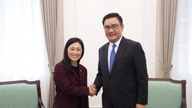 The Ministry of Foreign Affairs received a copy of the Letter of Credence for the U.S. Ambassador to Vietnam.On the afternoon of July 2nd, at the Ministry of Foreign Affairs headquarters, Mr. Le Cong Dung, Director of the State Protocol and Foreign Interpretation Department, received a copy of the Letter of Credence from Ms. Jennifer Wicks, Ambassador of the United States of America to Vietnam.  Ambassador Nguyen Quoc Dung visits and works in Minnesota, USA.From June 28-30, the Vietnamese Ambassador to the United States, Nguyen Quoc Dung, paid a visit and worked in Minnesota.  Vietnam encourages US businesses to expand investment in high technology.On the morning of June 26th, at the Government Headquarters, Deputy Prime Minister Ho Quoc Dung received Mr. Jeff Place, Supply Chain Director of Coherent Group (USA). During the meeting, the Deputy Prime Minister affirmed that Vietnam encourages US businesses to expand investment, especially in high-tech, innovation, and semiconductor industries. |
The message from the conference is not only a requirement for the whole country, but also a very practical reminder for Phu Tho in its new phase: The new organization must create new capabilities; new decentralization must be accompanied by new responsibilities; new data must form new governance methods; and the new apparatus must bring a new quality of service to the people.
This is also the path for the new Phu Tho to not only expand its administrative map but also become stronger in its development capacity; not only inherit the traditions of the ancestral land but also create a modern, humane, and prosperous future, worthy of the trust and expectations of the people.
Bui Hoai Son
Source: https://baophutho.vn/tu-bo-may-moi-den-nang-luc-phat-trien-moi-257218.htm