

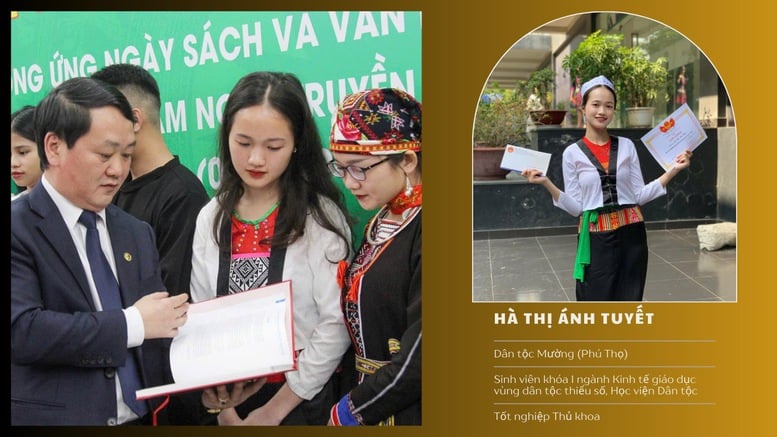
Ha Thi Anh Tuyet: "Don't give up on your studies and don't feel ashamed because you are from an ethnic minority. Consider it a special advantage; you yourselves will create values that no one else can replace." - Photo: VGP
A thirst for knowledge
Ha Thi Anh Tuyet (born in 2002), a student of the first cohort in the Economics of Education for Ethnic Minorities at the National Academy of Ethnic Minorities, has just graduated with the title of Valedictorian. This achievement is not only a source of personal pride but also a clear "commitment" to her homeland and the community where she was born.
Sharing with the Government Online Newspaper, Tuyet said that her childhood was filled with familiar images of the mountainous region of Phu Tho : lush green palm hills, hazy afternoons with kitchen smoke, the sound of gongs echoing during festivals, and the small footsteps of children walking to school every day on the bumpy road. It was in this environment that her aspiration to learn was nurtured.
"I still remember the image of the teachers coming up from the lowlands to the village, and the older students walking many kilometers to school every day. At that time, I thought very simply: only through education could our village change."
Growing up in a rich Muong cultural environment, nurtured by the melodies of the Vi and Rang folk songs, and the stories told by grandparents around the fireplace, I soon realized that many traditional cultural values are gradually fading away, not being preserved and appreciated as they should be.
"I chose education because I understand that education is not just about teaching literacy. Education is also a way to preserve our identity, so that the gongs and songs of our people are not forgotten," Tuyet shared.
Above all, it was the choice of someone who had experienced poverty. Witnessing many of her peers having to drop out of school to work in the fields or as laborers, she formed a very clear thought: since she was fortunate enough to receive an education, she had to return to help her village. Therefore, her commitment to education in ethnic minority areas was not only a career path but also a way of "repaying" the land that had nurtured her.

Familiar images of Phu Tho province emerge through the vast green palm forests and the simple, rustic Rang songs sung during festivals of the Muong ethnic group.
The "Curves" of the Pioneer
As a first-year student in the Economics of Education for Ethnic Minorities, a new and unique field of study, Tuyet's academic journey was not a bed of roses. On the contrary, it was a series of "turns and curves" that demanded the courage of a pioneer.
Tuyết recalled, "As the first cohort, we had almost no senior students to learn from. From the curriculum and learning methods to the research direction, everything was very new. While learning, we also figured things out on our own and provided feedback to make the program even better."
This field of study combines economics with numbers, models, and logical thinking, while education in ethnic minority areas demands deep empathy for culture and people. This presents numerous challenges for students.
"When I chose this major, some people asked me directly: 'What will you do after graduation?' But I believe that if I truly have the ability and dedication, society will need me."
That belief was proven by her impressive academic results. Her overall GPA was 8.8/10 and her conduct score was 96.4/100. The title of Valedictorian is not just about the impressive numbers, but a testament to the perseverance and intelligence of this Muong ethnic minority student.
Educational economics in ethnic minority areas is not simply a field of study, but a long-term mission. While economics can bring about immediate change, education is the decisive factor in the long-term future of an entire community.
"Educational economics in ethnic minority areas requires not only dedication but also scientific management, knowing how to optimize resources so that every dollar spent yields the highest possible benefit for the children of these communities." Tuyet likened her choice of field of study to planting a new type of tree on sloping land, requiring faith, perseverance, and knowledge. When the tree bears fruit, it will be "golden harvests of knowledge" for the remote villages.
Sharing her study secrets, Tuyet said: "Self-study is fundamental, but focusing on lectures and taking careful notes in class is also very important. I always appreciate the dedication of my teachers, not only in my studies but also in guiding me through life. Besides that, the spirit of solidarity and mutual support among the first cohort of students is also a foundation that helps the whole group progress together."
Looking to the future, I aspire to pursue postgraduate studies and work in the field of ethnic minority education, directly contributing to resolving economic and educational bottlenecks in ethnic minority areas.

Ha Thi Anh Tuyet was admitted to the Party while still a student - Photo: VGP
"The Commitment" of Young Party Members
A significant milestone in Tuyet's journey to adulthood was joining the Party while still a student. "For me, the title of Party member is not just a card or a designation, but a commitment to live and contribute. Being in the Party ranks helps me deeply understand the Party and State's policies on ethnic minorities, transforming personal aspirations into responsibility to the community. Party membership also serves as a foundation for me to uphold my ethics and always prioritize the collective interest over personal gain," Tuyet shared.
That joy and responsibility were further amplified when Tuyet received the news that she had been honored as an outstanding ethnic minority student in 2025, a program organized by the Ministry of Ethnic Minorities and Religions in coordination with the Ministry of Education and Training and the Central Committee of the Ho Chi Minh Communist Youth Union. It was a mix of pride, gratitude, and a sense of commitment. She felt proud that the Muong ethnic identity and the image of the National Academy of Ethnic Minorities were being recognized, and she also expressed her gratitude to her family, teachers, and the sound policies of the Party and State that have paved the way for children from ethnic minority areas to thrive.
According to Tuyet, the certificate of merit is not the end point, but a reminder to strive and contribute more. She wants to send a message to young people from ethnic minorities: "Knowledge is capital to avoid being deceived, a tool for wealth creation, and a weapon to protect ethnic identity. Don't give up learning and don't feel ashamed because you are from an ethnic minority. Consider it a special advantage; you will create values that no one can replace. Your village does not limit your vision, unless you limit yourself."
Son Hao
Source: https://baochinhphu.vn/tu-con-duong-dat-do-den-nhung-mua-vang-tri-thuc-102251224145356936.htm

































































































Comment (0)