

There is a Tam Bac that evokes fond memories.
When mentioning Hai Phong , people often think of the "Port City," the "City of Red Flamboyant Flowers," and the bridges, wharves, and salty rivers at the forefront of the waves. Rao Bridge, Dat Bridge, Binh Wharf, Tam Bac River… are not just place names, but memories, an integral part of the spiritual life of many generations of this city's residents.
Tam Bac is a small river, but it played a significant role in the history of Hai Phong. From the 17th century, when trade and fishing along the river developed, Tam Bac became a cornerstone for the formation of Hai Phong port. According to elders, Tam Bac Street was opened during the French colonial period. By the 19th century, the street's appearance gradually took shape as French businessmen and locals settled and traded there. In 1953, the street was named Bach Thai Buoi, after a prominent Vietnamese capitalist. After the revolutionary government took over the city in 1955, the street officially became Tam Bac, because it runs along the river of the same name.
Today, Tam Bac Street has become part of the Old Quarter in the heart of Hai Phong city. Its beauty is not only captured in works of art but also deeply ingrained in the memories of the people. Many ideas have been proposed for this area: transforming Tam Bac into a miniature "Seine River" with riverside bookstores, sketch artists, small cafes, green trees, and ideal relaxation spots. Not all have come to fruition, but the desire to preserve and revitalize the river is very clear.
The Tam Bac area does not stand alone. It is seamlessly connected to the village of Ven, the predecessor of Hai Phong, near the temple of General Le Chan, the founder of the ancient An Bien region and the "guardian deity" of the port city. It also houses the City Theatre, one of the three large theatres built by the French in Vietnam, a building deeply marked by Hai Phong's architecture and history.

Next to the City Theatre is the City Exhibition and Fine Arts Center, situated amidst a large green space, which regularly hosts exhibitions of paintings and photographs by artists, painters, and children. In recent years, Tam Bac Park has also been continuously expanded, forming a strip of parkland along the river.
When Hai Phong piloted the Quang Trung pedestrian street from Friday evening to Sunday every week, the area quickly became bustling. Crowds flocked there to stroll, shop, enjoy food , and watch art performances. The familiar space was "extended" in time, becoming more vibrant as night fell.
Quang Trung Walking Street is the second pedestrian street in Hai Phong's Old Quarter. It's not just a recreational spot, but also a concrete step in the strategy to develop the night-time economy and promote the city's cultural identity. Along both banks of the Tam Bac River, from The Lu to Tam Bac, music nights, public performances, and local food activities are organized, creating a relaxed, not overly noisy, yet captivating atmosphere that encourages visitors to linger.
Come and awaken the night tourism of the Eastern region.
In recent years, Hai Phong has taken initial steps in developing night-time tourism. Not only in the city center, but also expanding to key tourist areas, the night-time economy is gradually taking shape. In Do Son, a pilot model of 9 mobile kiosks selling OCOP products, dried seafood, and souvenirs on the Van Huong pedestrian street, combined with street art performances on weekends, has created a vibrant atmosphere from 5 PM to 11 PM, attracting a large number of tourists.
In Cat Ba, 2025 marks the opening of the VUI-Fest Bazaar night market with hundreds of eco-friendly stalls, along with a chain of restaurants, pubs, culinary experiences, and nighttime entertainment. The "Green Island Symphony" show and electric vehicle and bicycle tours of the town at night have contributed to extending the length of stay for tourists, especially those with high spending power.
One of the most notable highlights recently is the "Sacred Traces of Hang Kenh" night cultural tour, officially launched in June 2025. The tour combines spirituality, traditional art, and modern 3D mapping technology, telling the story of Ngo Quyen – the founder of the nation's independence – within the sacred space of Hang Kenh Temple.
The tour's unique feature is its unconventional approach to heritage, shifting from traditional "sightseeing and guided tours" to a multi-sensory experience: offering incense, watching water puppetry performances, traditional opera, folk singing, temple singing, calligraphy consultations, experiencing local cuisine, and shopping for traditional handicrafts. The 3D mapping show "The Waves of Bach Dang - The Heroic Spirit of Ngo Quyen" recreates history through light, sound, and moving images against a backdrop of ancient architecture, creating a powerful emotional impact on viewers.
Based on this model, many experts believe that Hai Phong can fully expand the nighttime heritage space at cultural heritage sites such as Con Son - Kiet Bac, Bach Dang Giang, Mao Dien Temple of Literature, Giam Pagoda, etc. Currently, most of these sites only operate during the day, while the ideal time to "tell the story of heritage" at night remains untapped. Despite some promising models, according to Hai Phong's tourism industry, the biggest bottleneck lies in the conflict between current regulations and the actual needs of the market. The requirement for many entertainment venues, bars, and lounges to close before 10 PM makes it difficult for large-scale investments in nighttime tourism to be effective and prevents the formation of vibrant, internationally-standard night streets.
Furthermore, expanding nighttime operating hours and spaces also poses challenges in terms of managing security and order, environmental sanitation, fire prevention and control, noise control, and the availability of high-quality human resources for nighttime services – especially for large entertainment complexes catering to international tourists.

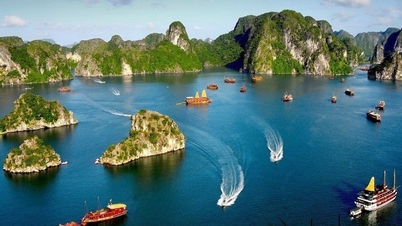
According to Mr. Nguyen Thanh Trung, Director of the Department of Culture, Sports and Tourism of Hai Phong, the city has all the necessary conditions to reposition its tourism brand based on the global and unique values of its heritage system. The Cat Ba Archipelago - Lan Ha Bay and the Con Son - Kiet Bac heritage space have been identified as two strategic pillars.
Currently, Hai Phong has nearly 900 accommodation establishments with over 23,000 rooms, 183 travel agencies, and many large corporations investing in large-scale tourism projects. By 2025, the city is estimated to welcome approximately 14.5 million tourists, generating revenue exceeding 15,000 billion VND. However, the contribution of tourism to the city's GRDP is only nearly 3%, indicating significant potential for further development.
In the coming period, Hai Phong prioritizes investment in connecting infrastructure, large-scale entertainment and resort complexes, innovative promotion and marketing, improving the quality of human resources, and perfecting specific mechanisms and policies to attract strategic investors, with the development of the night-time economy considered a key direction.
Aiming for over 16 million visitors by 2026, Hai Phong is gradually making an inevitable choice: not just to welcome more tourists, but to welcome them more deeply, more slowly, and to leave a longer lasting impression on visitors' memories. In this journey, the night economy is not just a sum of time and spending, but a way for the city to awaken deeply ingrained memories, preserving the "soul of the city," tourist areas, and world natural heritage sites amidst modern life. When night falls and the city tells its story through light, sound, and emotion, Hai Phong will not only be a destination on the tourism map, but a place people want to return to, to remember...
Source: https://baophapluat.vn/tu-ky-uc-pho-co-den-khong-gian-du-lich-dem.html


![[Photo] National Assembly Chairman Tran Thanh Man attends the policy seminar to promote Vietnam-Türkiye cooperation.](https://vphoto.vietnam.vn/thumb/1200x675/vietnam/resource/IMAGE/2026/04/16/1776351415367_vna-potal-chu-tich-quoc-hoi-tran-thanh-man-du-toa-dam-chinh-sach-thuc-day-hop-tac-viet-nam-tho-nhi-ky-8705791-jpg.webp)




















![[Image] Bridges and roads connecting the eastern part of Ho Chi Minh City](https://vphoto.vietnam.vn/thumb/1200x675/vietnam/resource/IMAGE/2026/04/16/1776328595108_ndo_br_bh-vt5-jpg.webp)
























![[Infographic] Details of the Hanoi-Quang Ninh High-Speed Railway Project](https://vphoto.vietnam.vn/thumb/402x226/vietnam/resource/IMAGE/2026/04/16/1776338188424_anh-man-hinh-2026-04-16-luc-18-16-10.png)
![[Photo] National Assembly Chairman Tran Thanh Man meets with the Speaker of the Georgian Parliament](https://vphoto.vietnam.vn/thumb/402x226/vietnam/resource/IMAGE/2026/04/16/1776338494029_anh-man-hinh-2026-04-16-luc-18-21-21.png)













Comment (0)