

Perhaps that's why his writing style is so unique and captivating the more you read it.
The opening of his unpublished posthumous works, *Miscellaneous Records* 89/90, sees scholar Vuong Hong Sen jokingly remarking: "Poetry, absentmindedness, absentmindedness, absentmindedness," he self-deprecatingly saying: "Ninety years old, bustling about. On ordinary days, he likes to eat 'fish tail fish sauce,' meaning the fish itself, he reserves the tail part, which has a lot of meat. However, since fish tail fish sauce became expensive and unaffordable, his daughter-in-law served him a plate with a lid. When he opened it, he only saw 'finely ground coarse salt.' He got angry and asked: 'There's no more fish tail fish sauce, huh?' His daughter-in-law replied: 'I'm tired of eating fish tail fish sauce all the time, so today I'm serving you crushed salt. You're a man who likes wordplay, so, if you don't want fish tail fish sauce, then at least have 'crushed salt,' and please accept it as a token of my gratitude.'"
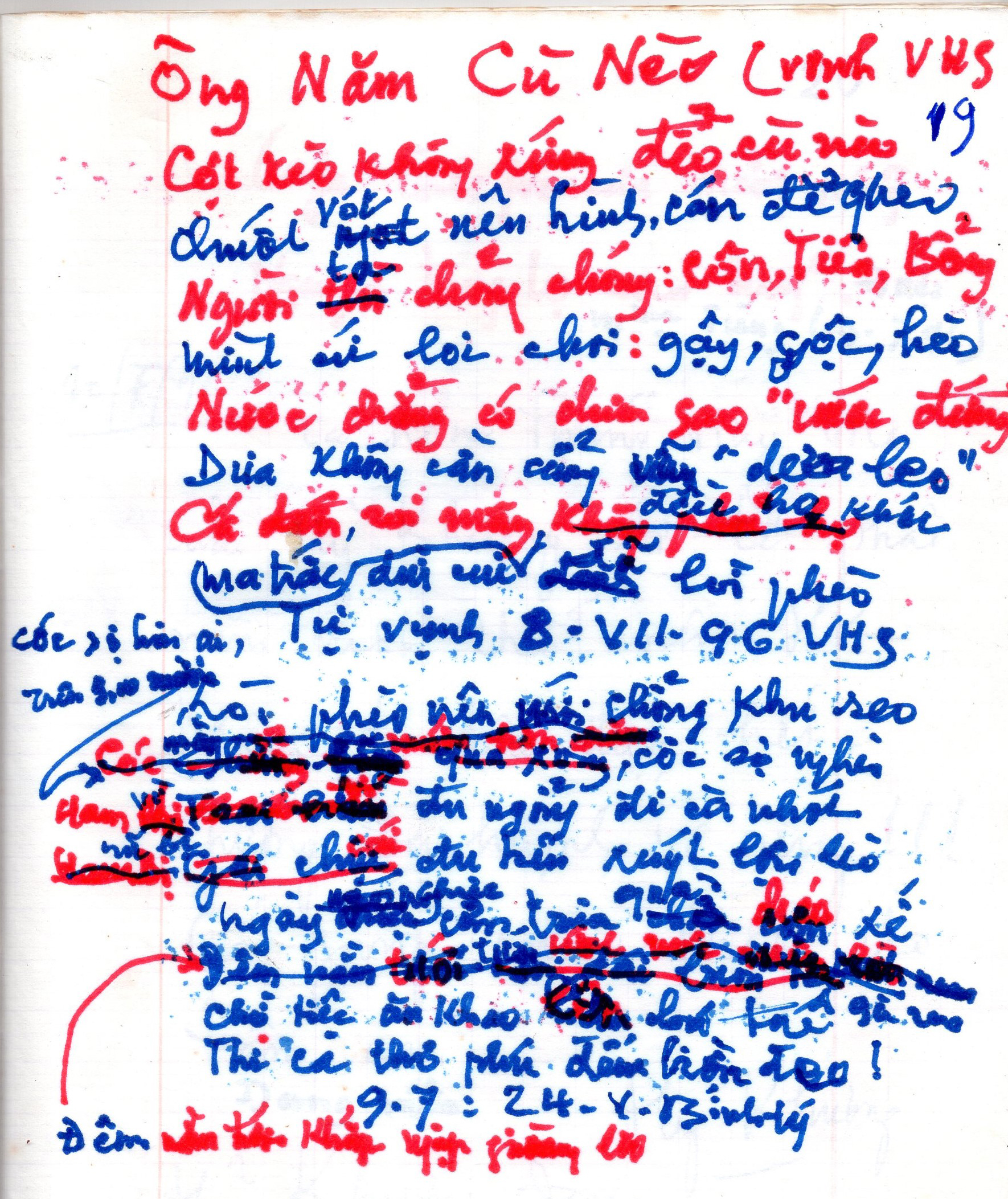
The handwritten text of the wordplay poem by Mr. Vuong Hong Sen
After reading it, you'll surely chuckle to yourself.
Regarding the art of wordplay, in the Thanh Nien newspaper issue dated October 14, 2017, in the article "The Fun of Vietnamese Wordplay," journalist Le Cong Son quoted researcher Nam Chi Bui Thanh Kien's assessment: "From its beginnings, wordplay has skillfully combined two elements: wordplay technique and vulgarity. The 'vulgar' element in the wordplay of both Cong Quynh and Ho Xuan Huong has sown a great influence and has now become an inherent characteristic of wordplay." "The phenomenon of wordplay originated in North Central Vietnam and followed its southward migration." We can also see this through the self-deprecating poetry of Mr. Sen; I have chosen a poem in which he "compared himself to a stick, living uselessly, taking up space":
The intestines are protruding, remember to stand guard in the shouting area.
A ninety-year-old toad fears poverty.
Water has no legs, so how can it "stand still"?
A cucumber without legs is still a "cucumber".
The adventurous young man limped along.
Girls who like to swing on fairies will just end up tumbling around.
Waiting for the nine-week celebration, the poetry and calligraphy competition will take place.
The rhyming couplet is counted consecutively.
He continued: "I thought I was 'driving' a market, with literary friends from Central and Southern Vietnam composing rhyming verses, but only Te Nhi corrected two poems that were truly infuriating to a teacher." Now, I choose one:
Don't anchor, even in the pouring rain and wind.
As long as you have the strength and ability to walk, you won't be poor.
I heard stories about the lustful god with keen hearing and eyesight.
Looking at the painting of the beautiful woman, one's eyes do not squint.
Winning or losing, let's ignore the antics of Europe and Asia.
Why fight like dogs playing with cats?
Celebrating ninety years with a string of beads.
A hundred years have passed, and I count the days I've worn this.
WHEN OLD MAN VUONG HONG SEN… ARGUED
Not only did he use wordplay, but occasionally we see Mr. Sển "arguing" about things that have long been overlooked. In his posthumous work *Miscellaneous Records* 89/90, he discussed two lines of poetry from *Luc Van Tien* by Mr. Do Chieu. Currently, all printed versions clearly state:
Listen quietly, everyone!
Be mindful of past mistakes, and be cautious for the future.
However, according to him, the phrase should be "Keep a low profile before acting, be cautious about what happens afterward," with the argument: "Don't forget to mention the melody of 'be cautious about what happens afterward,' four words that anyone who reads or sings them will strain their throats. We here are familiar with the phrases 'keep a low profile' and 'be cautious,' and we recall that if someone knows the tune of the fiddle, they can hold the stick, thrust it forward to get the word 'avoid,' and pull it back to get the word 'cautious,' it's incredibly powerful, and unexpectedly produces a piece of music that is both pleasant to the ear, strong to the voice, and not constrained."
This opinion will certainly be challenged, because according to symmetry, "fierce" versus "good," and "before" versus "after" are more logical. A scholar with excellent writing skills, profound knowledge, and extensive learning like the scholar himself would surely know this; how could he possibly use the words "keep" and "avoid"? Initially, I thought so too, but whatever I say must be based on the earliest printed version of this work.
With this in mind, I revisited the book Les poèmes de l'annam - Lục Vân Tiên ca diễn, printed by Abel des Michels in France in 1883, the first edition printed while Mr. Đồ was still alive. Page 27 contains this verse, exactly as Mr. Sển just analyzed: "Keep in mind past mistakes, be cautious about future consequences." Then, editions printed in Southern Vietnam in the first half of the 20th century also printed it this way.
Regarding the characters in Luc Van Tien, in 1919 in Saigon, a version of Bui Kiem's folk song, written by Nguyen Van Tron, was printed. According to Mr. Sen, this genre, if spelled correctly, should be "giam". Here, he records the account of Mr. Nguyen Van Theu, born at Rach Ban Bridge, now Co Bac Street, in 1926, who sang giam to earn a living. This person said when reciting Bui Kiem's verses: "Personally, I found many lines in the original text difficult to sing smoothly and pleasantly, so I added verses and inserted many words that I modified and embellished to suit the rising and falling tones of the song. I disregarded literary rules; I only knew how to sing according to my simple, folk heart… For example, the first line: 'Suddenly, Bui Kiem entered the house,' the original text only had six words, 'Suddenly, Bui Kiem entered the house,' and adding the words 'brother' and 'step' already constitutes 'verbal embellishment'."
From this explanation, Mr. Sển concluded: "I understand 'Giặm' as 'adding fish sauce and salt' to make a dish more flavorful, savory, and palatable." Is this explanation correct from an "academic research" perspective? When reading "Nghệ Tĩnh Giặm Singing" (2 volumes, Social Sciences Publishing House, 1963), we see that co-author Professor Nguyễn Đổng Chi and researcher Ninh Viết also affirm "giặm singing," not "dặm singing," and offer a similar explanation to the above interpretation:
"The term 'giặm' means to add something, fill in, complement, or complete something that is missing, to fill a space that can still accommodate it... Often, when composing a song, it is necessary to insert a 'repetition' (or 'reiteration'), hence the name 'giặm singing'."
The second interpretation stems from the fact that "singing in rhyme" often involves rhyming. Usually, in call-and-response singing, the rhyme of the first line of the song must rhyme with the last line of the question. For example: Question: "I ask you a few words/Please explain clearly." Answer: "The words you just said/Have caused me sorrow." The act of rhyming or singing in rhyme is called "giặm," also known as "bắt xắp." Therefore, "singing in rhyme" is also sometimes called "hát xắp" (or "hát luồn") as some people have recently come to call it" (pp. 14-15).
(to be continued)
Source link
























































![[Infographic] Vietnam's Economic Situation Report, Q1 2026: Strong Growth Momentum](https://vphoto.vietnam.vn/thumb/402x226/vietnam/resource/IMAGE/2026/04/04/1775298512042_tang-truong-kinh-te-viet-nam.jpeg)
![[Image] Close-up view of the 10-lane road connecting to Long Thanh Airport](https://vphoto.vietnam.vn/thumb/402x226/vietnam/resource/IMAGE/2026/04/04/1775291871988_ndo_br_1-resize-5690-jpg.webp)


























Comment (0)