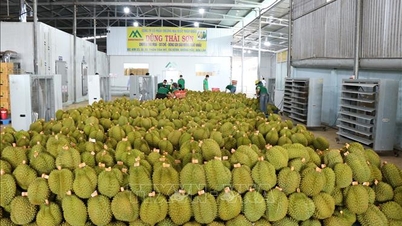
Having had the opportunity to participate in the thematic exchange "From Book Pages to Film and Play," organized by the An Giang Young Literature Club in collaboration with the Provincial Library, I was impressed by the lively atmosphere of the program, with a large number of junior high school students from wards and communes across the province enthusiastically participating in discussions with the speakers. Throughout the exchange, the students were introduced to many familiar literary works that have been adapted into films and plays, such as "The Adventures of Cricket," "Southern Forest Land," "Journey to the West," "Without Family," "The Little Prince," etc. Images and film excerpts shown interspersed with the sharing quickly captivated the attention of the participants.

Students participate in a thematic exchange session titled "From Books to Films and Plays" at the Provincial Library, Branch 1, Rach Gia Ward. Photo: TUONG VI
As a speaker, writer Le Quang Trang, head of the An Giang Young Writers' Club, shared fascinating information about the journey of famous literary works from the pages of books to the screen. Beyond introducing the content of the works, Mr. Le Quang Trang also helped the students understand the adaptation process, the changes in character development, plot, and setting when a literary work is adapted for film or stage. Many students listened attentively, continuously asking questions and sharing films they had seen, creating an open and friendly atmosphere of interaction.
Writer Le Quang Trang believes that films can be an effective way to spark young people's interest in literature. Many students today become familiar with a literary work through film adaptations before even reading the original. "Not all students are familiar with a literary work from the start. Many know about characters like Cricket, An, or other literary figures through films first, and then, out of curiosity, seek out the original work. The important thing is to create initial interest, because once they like the character or story, they will want to explore deeper aspects that the film couldn't fully convey," said writer Le Quang Trang.

According to Mr. Trang, each art form has its own strengths. While film makes stories more visual and vivid, literature opens up a space for imagination and deeper layers of meaning for readers. Therefore, approaching literature through film is not intended to replace reading books, but rather to create another door for young people to get closer to literature.
During the exchange session, Dao Viet Minh Long, a 7th-grade student from Vo Nguyen Giap Junior High School in Rach Gia ward, boldly asked a question about approaching literature through films. Long shared that he had watched the film "I See Yellow Flowers on Green Grass" and was impressed by some scenes depicting rural life. However, upon learning more about the original work by author Nguyen Nhat Anh, he realized that many details were told in greater depth. "For example, the scene where Tuong gives his food to his younger sister, or the times when Tuong and Thieu play in the fields, in the film I mainly saw beautiful images and gentle emotions. But in the book, I understood Thieu's thoughts more clearly; at times Thieu felt both affection for his younger brother and childish selfishness," Minh Long said.
Answering a student's question, writer Le Quang Trang said: "These differences are crucial in helping students better understand the value of literature when adapted into film. In a film, a scene may only last a few dozen seconds but can convey the overall image and emotions of the character. In a story, students can more clearly see Thieu's thought process in very ordinary situations."
According to Ms. Nguyen Thi Tu Mi, Deputy Director of the Provincial Library, incorporating films and visual aids into book presentation activities is not only about creating initial interest, but also a way for libraries to change their approach to young readers in the current context.
Instead of simply displaying books or introducing them in a traditional way, libraries are gradually incorporating experiential activities such as watching film adaptations, sparking discussions about the characters, and then guiding students to the original works. This approach helps students approach books not in an "imposed" way, but through their natural curiosity. "In fact, many students come to the library not because they already have a reading habit, but because they started after watching a film, hearing a story, or participating in some experiential activity. Once they have an initial impression, finding and reading books becomes easier," Ms. Tu Mi shared.


TUONG VI
Source: https://baoangiang.com.vn/tu-phim-den-trang-sach-a490087.html

![[Image] Schools organize meetings and introduce teaching models to students admitted to grade 10.](https://vphoto.vietnam.vn/thumb/1200x675/vietnam/resource/IMAGE/2026/06/25/1782368077271_ndo_br_z7970052192242-1ec8daeb77a6eed1a4e9f58c564ddd3e-jpg.webp)
![[Photo] General Secretary and President To Lam attends the 13th National Congress of the Ho Chi Minh Communist Youth Union](https://vphoto.vietnam.vn/thumb/1200x675/vietnam/resource/IMAGE/2026/06/25/1782356968989_ndo_br_1-jpg.webp)
![[Photo] General Secretary and President To Lam receives Palestinian Ambassador Saadi Salama](https://vphoto.vietnam.vn/thumb/1200x675/vietnam/resource/IMAGE/2026/06/25/1782365384740_a1-bnd-9423-8322-jpg.webp)