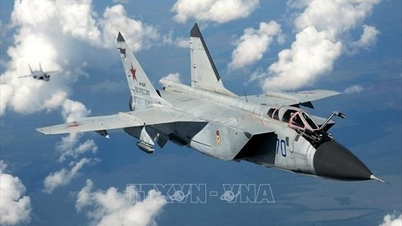
The Radar Corps coordinated with Air Defense forces to detect and guide missiles, enabling the Air Force to destroy enemy aircraft.
With electromagnetic wave transmission technology reaching speeds comparable to the speed of light, surveillance radars capable of detecting and managing targets at distances of thousands of kilometers, as well as radars that detect and track targets at distances of hundreds of kilometers, have successfully completed their missions, contributing to the victory of the North Vietnamese army and people against the two wars of destruction waged by the US imperialists, shooting down 4,181 enemy aircraft.
Modern generations of "air surveillance radars" can not only detect enemy strategic bombers, fighter jets, attack aircraft, electronic reconnaissance aircraft, transport planes, and helicopters, but today they also have the ability to manage and classify many types of flying targets with small radar cross-sections, varying speeds and altitudes, such as unmanned aerial vehicles (UAVs), ultralight aircraft, low-flying targets, and terrain-hugging targets in complex weather conditions and strong interference.
These "electronic eyes" contribute to creating a robust system for managing and protecting the nation's airspace from early on and from afar.
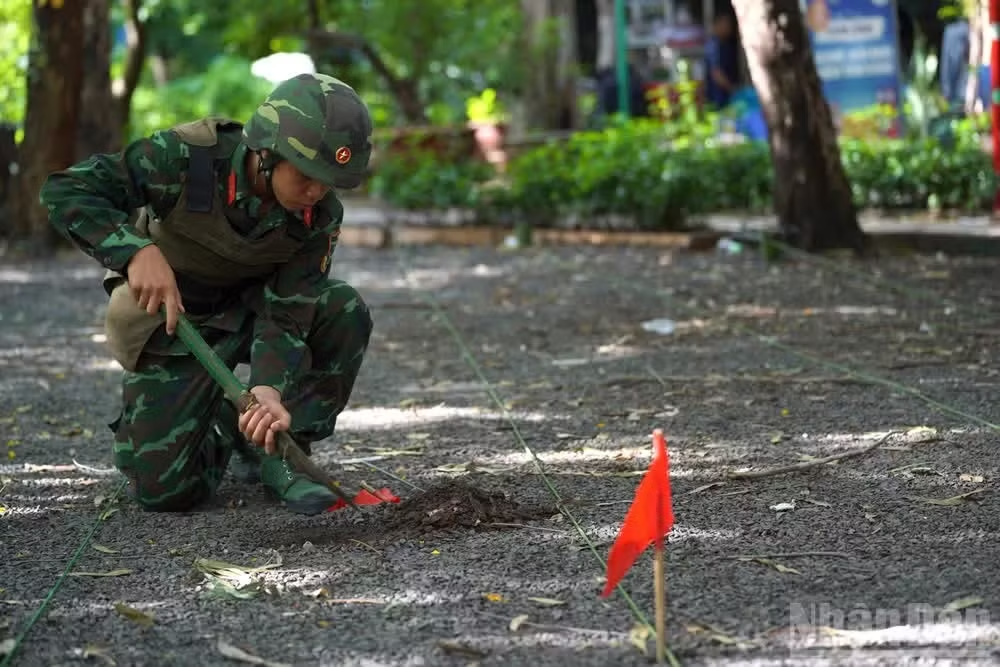
During the "500-day campaign to intensify the search, collection, and identification of the remains of fallen soldiers," using various methods, from researching and comparing records, wartime aerial photographs, battle maps, witness accounts, and discoveries by the people, thousands of remains of fallen soldiers were found nationwide.



Recently, search teams have been equipped with Ground Penetrating Radar (GPR) technology, which uses high-frequency electromagnetic waves (from 10 MHz to 3,000 MHz) to detect underground objects up to 6 meters below the surface without excavation or destruction, in order to find the remains and artifacts of fallen soldiers.
Numerous IDS devices are being deployed in the Truong Chinh street area, Dak Cam ward (Quang Ngai province), to identify the burial sites of fallen soldiers based on records provided by a joint Vietnamese- American research team.
These days, the IDS (Intelligent Data Search) is also being deployed by the Ho Chi Minh City Command in the Le Thi Rieng Park area, Hoa Hung ward, to survey and search for the remains of martyrs who died in the 1968 Tet Offensive.
Ground-penetrating radar (IDS) not only identifies areas showing signs of soil disturbance from previous burial activities, but also helps detect anomalies and related artifacts such as tattered sacks, hammocks, belt buckles, buttons, rubber sandals, canteens, helmets, metal household items, bone fragments, or traces of unusual structures in the ground.
These data are crucial for search teams to more accurately pinpoint the search area, determine the appropriate excavation location and scale, limit scattered excavations, significantly reduce manpower, time, and costs, and improve the ability to identify and cross-reference information to determine the identities of fallen soldiers.
From air defense radar protecting the homeland to ground-penetrating radar serving journeys to pay tribute to fallen heroes, this is a humane continuation of Vietnamese military science.
Just as in wartime, electromagnetic waves helped detect enemies from the horizon to protect every inch of our land and sky, so too, using those invisible waves, today's generations are persistently searching for and restoring the names of the nation's outstanding sons and daughters who fell for today's happiness.



The application of modern science and technology has helped accelerate the implementation of the "500-Day Campaign," improving the efficiency of searching for and collecting approximately 7,000 remains of martyrs whose information is incomplete. This vividly demonstrates the moral principle of "remembering the source when drinking water" and "repaying gratitude," which has become a command from the heart of the entire nation.
Source: https://nhandan.vn/tu-radar-canh-troi-den-radar-xuyen-dat-post972806.html




![[Image] National conference summarizing one year of operation of the overall organizational model of the political system, the three-tiered government model.](https://vphoto.vietnam.vn/thumb/1200x675/vietnam/resource/IMAGE/2026/07/01/1782882811691_ndo_br_1-jpg.webp)







![[Video] General Secretary and President To Lam: Implementing Resolution 57 must create concrete products and value.](https://vphoto.vietnam.vn/thumb/402x226/vietnam/resource/IMAGE/2026/07/01/1782920038776_dung00-49-48-19still006-png.webp)