

Specifically, the State Bank of Vietnam announced the central exchange rate at 25,107 VND. With a trading band of ±5%, the ceiling exchange rate applied to commercial banks is currently around 26,362 VND/USD, while the floor exchange rate is 23,852 VND/USD.
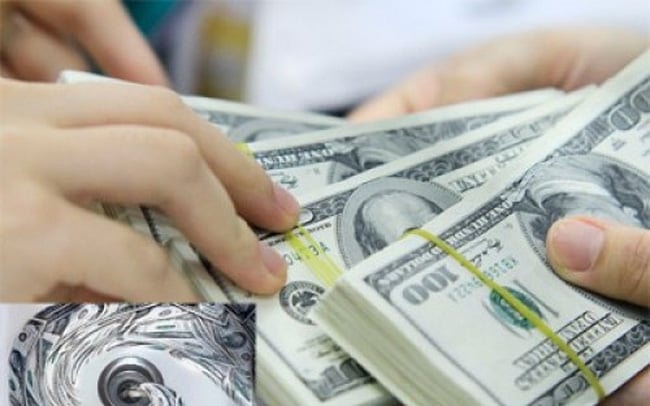
In the banking market, the USD price continues its upward trend and is approaching its ceiling. At major banks such as Vietcombank, BIDV , and VietinBank, the common buying price is around 26,100 – 26,150 VND/USD, while the selling price is close to 26,350 – 26,362 VND/USD. This development indicates that the demand for foreign currency in the system remains high, especially as businesses enter a phase of increased imports and international payments.
Meanwhile, the free market recorded lower trading volumes compared to previous peaks but still maintained a significant gap with banks. The prevailing USD price was around 26,600 – 26,650 VND/USD, about 300–500 VND higher than the bank's selling price. This difference reflects the continued demand for foreign currency among the population and the informal sector, although there hasn't been a sudden surge like in the previous period.
With a stable macroeconomic environment, strengthened foreign exchange reserves, and flexible monetary policy, the USD/VND exchange rate is expected to remain within controllable limits.
On the international market, the US dollar is being influenced by a combination of factors. The US Dollar Index (DXY) is currently fluctuating around 99.5 points, lower than previous periods of strong gains, but still maintaining a relatively stable position against a basket of major currencies such as the euro, Japanese yen, and British pound.
The movement of the DXY indicates that the global market is caught in a tug-of-war between expectations that the US Federal Reserve (Fed) will maintain a cautious policy and concerns about economic growth. This has prevented the USD from falling significantly, thereby continuing to exert some pressure on exchange rates in emerging economies, including Vietnam.
In the coming period, the exchange rate trend will continue to depend on the performance of the US dollar in the international market, especially the fluctuations of the DXY, along with domestic demand for foreign currency according to the economic cycle.
Source: https://hanoimoi.vn/ty-gia-usd-ngan-hang-cham-tran-742637.html





![[Infographic] Cross-exchange rates for determining taxable value from April 2-8](https://vphoto.vietnam.vn/thumb/402x226/vietnam/resource/IMAGE/2026/04/02/1775098913315_w1024q85fauto20260402094804.jpeg)










































































Comment (0)