

The University Medical Center of Ho Chi Minh City recently performed a successful surgery on patient D.T.D (57 years old, residing in Khanh Hoa ). The patient underwent their first surgery in 2020 with a diagnosis of pituitary adenoma invading the middle cranial base, bilateral cavernous sinuses, and posterior cranial fossa. The patient underwent endoscopic surgery to remove most of the lesions in the middle cranial base, freeing previously compressed nerve structures such as the optic nerve and brainstem. Following the surgery, the patient was monitored and underwent continuous MRI scans.
Recently, the tumor has progressed, invading more into the posterior cranial fossa, cavernous sinuses, and bilateral temporal fossae, as well as the lower cranial nerves, causing symptoms such as headache, dizziness, and tinnitus.

Common symptoms of skull base tumors include headache and blurred vision.
The patient was scheduled for endoscopic and microsurgical removal of the entire lesion and reconstruction of the skull base invaded by the tumor. The surgery lasted four hours, after which the patient will be monitored post-operatively to rule out complications.
Following surgery, the patient was stable, alert, with significantly reduced headache symptoms, no cranial nerve damage, and no cerebrospinal fluid leakage through the nose after the operation.
Combining micro-endoscopy and microsurgery for the treatment of skull base tumors.
According to Dr. Pham Thanh Binh, Department of Neurosurgery, University Medical Center of Ho Chi Minh City, for large, complex skull base lesions extending both above and below the skull base, accessing the tumor using both microsurgery and microsurgical techniques allows doctors to optimize the viewing angle, access the lesion from multiple directions to maximize removal, and increase patient safety. The small incision minimizes nerve and motor impairment, allows for complete removal of damaged tissue, and the surgery time is approximately 3-4 hours with minimal damage to healthy tissue. Immediately after surgery, patients can walk and eat normally.
Endoscopic transnasal-sinus surgery for skull base lesions is a new method that is increasingly being developed and expanded to access many difficult lesions that were previously untreatable surgically.
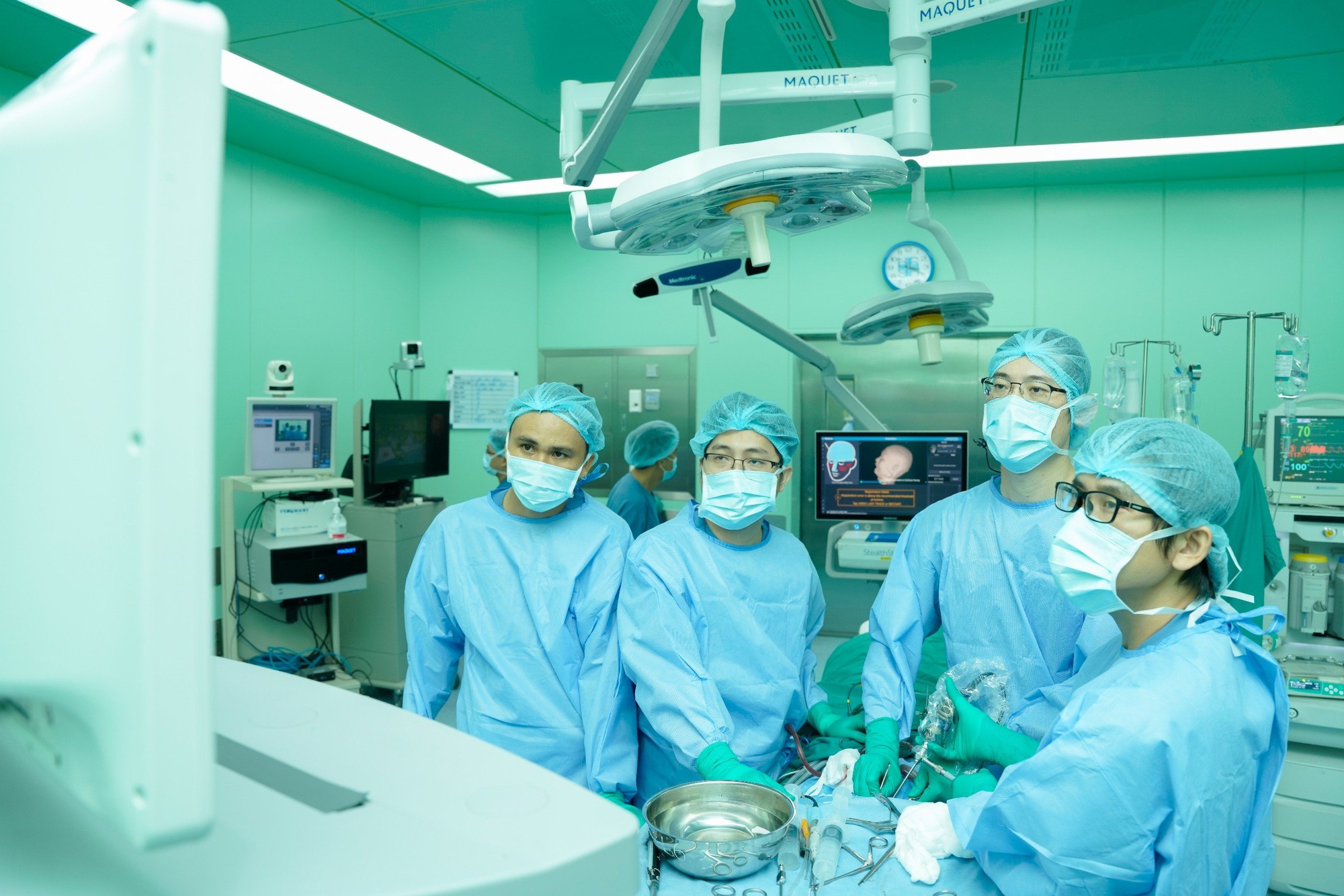
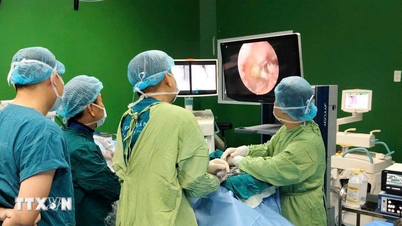
Doctors perform micro-endoscopy and microsurgery techniques to treat complex skull base tumors.
What is a skull base tumor?
Dr. Nguyen Minh Anh, Head of the Neurosurgery Department at the University Medical Center of Ho Chi Minh City, said that skull base tumors come in many different types, developing at the skull base, the junction between the brain above and the structures below (nasal sinuses, orbit, middle cranial fossa, posterior cranial fossa). Common skull base tumors include: meningiomas, olfactory neuroblastomas, pituitary tumors, spinal cord tumors, craniopharyngioma, bone and cartilage tumors, and cancers of the paranasal sinuses.
Skull base tumors can be benign or malignant tumors that have metastasized from other sites. Worldwide , the incidence of this type of tumor is approximately 6.2/100,000 people per year; specific data for Vietnam is not yet available.
Symptom
Symptoms of skull base tumors are often very diverse, depending on the size, specific location, and degree of invasion of the tumors into surrounding structures. Patients are often only discovered during health screenings. Common manifestations may include nerve compression causing headaches, blurred vision, double vision, difficulty swallowing or choking while eating, numbness in one or both sides of the face, progressive numbness and weakness in the limbs; endocrine disorders due to hypothalamic-pituitary dysfunction causing fatigue, poor appetite, weight loss, and frequent urination; and lesions in the lower skull base causing nasal congestion, nosebleeds, and loss of smell.
At the training program "Combining micro-endoscopy and microsurgery for the treatment of complex skull base tumors" recently held at the University Medical Center of Ho Chi Minh City, doctors from the Neurosurgery Department shared information about this technique, performed demonstration surgeries, and provided live commentary for colleagues to observe, exchange ideas, and share experiences, contributing to improving the effectiveness of treatment for patients with complex skull base tumors.
Source link



![[Photo] Prime Minister Pham Minh Chinh receives the Chinese Ambassador to Vietnam](https://vphoto.vietnam.vn/thumb/1200x675/vietnam/resource/IMAGE/2026/04/05/1775397481797_ndo_br_dsc-5512-jpg.webp)






































































































Comment (0)