

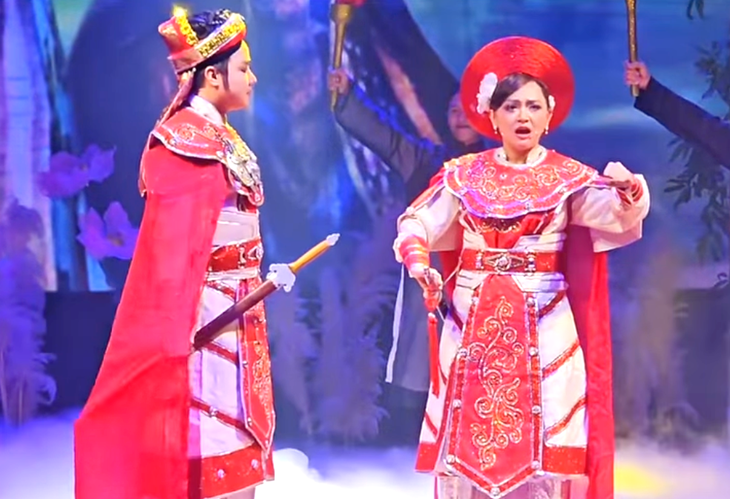
The sound of drums in Me Linh - Screenshot
From a naive performance
Recently, a video went viral online showing a young person, a descendant of a famous artistic family, attempting a classic excerpt from a traditional Vietnamese opera. The performance, though only a few minutes long, immediately sparked a frenzy of comments.
Experts and fans alike believe the performance was unsatisfactory. From the singing and pronunciation to the dance moves and expressions, everything revealed a lack of understanding of the character and the traditional style of cải lương (Vietnamese opera).
We cannot, in the name of encouraging young people, amateurize an art form that is built on a foundation of rigorous standards.
The public was even more hurt when they learned it was an unauthorized performance.
This information makes the already few opinions defending the young female artist even less convincing.
Young people need opportunities, but clearly not through scandal, with a shoddy performance that hasn't undergone proper rehearsal.
Based on this recent incident, one might also question whether the professional evaluation mechanism is sufficiently rigorous and provides adequate deterrent sanctions.
And what should the Cai Luong stage do today when faced with a shortage of new generation artists?
Professional ethics of artists
In today's art appreciation landscape, coupled with the development of cyberspace, a cultural triangular pattern of behavior has emerged. The three elements of artist, audience, and social media are simultaneously shaping how art is created, received, and disseminated.
First and foremost, there is the artist, the starting point of every artistic journey. Each role, each work, requires careful consideration of what character to choose, how to portray it, and how to engage with tradition.
Throughout theatrical history, there have been roles that transcended the boundaries of a typical role to become artistic pinnacles.
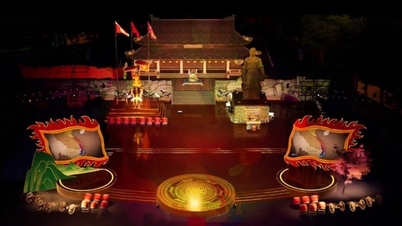
The role of Trưng Trắc in the play "The Drum of Mê Linh" was once associated with the name of the late artist Thanh Nga - a legendary icon of cải lương (Vietnamese traditional opera).
In Western theater, the role of Hamlet in William Shakespeare's play has long been a benchmark for an actor's skill. On Broadway, the role of Christine in The Phantom of the Opera demands an extremely rigorous combination of vocal technique and stage performance.
Such roles are not just part of the script, but also cultural icons for audiences across generations.
Therefore, when an artist, especially a young artist, embodies such roles, they are essentially entering into a dialogue with theatrical history. Their courage is commendable. However, artistic practice requires a long process of accumulation and diligent training; one must avoid rushing and skipping stages, as haste makes waste.
Most great artists start with small roles, learning the craft from acting classes before gradually rising to iconic roles. This means they receive thorough training in their craft and professional ethics in a professional environment before tackling the legacy of their predecessors. This reflects a serious attitude towards their profession, respect for the audience, and self-respect.
The public and network algorithms
From the audience's perspective, they are not just ticket buyers, but essentially the ultimate judging panel. Applause or silence, praise or discussion after the performance—all are feedback signals that help the stage adjust itself.
The history of world art is full of examples of strong audience reactions. Viewers have the right to comment on performances that are not up to par. In fact, such criticalness is a way of protecting aesthetic standards. The public's commentary shows that they are not indifferent or turning their backs on art, especially traditional art.
However, in the digital age, audience reactions have transcended the confines of the theater, spreading widely across the internet. Operating according to the logic of the attention-based economy model, social media creates algorithms that prioritize controversial and emotionally conflicting content, making it the focal point for the masses.
We've seen this happen in many cultural events. For example, incidents at major awards ceremonies like the Oscars or Grammys always attract public attention and discussion.
Social media, therefore, serves as both a powerful channel for disseminating art and a platform where audiences express their emotions, offer opinions, and quickly form waves of public discourse.
This explains why professional debates can easily escalate into heated arguments. It's not uncommon for inappropriate and extreme comments to appear due to anger and a lack of self-control. Many accounts engage in personal attacks, utter harsh words, and spiral into controversy.
Creating a healthy space for dialogue.
It's clear that if the three elements of artist, audience, and social media are out of balance, art can easily find itself in a difficult situation. Artists may lack sufficient professional experience but still rush into major roles.
Audience reactions are normal in art, but the online environment pushes emotions to extremes, blurring the line between criticism and personal attacks.
Ultimately, art always needs a space for healthy dialogue. Artists need to be serious about their craft. Audiences can express their opinions, but they also need to maintain composure and moderation.
Social media, if used wisely, can become a place to spread a love of art instead of fostering bitterness.
Only when the triangle of cultural behavior remains balanced can cultural life develop sustainably in the digital age.
Source: https://tuoitre.vn/ung-xu-van-hoa-voi-van-hoa-20260319094621017.htm

![[Photo] The General Secretary and the Prime Minister attend the groundbreaking ceremony for multiple-level boarding schools in border areas.](https://vphoto.vietnam.vn/thumb/1200x675/vietnam/resource/IMAGE/2026/03/19/1773888999705_vna-potal-tong-bi-thu-va-thu-tuong-du-le-khoi-cong-dong-tho-dong-loat-cac-truong-noi-tru-lien-cap-bien-gioi-8649904-3885-jpg.webp)
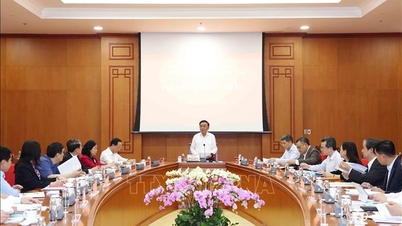
![[Photo] Tran Cam Tu, Standing Member of the Secretariat of the Central Committee, presides over the first meeting of the Central Steering Committee on the Development of Vietnamese Culture.](https://vphoto.vietnam.vn/thumb/1200x675/vietnam/resource/IMAGE/2026/03/19/1773895004549_ndo-br-bnd-1195-2-jpg.webp)
![[Photo] Tran Cam Tu, Standing Member of the Secretariat of the Central Committee, presides over the first meeting of the Central Steering Committee on the Development of Vietnamese Culture.](https://vphoto.vietnam.vn/thumb/402x226/vietnam/resource/IMAGE/2026/03/19/1773895004549_ndo-br-bnd-1195-2-jpg.webp)















































Comment (0)