


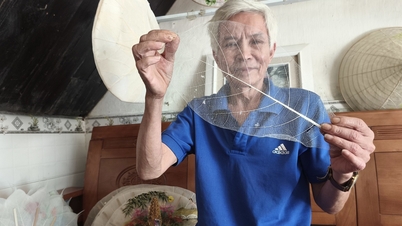
People in Son Dien commune process bamboo strips to supply to traders who buy them.
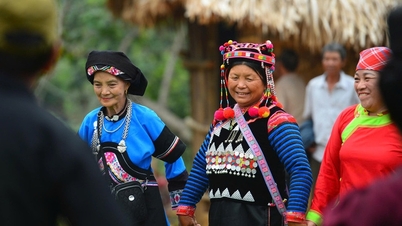
In Tam Lu commune, Mr. Vi Van Pien's family owns 4 hectares of forest, including 3 hectares planted with bamboo. Following the commune's policy on forest development linked to income improvement, Mr. Pien has taken the lead in planting new bamboo, protecting and restoring the area of regenerated bamboo. He said that planting bamboo requires patience and caring for the forest as you would a rice field; harvesting must be done at the right time to ensure good regeneration. In 2025, the price of bamboo is expected to reach nearly 300,000 VND per quintal. On average, each family member can produce about 1 quintal of bamboo strips per day, thus providing a more stable income than before.
In Na Meo commune, the story of livelihoods derived from bamboo and rattan is often mentioned by locals as one of the households with the largest bamboo forest area in the commune. With 35 hectares of degraded forest land, his family converted it to planting bamboo and rattan. Thanks to guidance from agricultural officials on planting, caring for, and pest control techniques, the forest is thriving. According to the family's calculations, after deducting expenses, they earn hundreds of millions of dong annually. Importantly, the forest is well cared for, the land is preserved, and the workers have local employment.
In Son Dien commune, the price of bamboo at the end of 2025 was purchased by traders at around 15,000 - 16,000 VND/kg. At times, the price reached 200,000 VND/quintal for bamboo and 280,000 VND/quintal for other types of bamboo. This price is much higher than in previous years, creating more motivation for forest growers to focus on caring for and harvesting in a sustainable manner.
Son Dien commune, formerly part of Quan Son district, boasts a large area of bamboo, reed, and rattan forests, approximately over 4,000 hectares. Bamboo, reed, and rattan are identified as key economic crops, contributing to poverty reduction in the area. Thanks to the forest economy, the commune's poverty rate has steadily decreased annually. According to the multidimensional poverty standard, in 2021, the poverty rate was 40.29%, projected to fall below 20% by the end of 2025. Pham Van Tinh, Chairman of the Son Dien Commune People's Committee, stated: “Developing key crops suitable to the soil and climate conditions is the right and effective approach. Therefore, the locality has focused on educating people to care for bamboo, reed, and rattan forests using proper techniques, harvesting according to the correct cycle, and linking reforestation with forest protection, thereby increasing income and achieving sustainable poverty reduction.”
From the practical experience in mountainous areas, it can be seen that "green gold" only truly realizes its value when there is close management and coordination. People need good seeds, proper cultivation techniques, convenient forestry roads, and a stable market. Local authorities need to plan raw material areas and guide rational harvesting to avoid premature cutting, selling at low prices, and deforestation.
Thanh Hoa province has the largest area of bamboo and rattan cultivation in the country, approximately 100,000 hectares, accounting for 50% of the province's total planted forest area. This area is concentrated in the Quan Son, Quan Hoa, Lang Chanh, and Ba Thuoc (formerly) regions. On average, it supplies about 60 million seedlings and 80,000 tons of raw materials annually for processing and export. Previously, about 55% of bamboo and rattan production was consumed through small-scale businesses within the province, mainly producing toothpicks, chopsticks, votive paper, or being sent for preliminary processing in other provinces, thus resulting in low added value.
In recent years, deep processing has been promoted. Currently, the province has about 60 enterprises and facilities processing bamboo. Each year, these facilities purchase approximately 30 million bamboo stalks from local people. Many facilities have invested in technology for cutting, splitting, shaping, pressing, steaming, drying, and treating against termites. Bamboo products have become more diverse, ranging from straws, knives and spoons, brushes, containers, decorative trays to tables, chairs, and furniture...
Furthermore, many bamboo and rattan products have entered international markets, especially Europe, Japan, and South Korea. For example, Vibabo Co., Ltd. has signed long-term contracts to supply bamboo straws, bamboo tableware, and pressed bamboo furniture to foreign partners, with orders for tens of millions of straws annually, generating revenue of approximately 4 billion VND per year. The company provides stable employment for 30 workers, with an income of about 8 million VND per person per month. This demonstrates that if quality is improved and products are standardized, bamboo and rattan products can go further.
In Linh Son commune, the bamboo and rattan product factory of Bamboo King Vina Joint Stock Company is built on an area of 15 hectares, of which 7.5 hectares is the production workshop. The factory focuses on building materials, laminated wood panels, interior and exterior furnishings, and household items such as trays and boxes. Its products are supplied to many major partners, including IKEA – the world's largest furniture retailer headquartered in Sweden. Currently, the factory employs approximately 250 workers and aims to recruit 1,500 when operating at full capacity. Along with the factory, the chain of activities involving planting, harvesting, and supplying raw materials will create many more indirect jobs in the local area and surrounding regions.
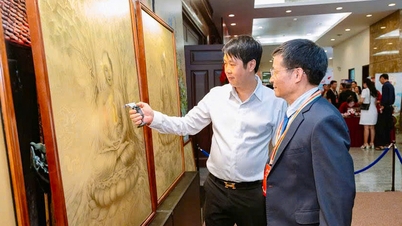
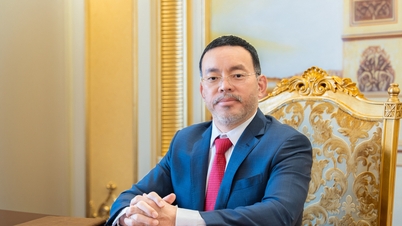
Mr. La Quan Hoang, Deputy General Director
Bamboo King Vina stated: “For the factory to operate stably, the raw material supply area must be sustainable. The company is coordinating with local authorities, cooperatives, and households to standardize the harvesting process, improve the quality of bamboo and rattan; and develop products according to market standards, ensuring traceability. When the output is stable, forest growers can invest with confidence, and the company can proactively plan production.”
Therefore, the "green gold" of Thanh Hoa's mountainous region lies not only in the forest area but also in the way the value chain is organized. From forest-planting households to processing businesses and consumption markets, everything must be interconnected. When forests are properly cared for and harvested according to schedule; when businesses invest in technology and provide stable purchasing agreements; and when localities effectively manage forest land and support linkages, bamboo will continue to be a source of wealth, while simultaneously preserving land, water, and ensuring sustainable livelihoods for the people.
Text and photos: Gia Bao
Source: https://baothanhhoa.vn/vang-xanh-o-mien-nui-xu-thanh-287385.htm































































Comment (0)