


The cotton tree is a key highlight in the Pồn Pôông festival of the Muong people in Sao Vang commune.
Ba Ngoc village in Sao Vang commune is home to the Muong ethnic minority. Mr. Luong Xuan Hong, one of those dedicated to preserving and promoting the cultural values of the Muong people, said: "Throughout their development on this land, the Muong people have created unique and diverse cultural values, from customs and traditions to festivals, folk songs, folk dances, and folk games... In recent years, these cultural values have also been performed by the people at festivals in many localities in the province, such as the Le Hoan Temple festival (Xuan Lap commune), the Lam Kinh festival (Lam Son commune)... Through this, they not only promote the heritage to a large number of tourists but also allow the heritage to increasingly contribute to daily life."
Here, the Pồn Pôông festival is usually held by the people at the beginning of the new year, during the rice planting season, the Thanh Minh festival, and the new rice harvest festival. In the festival, the dance and singing around the cotton tree is the central and most distinctive ritual. The dance and singing around the cotton tree are closely linked to the people's lives, such as clearing land for farming, building houses, planting cotton, weaving, and hunting wild animals. The Pồn Pôông festival is preserved and regularly organized not only to enhance the spiritual life of the Mường people and create faith and hope for a prosperous new year, but also to contribute to strengthening solidarity within the community.
“The intangible cultural heritage system does not exist independently but is created by humans. Rituals, festivals, customs, cuisine ... all originate from knowledge and skills preserved in people's memories. Therefore, only through regular practice and transmission can the heritage be preserved and its value promoted. That's why, in recent times, in addition to actively collecting intangible cultural values of the Muong people such as Xuong singing, gong playing, and social customs to teach to the younger generation, those knowledgeable about Muong cultural identity in the village have also strengthened the formation of performing arts groups that regularly and actively perform for the villagers. The village also actively promotes and encourages young people to participate in preserving and conserving the culture to avoid the risk of its disappearance,” Mr. Hong shared.
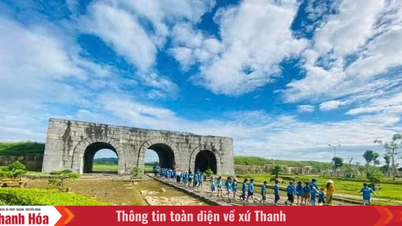
At the Ho Dynasty Citadel World Heritage site (Tay Do commune), thanks to the collective efforts of the community, the heritage site has not only been preserved intact from degradation but has also been infused with new life, becoming a popular tourist destination. Ms. Nguyen Thi Hoa, a resident living around the Ho Dynasty Citadel, shared: “For us, the Ho Dynasty Citadel and the surrounding heritage sites always play an important role in our lives. Therefore, each resident has a responsibility to preserve the environment, avoiding encroachment or littering around the site, and actively promote its value in daily life. In addition, regional art clubs such as the Lang Beo traditional opera and the Xuan Ang traditional opera actively practice and perform at the Ho Dynasty Citadel to further attract tourists.”
Affirming the central role of the community in preserving the Ho Dynasty Citadel heritage, Mr. Trinh Huu Anh, Deputy Director of the Management Board of the Ho Dynasty Citadel and key historical sites of the province, said: "The community plays a key role in the preservation and promotion of heritage values. Therefore, we have actively encouraged community participation from monitoring and preservation to tourism development; motivated and encouraged people to collect and donate collected artifacts to specialized agencies for management; proactively coordinated with schools to organize competitions to learn about heritage, experience citadel construction techniques, painting competitions, and 'I'm a tour guide' presentations... at the Ho Dynasty Citadel."
Thanh Hoa province is home to a rich and valuable system of historical sites, festivals, folk performances, and traditional art forms. Notably, thanks to the collective efforts of the community in preserving and promoting these values, many heritage sites have transcended local boundaries to become part of the common heritage of humanity, such as the Ho Dynasty Citadel; and special national monuments like Lam Kinh and the Ba Trieu Temple. Furthermore, these cultural heritage sites have become unique tourism products, attracting tourists to Thanh Hoa province and contributing positively to its socio-economic development.
Text and photos: Nguyen Dat
Source: https://baothanhhoa.vn/phat-huy-gia-tri-di-san-van-hoa-tu-cong-dong-288750.htm


![[Image] Hanoi's urban life under the challenge of a "scorching hot" environment](https://vphoto.vietnam.vn/thumb/1200x675/vietnam/resource/IMAGE/2026/05/25/1779706979265_nang-nong-t5-2026-minh-duy-7-4636-jpg.webp)

![[Image] Close-up view of the interchange connecting the two expressways and Long Thanh Airport.](https://vphoto.vietnam.vn/thumb/1200x675/vietnam/resource/IMAGE/2026/05/25/1779703378210_ndo_br_z7863716673926-224453a31600126cce10622af6290afd-4549-jpg.webp)



































































Comment (0)