

The message that "housing must serve the people, not be used for speculative profit," along with the requirement to strongly develop rental housing by 2030, is opening up a new direction for localities. For Phu Tho , this is not only a pressure to meet targets, but also a great opportunity to restructure urban space, attract labor, retain businesses, and create a foundation for sustainable development in the new phase.

The social housing project in the Nam Vinh Yen new urban area, once completed, will provide favorable conditions for workers and low-income individuals to settle down and build a stable life.
Following the merger, the population, industry, and urbanization of the newly formed Phu Tho province have increased significantly. This has led to a huge demand for housing for workers, low-income earners, young officials and employees, and the workforce migrating from rural to urban areas. This presents a significant opportunity for the systematic, long-term, and modern development of social housing.
According to Decision 444/QD-TTg of the Prime Minister , by 2030, Phu Tho province is tasked with completing approximately 64,400 social housing units. Specifically, during the 2021-2025 period, the province must complete 3,877 units. This figure demonstrates the enormous scale of the task, but also reflects the strong development potential of this sector in the locality.
Notably, unlike in the past when social housing was often viewed as a "mandatory social welfare" task, the development mindset has now changed significantly. Social housing is no longer a secondary segment, but has become an important component in urban development and local economic strategies.
In Phu Tho province, the reality shows that industrial development is creating a huge demand for housing. Industrial zones in Viet Tri, Phu Ha, Cam Khe, Tam Nong, Binh Xuyen, Khai Quang, and the former Hoa Binh area are attracting an increasing number of workers. However, many workers still have to rent makeshift accommodation in cramped conditions, lacking amenities and offering unstable long-term housing.
That is also why the new directive from General Secretary and President To Lam is considered a significant boost. With the Central Committee requiring localities to proactively prepare clean land funds, finalize planning, build long-term financial mechanisms, and strongly develop the rental housing market, Phu Tho has more basis to address many long-standing bottlenecks.
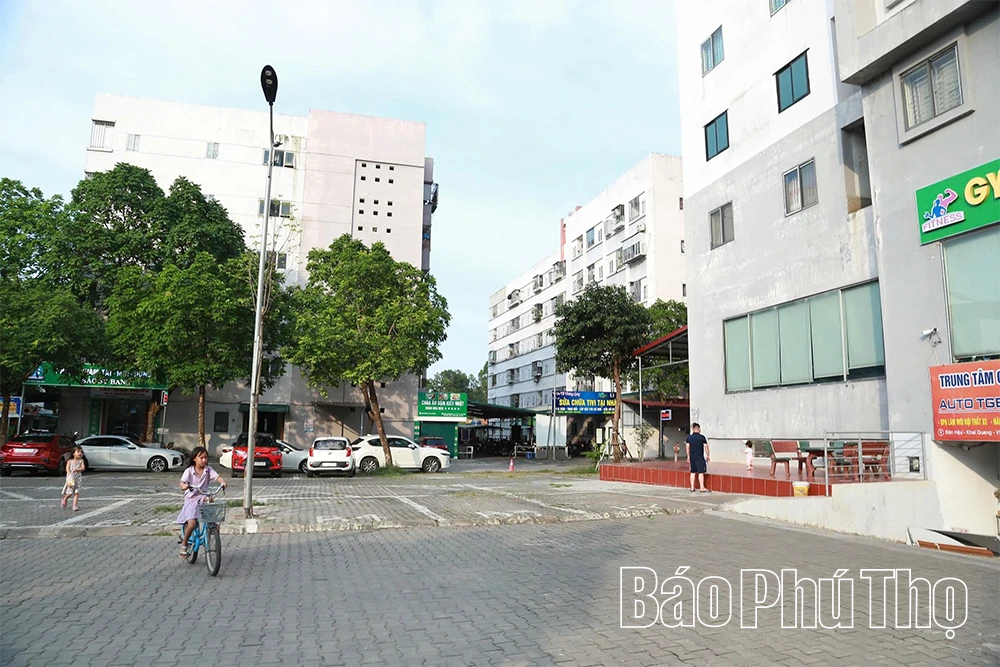
The housing complex for workers and low-income earners in Vinh Phuc ward plays a crucial role in addressing the housing needs of low-income workers in the area.
From a practical standpoint, Phu Tho has many advantages for developing social housing. Firstly, it has a relatively large amount of urban and industrial land compared to other localities. Secondly, its inter-regional transportation infrastructure is increasingly improving, especially after the expressways connecting Phu Tho with neighboring regions were upgraded. Thirdly, the province's land prices remain at a suitable level for developing affordable housing projects.
More importantly, after the merger, the province's economic development scale is much larger than before. As the rate of urbanization accelerates, the need for housing will become one of the decisive factors in attracting investment. A locality that wants to retain businesses cannot rely solely on industrial park infrastructure; it must also have accompanying social infrastructure, with housing being a core element.
It is no coincidence that in his recent concluding remarks, the General Secretary emphasized the need for housing development to be linked to urban development strategies, transportation, labor, and social security. This is particularly relevant to the current context of Phu Tho province, which is aiming to become a new growth pole in the Northern Midlands and Mountains region.
A very new point in this directive is the requirement to strongly develop rental housing. This can be seen as a promising direction for Phu Tho. In reality, most workers in industrial zones cannot afford to buy a house immediately, but the demand for long-term rental housing at reasonable prices is very high.
With the right mechanisms in place, Phu Tho province can absolutely develop modern, integrated social housing complexes for rent, located near industrial zones and with convenient transportation connections. In that case, social housing would not only address housing needs but also contribute to improving the quality of life, stabilizing the workforce, and enhancing competitiveness in attracting investment.
Of course, opportunities only truly become a reality when accompanied by a determination to act. For many years, the development of social housing has faced numerous difficulties such as lengthy procedures, low profits, a lack of clean land, difficulty accessing credit, and a mismatch between supply and demand.
Therefore, the General Secretary's demand to "not let the market self-regulate" is of great importance. The State needs to play a stronger facilitating role, from planning, land allocation, and credit mechanisms to controlling speculation and ensuring transparency in identifying beneficiaries.
For Phu Tho, this is the time to reconsider its housing development strategy towards a longer-term perspective. It's not just about building houses to meet targets, but about creating livable urban areas for workers. Instead of focusing solely on houses for sale, attention should be paid to rental housing, worker accommodation, youth worker dormitories, and affordable housing models.
Once workers have stable housing, businesses will feel secure in expanding production. When urban areas develop harmoniously, the quality of life improves, and the locality's attractiveness to investment also increases. Furthermore, this forms the foundation for Phu Tho's sustainable development in the process of industrialization and urbanization.
The central government's major policies have paved the way. The remaining issue is how localities will seize this opportunity. With significant potential for development, coupled with a determination to boost growth and improve social welfare, Phu Tho is facing a valuable opportunity to turn the dream of home ownership for tens of thousands of workers into reality.
Quang Nam
Source: https://baophutho.vn/mo-loi-an-cu-tu-chu-truong-lon-254655.htm













































































Comment (0)