.jpg)
T29 Hero
During the resistance war against the US, the B'Lao Town Party Committee (the area of present-day Bao Loc) was known by the code name T29. This area was part of the Southern Central Highlands under Military Region VI, and was a strategically important area of Lam Dong province.
According to the book "History of the Revolutionary Tradition of T29," during the period from 1963 to 1975, T29 had over 24,000 inhabitants and operated within 13 communes, 12 of which were located in enemy-controlled areas. At that time, the base of operations for T29 was Ta Ngao commune (now part of Bao Lam 3 commune).
At this time, the enemy had reinforced the 44th Regiment, coordinating with local forces and the 54th Regiment stationed in Di Linh, launching numerous large-scale sweeping operations. Implementing the resolutions of the Politburo and the Central Committee of the Party, the T29 armed forces, guided by the revolutionary principle of seizing power primarily through the political strength of the masses, combined with armed forces, attacking the enemy on both military and political fronts. From there, they organized, led, and directed the mass revolutionary movement and the struggle against the enemy, achieving partial victories.
Implementing this policy, the T29 revolutionary movement continuously achieved important victories. With the support of the armed forces of Lam Dong province and Battalion 186 of the VI Regional Party Committee, the army and people of T29 continuously attacked the enemy using a "two-legged, three-pronged" strategy throughout the area.
Through this, they contributed to the Southern revolution's complete defeat of the US-puppet regime's "Special War" strategy, creating new momentum and strength to further develop the revolutionary movement in the locality. From 1965 to 1968, the T29 armed forces continued to attack the enemy in several key areas, combined with the movement to build fighting villages and communes; at the same time, they intensified the guerrilla warfare movement in areas temporarily occupied by the enemy.
During the resistance war, the Party Committee of T29 directly led and directed the armed forces, working groups, and secret guerrillas to coordinate with the armed forces of Lam Dong province and the main forces of the Central Committee of the Southern Region to fight hundreds of battles against the enemy, eliminating thousands of enemy soldiers.
During the years 1974-1975, the Central Highlands were identified as a key area, and the southern Central Highlands - Lam Dong was a strategically important direction. The Regional Command assigned Lam Dong and the 7th Division the task of preparing the battlefield and mobilizing the masses to rise up and liberate the town of B'Lao.
.jpg)



Under the direction of the Provincial Party Committee and the Provincial Military Command, the forces of T29 participated in preparing the conditions and secretly guiding the "spearheads" of the 7th Division to attack along Highway 20 into B'Lao town. At 9:30 AM on March 28, 1975, our forces annihilated and dispersed all enemy forces in B'Lao town. This victory created the opportunity to liberate other areas in the Southern Central Highlands, paving the way for the liberation of the South and the reunification of the country.
Returning home to the call of comrades.
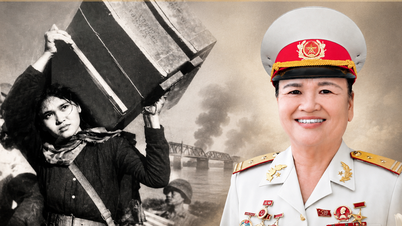
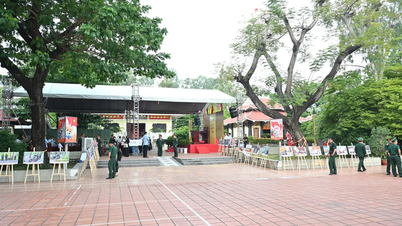
A light July rain cast a thin veil over the Bao Loc Martyrs' Cemetery. Before the long rows of white graves, veteran Luu Thi Thanh An – still affectionately known as Sau An by her former comrades – silently lit incense sticks. At 81, the former Secretary of the Bao Loc City Party Committee, former platoon deputy and squad leader of Squad 1 of the March 8th Women's Artillery Unit, her eyes still gazed intently at each unmarked tombstone.
Memories of days spent trekking through forests and wading through streams, of the painful bombings and shelling, flooded back, and veteran Sau An confided: “I have never forgotten the faces of the 53 women in my unit. Among them, 20 comrades were from the K'ho and Ma ethnic groups, mostly from the Bao Loc and Di Linh areas. They fought and perished. Some were found and called by name, some only returned to the collective call of 'comrades,' and some still lie beside the stream, under the trees.”
.jpg)
The first day of July also marks the time when the Provincial Steering Committee 515 begins collecting samples of remains of unidentified martyrs at the Bao Loc Martyrs' Cemetery. Lieutenant Colonel Tran Thanh Son, Deputy Head of Political Affairs, Provincial Military Command, and a member of the Provincial Steering Committee 515, is in charge of overseeing the sample collection at the central martyrs' cemeteries of the province, including Bao Loc Martyrs' Cemetery, Di Linh Martyrs' Cemetery, and Da Lat Martyrs' Cemetery. He stated that the forces will collect 102 samples of martyrs' remains at the Bao Loc Martyrs' Cemetery. With utmost effort, determination, and responsibility, they aim to complete the sample collection by July 7th.
Lieutenant Colonel Doan Hong Hai, Deputy Political Commissar of Defense Zone 1 – Duc Trong, Head of Sampling Team No. 1, Provincial Steering Committee 515, said: In this area, there are many graves with solid structures, so to ensure the safety of these graves...
Therefore, during excavation, specialized personnel must use specialized equipment, cut through barriers, and carefully remove layers of soil and sand to access the graves. Simultaneously, staff collect samples and digitize information, regularly updating detailed field data to ensure the accuracy and consistency of information for each grave.
The graves of martyrs at Bao Loc Martyrs' Cemetery mostly belong to soldiers who died in the resistance war against the US. Therefore, on the morning of July 1st alone, the forces collected 9 samples that met the requirements for DNA testing. "Each qualified sample is another chance to find the name of an unknown martyr," affirmed Lieutenant Colonel Doan Hong Hai.
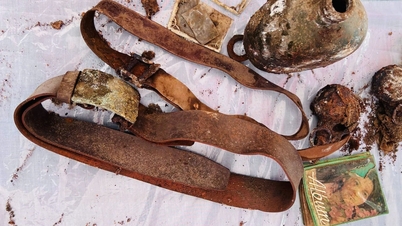
The early July rains came and went quickly. As soon as the rain stopped, the officers and soldiers hurried back to each grave. The sounds of concrete cutters and hammers echoed only briefly before giving way to silence. Upon reaching the layer of soil containing the remains, all operations were performed by hand. Small trowels and soft brushes were used to carefully remove each layer of fine soil.

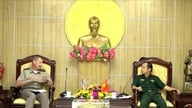
Officers and soldiers knelt beside the graves, gently lifting each bone fragment as if softly touching the sleeping figures. Each discovered remains was marked, its location recorded, the scene photographed, and carefully sealed. In the solemn atmosphere of the cemetery, each slow, tender movement was a silent tribute to those who perished on the T29 battlefield years ago.
.jpg)
The T29 unit of yesteryear embraced our brothers and sisters. And amidst the Bảo Lộc landscape today, their names are being sought out again. The first rains of July still fall silently on the cemetery, where each grave holds an unfinished story. Beneath each carefully excavated layer of earth, in each preserved remains meticulously kept for DNA testing, lies not only the aspiration to identify a fallen soldier, but also the journey of reconnecting families after more than half a century of separation. This is also how today's generation continues the promise to those who have fallen: to ensure that no sacrifice is forgotten, and that no soldier remains forever anonymous.
Witnessing the officers, soldiers, and other forces carrying out their duties, veteran Nguyen Thi Tuyet Hong was deeply moved, her eyes welling up with tears: “Even though time has passed, the Party, the State, the army, and the local authorities remain responsible for searching for and gathering fallen soldiers to reunite them with their comrades and families. This warms the hearts of veterans like us, further strengthening our belief and pride in the nation's tradition of 'drinking water, remembering the source'.”
Source: https://baolamdong.vn/ve-tim-lai-dong-doi-o-t29-451633.html