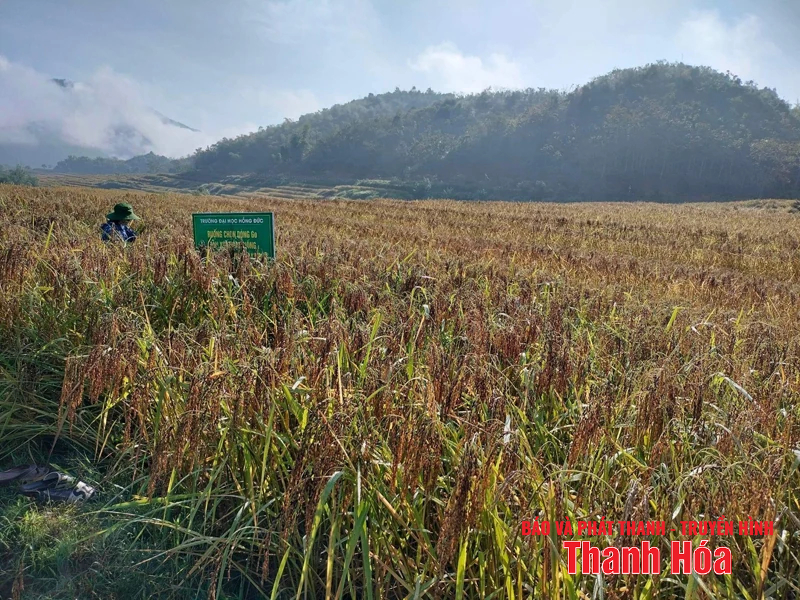
The Cay Noi sticky rice field in Sang village, Quang Chieu commune.
Unlike other rice varieties that can be grown twice a year, Cay Noi glutinous rice can only be cultivated once a year. At this time, the people of Quang Chieu commune are busily entering the planting season for Cay Noi glutinous rice. The atmosphere is lively and bustling, filled with cheerful laughter in the fields.
The Cay Noi glutinous rice variety, originally from Laos, has been cultivated in the western border communes of the province for many years. This variety is very selective about soil conditions; it cannot be grown just anywhere. It requires high-lying land rich in potassium and a reliable water supply to ensure optimal growth and development. Initially, the local people only grew this rice for daily consumption or for making cakes during festivals and holidays, so the entire Quang Chieu commune only had a few dozen hectares, with an average yield of 35-40 quintals/hectare. Recognizing that the Cay Noi glutinous rice variety was well-suited to the local soil and produced high-quality rice, the people expanded the cultivation area to sell it commercially. Currently, Quang Chieu commune has 400 hectares of agricultural land, of which more than 300 hectares are planted with Cay Noi glutinous rice.
The reason why Cay Noi rice grown in Quang Chieu is tastier is because the area has different soil and climate conditions compared to other regions. The abundant sunshine allows for good photosynthesis in the rice plants, and the average annual temperature fluctuates between 28 and 30 degrees Celsius. The temperature difference between day and night is relatively large, preventing energy loss and ensuring the rice grains are continuously supplied with nutrients. Through long-term settlement, the Thai ethnic people of Quang Chieu commune have developed a valuable system of indigenous knowledge in rice production, combined with a strong awareness of protecting rare seed sources, water resources, and the environment for sustainable agricultural development. Besides the long-standing techniques of planting and caring for the crop, the local people have also learned to apply scientific and technological advancements in rice production.
Since Cay Noi rice became a popular agricultural commodity, the lives of the people in Quang Chieu commune have gradually improved. The harvested produce is sold as soon as it's harvested; in fact, many traders even have to come directly to the fields to place deposits before they can buy the rice. Discerning customers also drive their cars to the fields to inquire about purchasing, making the harvest season in Quang Chieu even more bustling.
Growing up surrounded by the aroma of sticky rice, and with a desire for the "precious grains" of her homeland to have a place in the market, Ms. Luong Thi Nong established the Chung Thanh Agricultural and Forestry Cooperative. The cooperative links with 31 households in the commune to produce Cay Noi rice under the OCOP program. These households receive technical support, fertilizer, and assistance in selling their products at stable prices. This provides the conditions for farmers to confidently develop this specialty rice variety, increase its value, expand their market, and gradually eliminate the problem of "bumper harvests leading to low prices."
On average, the Chung Thanh Agricultural and Forestry Cooperative harvests about 100 tons of Cay Noi glutinous rice per season, equivalent to a finished rice product value of 700-800 million VND per season. Even though farmers don't sell their rice directly to the Chung Thanh Agricultural and Forestry Cooperative, the selling price of Cay Noi glutinous rice is significantly higher. Specifically, during the peak season, Cay Noi glutinous rice sells for 30,000-40,000 VND/kg. Calculations show that with relatively stable prices over the past period, rice farmers can earn a profit of 3-3.5 million VND/sao/season, equivalent to 70 million VND/ha/season, significantly higher than other local crops. "Thanks to its good quality and support in finding markets, Cay Noi sticky rice is sold out as soon as it's produced. The main markets are within the province and major distributors in Hanoi and Ninh Binh province," shared Ms. Luong Thi Nong, director of Chung Thanh Agricultural and Forestry Cooperative.
With the guidance and support of the local Party committee and government, we are confident that Cay Noi sticky rice – a unique agricultural product of Quang Chieu commune – will quickly gain acceptance among domestic consumers. This will bring high income to the people, contributing positively to socio-economic development and poverty reduction efforts in this border commune.
Text and photos: Tang Thuy
Source: https://baothanhhoa.vn/ve-vung-lua-nep-cay-noi-254679.htm












































































Comment (0)