

The lifespan of a worker bee is only about 27 to 30 days. During peak season, the bees spend their days collecting honey, and at night they have to constantly fan their wings to process the honey. The harder they work, the shorter their lifespan.
In rubber plantations, bees collect nectar from rubber tree leaves (not flowers). For bees, pollen is like fish, and honey is like food. Without pollen, without anything to eat, the bees will die. Beekeepers who want their bees to be healthy enough to collect nectar for a long time and to reproduce and thrive must feed them; the food consists of stored pollen, ground soybean meal mixed with sugar or honey.
Khoa, Mr. Toan's son, takes care of bees in the Ea So forest. |

Bees are also susceptible to diseases like mites and lice. These pests suck blood, causing bees to become disabled, lose wings, become lame, or have amputated limbs. Sudden changes in weather from hot to cold can easily lead to bees contracting pneumonia, paralysis, and diarrhea. Bees with diarrhea will leave yellowish streaks with a sour, foul odor on furniture and hive roofs. Bees with pneumonia and paralysis often exhibit similar symptoms: trembling, inability to walk, and dying upon reaching the hive entrance. Beekeepers usually treat bees with antibiotics. However, in the export of honey products, foreign partners now prohibit the use of antibiotics during the honey-making process. Bees treated with antibiotics, even their wax, are unsaleable. Therefore, beekeepers only have the option of preventing bee diseases: during cold weather, move the bees to warmer climates; if relocation is not possible, they must use tarpaulins to cover and protect the bees, and concentrate the colonies to create a large, warm environment for the bees to huddle together. Combine feeding them plenty of nutritious pollen, bean meal, and specialized vitamins to help the bees increase their resistance. If you notice the bees suffering from stomach pain or diarrhea, you can grind ginger, extract the juice, mix it with honey, and give it to the bees to drink.
Besides disease threats, bees also face many other enemies. These include the seasonal bluebird, a predator that can devour an entire colony in a few days. Beekeepers must also watch out for hornets and wasps that eat the larvae and queen. A single wasp at the entrance of a hive can decapitate any bee flying in or out. Ladybugs, mirror ants, caterpillars, and wax bugs are also natural enemies of bees. These insects eat the larvae and destroy honeycombs, pollen frames, and young bees if not detected in time.
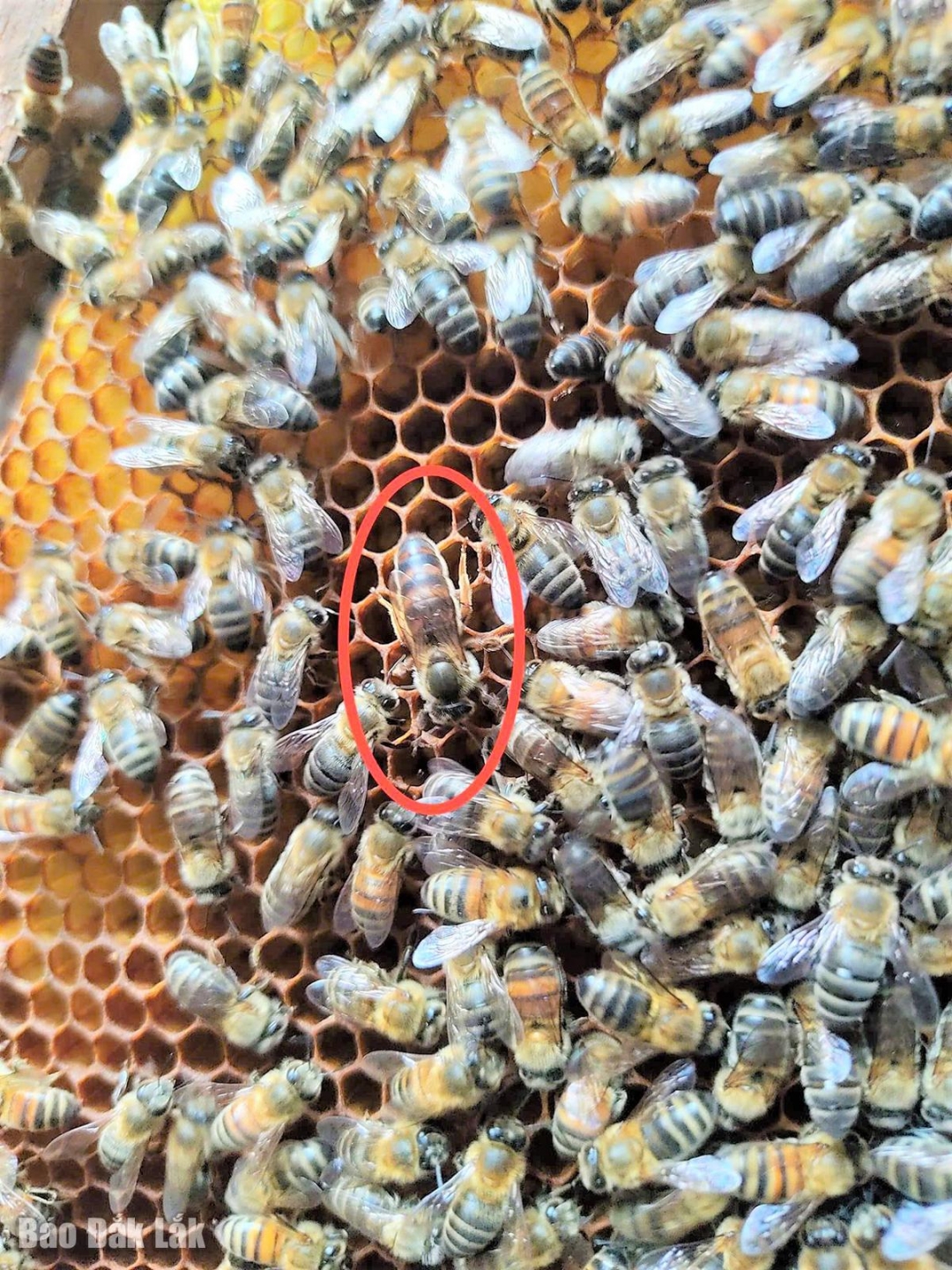
Queen. |
However, for beekeepers, the greatest danger is still the theft of honey and bees. Just a moment of carelessness and the entire hive or bee colony is lost. Beehives now always have interlocking chains and increased manpower to prevent theft.
Some time ago, someone from Greece approached Mr. Toan's family and invited them to visit their country to learn about bee swarming techniques. Their purpose was to learn about preventing bee swarms from "flying away"! Mr. Toan explained: "In a colony, there's usually only one queen. But somehow, under the queen's guidance, the worker bees will create queen cells for the queen to lay her larvae in. A few queens, once fully grown, will breed their own colonies until, at some point, they naturally separate from the main colony and fly away, forming their own. These queens fly away, taking a large number of worker bees with them. To avoid losses, beekeepers must find ways to keep these queens."
Supplementing the bees' food reserves with pollen helps increase their productivity. |

It has been learned that beekeepers in European countries use stacked hives (two hives stacked on top of each other). In Vietnam, due to the need for frequent relocation, beekeepers use single, compact hives that are easy to transport. With stacked hives, when harvesting honey, beekeepers only extract the honey from the upper layer, without touching the lower hives. Beekeepers rarely check the hives, so queen cells are often "blown away." "I just instruct them to regularly check and detect early signs of queen cell separation, or proactively separate the queen into a new colony under their control. Many queens split within 5 frames, and we have to eliminate those queens. In my colonies, many queens are very old but still don't produce new queens; that's because of our selection and breeding," Mr. Toan explained.
There are two types of queen bees: those that swarm and those that don't. Beekeepers will remove the non-swarming queens or create queen cells because if left for too long, they will "fly away." "These are experiences that even European beekeepers have to learn from us. If the bees just fly up into the trees during the honey season, the beekeeper will go bankrupt," Mr. Toan joked.
With extensive beekeeping experience, Mr. Toan's family bee farm can create its own queen bees to separate and multiply colonies. When the hives are full, or when preparing to move the bees to distant locations to find nectar sources, the beekeeper must create new queens and colonies. This ensures that when a large number of mature bees are sent to collect honey in distant provinces, there are still new colonies to support them at home. Mr. Toan's family has created queens that are prolific, lay eggs vigorously, and are resistant to disease, while still ensuring abundant pollen and honey production by pairing high-performing honey-producing male bees with healthy, pollen-collecting queens.
Source: https://baodaklak.vn/phong-su-ky-su/202506/vi-dang-cua-mat-ong-ky-cuoi-9770256/
![[Photo] Prime Minister Pham Minh Chinh receives the Chinese Ambassador to Vietnam](https://vphoto.vietnam.vn/thumb/1200x675/vietnam/resource/IMAGE/2026/04/05/1775397481797_ndo_br_dsc-5512-jpg.webp)















































































Comment (0)