

 |
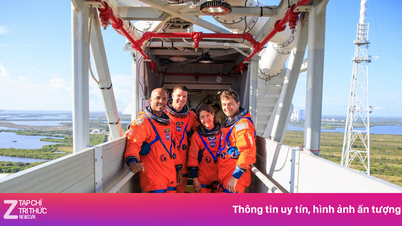
The crew, in order: Victor Glover, Reid Wiseman, Christina Koch from NASA, and Jeremy Hansen from the Canadian Space Agency (CSA). Photo: Reuters . |
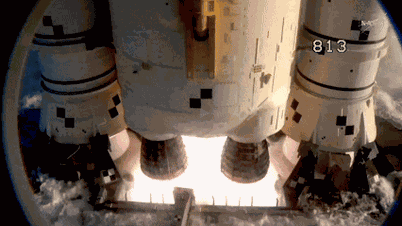
At approximately 5:35 AM on April 2nd ( Hanoi time), the SLS rocket system was officially activated and lifted off from launch pad 39B at the Kennedy Space Center in Florida, USA. This marks a significant step in the campaign to return to the Moon with the Artemis II launch, bringing humans closer to orbit and the far side of the satellite.
The Artemis II mission was the first crewed flight in NASA's Artemis program, intended to take four astronauts on a journey around the Moon. In the crew photos from the Canadian Space Agency (CSA), the first impression for many is their bright orange suits.
This color is officially called International Orange – the same shade as the anti-fog coating on the Golden Gate Bridge in the United States.
Its core mission is to create absolute optical contrast. In the vast, dark ocean, this reflective orange color helps rescue forces easily locate the astronauts in a flash as the capsule lands.
In addition to its optical function, according to NASA, the orange suit worn by the astronauts on this mission is also known as the Orion Crew Survival System (OCSS).
This spacesuit is designed to fit each astronaut perfectly and is equipped with technological features to protect astronauts on launch day, in emergency situations, during high-risk missions near the Moon, and to assist in the high-speed return to Earth.
Furthermore, according to NASA, if the Orion spacecraft's capsule were suddenly punctured by a micrometeorite and completely lost pressure in deep space, the OCSS suit would immediately inflate into a personal survival capsule.
It possesses an independent oxygen supply, temperature control, and pressurization system, capable of sustaining astronauts' lives for six consecutive days in a vacuum until the spacecraft ejects back to Earth.
Four astronauts—Reid Wiseman, Victor Glover, Christina Koch, and Jeremy Hansen—will orbit the Moon. Their mission is a preparatory one, paving the way for a future official landing. This group will become the furthest humans have ever ventured into space, as the Orion spacecraft's orbit approaches the far side of the Moon.
The mission, named Artemis II, is considered the 21st-century version of Apollo 8. The flight aims to test whether the spacecraft can safely sustain a crew for 10 consecutive days. The trip is scheduled to end on April 10th when the spacecraft lands in the Pacific Ocean .
Source: https://znews.vn/vi-sao-phi-hanh-gia-artemis-ii-mac-do-cam-post1640130.html









































































![[Photo gallery] Nhon Trach is ready to transform into a modern and civilized city.](https://vphoto.vietnam.vn/thumb/402x226/vietnam/resource/IMAGE/2026/04/02/1775104005524_hinh_1_20260402085339.jpeg)

![[Photo gallery] Dong Phu aims for modern and sustainable urban development.](https://vphoto.vietnam.vn/thumb/402x226/vietnam/resource/IMAGE/2026/04/02/1775104023925_111_20260402104322.jpeg)














Comment (0)