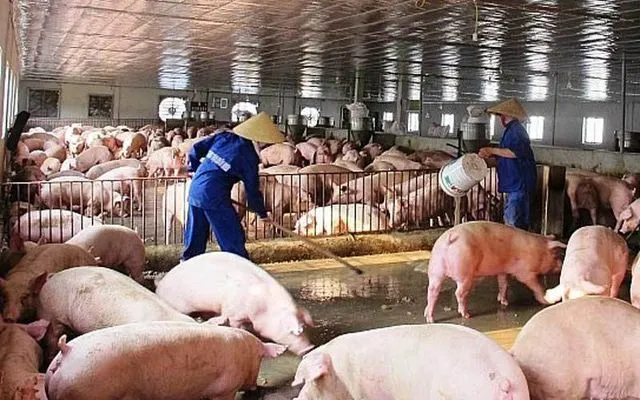
Pork prices across the country continue to rise rapidly due to the fact that domestic supply has not yet fully recovered.
In 2025, Vietnam spent nearly $2 billion importing meat and animal by-products. While these imports were intended to supplement domestic supply, the domestic pork market still witnessed a rapid increase in live pig prices, which remained high as consumer demand for the Lunar New Year approached.
Live pig prices continue to rise across all three regions, increasing by 2,000 VND/kg. In the North, live pig prices currently range from 78,000 to 81,000 VND/kg, the highest level since the beginning of the year. In the Central and Central Highlands regions, the live pig market also recorded a fairly uniform upward trend, reaching 75,000 - 79,000 VND/kg. In the South, live pig prices currently fluctuate between 75,000 and 78,000 VND/kg.
According to the Ministry of Agriculture and Environment , in 2025, Vietnam's import value of meat, meat products, and edible by-products from slaughterhouses is estimated to reach approximately US$2 billion, an increase of nearly 12% compared to the previous year. However, despite the large volume of imported meat, domestic pork prices have continued to escalate significantly since the end of last year. In just one month, prices in many localities have increased by 10,000 - 14,000 VND/kg.
Mr. Nguyen Van Trong, Vice Chairman of the Vietnam Association of Farms and Agricultural Enterprises, said: "Imports have been ongoing for many years and will not significantly affect domestic production in 2025. This year, we may import over 300,000 tons of pork, about 300,000 tons of poultry, and over 200,000 tons of grass-fed livestock. These figures only account for 10% of the total domestic meat production, so domestic production remains the majority."
"Vietnamese people's consumption habits are also different. We mainly consume fresh meat. Especially at the end of the year, Vietnamese people use pork to make products for Tet (Lunar New Year). For example, in sausage making, using fresh meat is better, so domestically produced meat remains important to consumers," said Mr. Pham Kim Dang, Deputy Director of the Department of Animal Husbandry and Veterinary Medicine, Ministry of Agriculture and Environment.
According to the Department of Animal Husbandry and Veterinary Medicine, the main reason for the increase in pork prices is the fact that domestic supply has not fully recovered. Last year, nearly 1.5 million pigs had to be culled due to African swine fever. In many central provinces, restocking is slow due to the prolonged impact of floods and heavy rains, which have reduced the scale of livestock farming. Farmers are now making high profits, so they will have the motivation to restock.
Source: https://vtv.vn/viet-nam-chi-gan-2-ty-usd-nhap-khau-thit-100260128090815738.htm











































































































Comment (0)