

 |
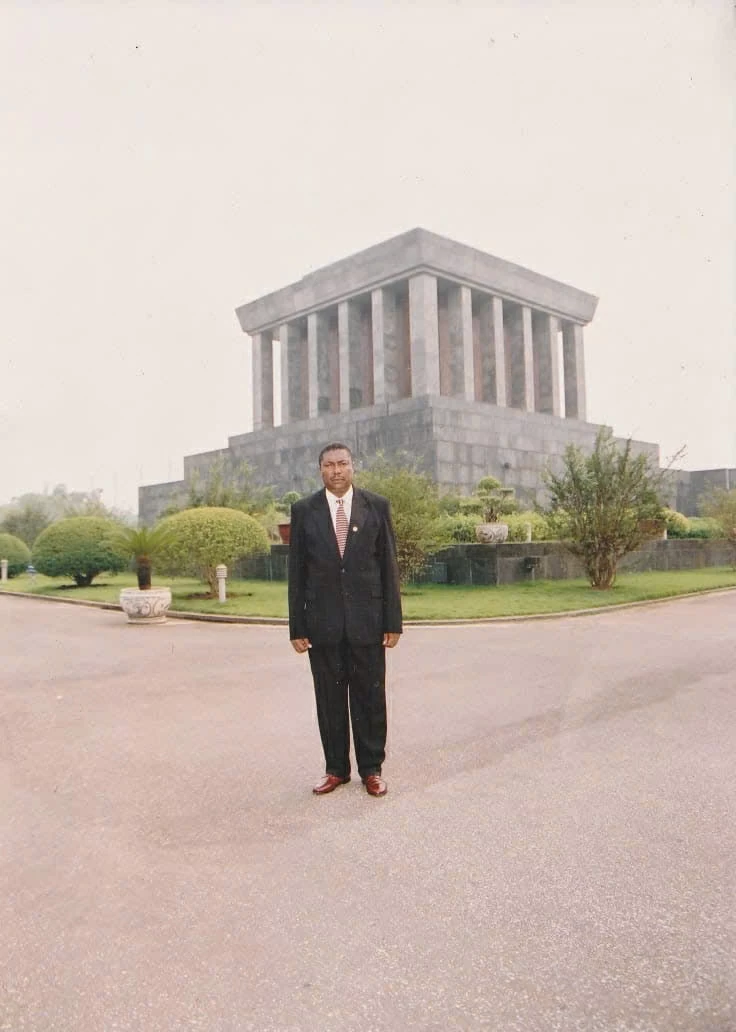
| Mr. Jesús Aise Sotolongo poses for a commemorative photo in front of the Ho Chi Minh Mausoleum. (Photo: Provided by the interviewee) |
Like all Cubans, I was raised in solidarity with the Vietnamese people's struggle and in respect for their glorious achievements in the historic war of liberation and reunification of the country.
Fidel's immortal words, "For Vietnam, we are ready to shed even our own blood…" have been deeply etched in our hearts, as well as in the hearts of all Vietnamese people.
Vietnamese Inspiration
Vietnam is a shining example of a nation ready to shed sweat and blood to win freedom and independence, and has risen from the ashes and ruins left by a brutal war. Vietnam is a source of inspiration that helps us continue to protect and develop our revolutionary path.
Having had the privilege of visiting Vietnam many times and traveling to most parts of the country has helped me better understand the economic development process during the Doi Moi (Renovation) period. I have witnessed firsthand, under the leadership of the Communist Party of Vietnam , the boldness, intelligence, and creativity of the people being strongly promoted to lead the country on the path of socio-economic development and regional and international integration.
The detailed information provided by Party and State leaders, officials, and experts has greatly contributed to my professional development. I received profound and comprehensive explanations of the concepts of Renovation, the nature of the socialist-oriented market economy , the transformation of ownership and management in agriculture and industry, the implementation of proactive monetary and fiscal policies, opening up international trade, attracting foreign investment, signing bilateral and multilateral economic agreements, and many other proactive policies. At the same time, they also shared valuable experiences regarding both successes and limitations in the economic transformation process.
My understanding of the Doi Moi (Renovation) period was further enriched by visits to historical sites – places where Vietnamese troops deployed bold and ingenious military strategies, combined with the courage of soldiers and guerrillas, which, despite limited technology, still caused the war machines of France and America to taste defeat.
At the same time, I also had the opportunity to experience the rich culture of Vietnam, from ancestral traditions and diverse art forms to distinctive cuisine, all blending together to create a captivating Vietnamese cultural identity.
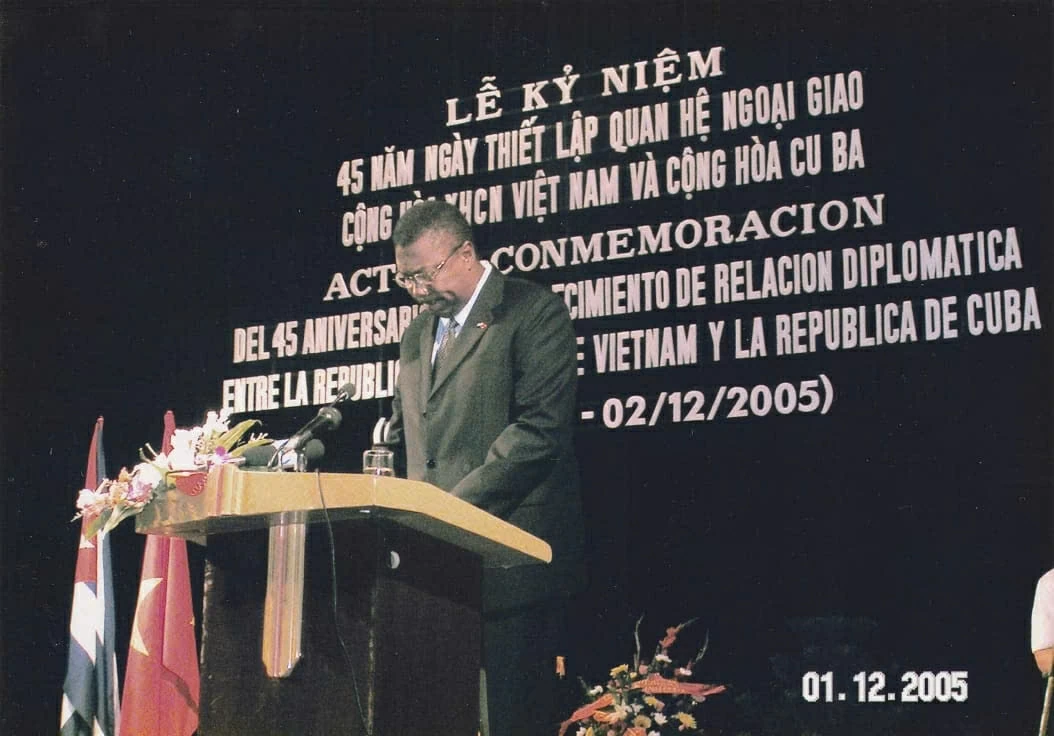 |
| Mr. Jesús Aise Sotolongo speaks at the ceremony commemorating the 45th anniversary of the establishment of diplomatic relations between Vietnam and Cuba (1960-2005). (Photo: Provided by the interviewee) |
Close comradeship
My four years as the Cuban Ambassador to Vietnam were a time of intense work, but it was the friendship, solidarity, cooperation, and selfless support of the Vietnamese Party, State, and people that helped me successfully complete my nhiệm vụ. With genuine affection, the leaders and senior officials directly provided me with invaluable assistance to ensure the smooth operation of the Cuban State Mission in Vietnam. An atmosphere of political trust, mutual understanding, and close comradeship was formed. I was affectionately called "Comrade Ambassador."
Events taking place in Cuba always receive special attention from the Vietnamese press. There is no major Cuban holiday that Vietnam does not celebrate as if it were its own, and Cubans are always invited to attend and hold a place of honor in all events.
However, what moved me most was the opportunity to be close to the Vietnamese people. It was touching to see that everywhere—in cities, villages, factories, farms, schools—people, men, women, the elderly, and children alike, spoke of Cuba, Fidel, and José Martí with sincerity and pride. The hospitality and friendly, discreet yet warm smiles of the Vietnamese people made every aspect of our journey memorable.
Cuba and Vietnam share a special, traditional, and strategic friendship. This relationship is forged from similarities in their history of national liberation struggles, anti-imperialist sentiments, shared ideological foundations, and socialist orientations in the development of both countries. These factors have fostered a determination to continuously strengthen and develop the close and loyal relationship between the two Parties, two States, and two peoples, as clearly demonstrated in all bilateral cooperation activities.
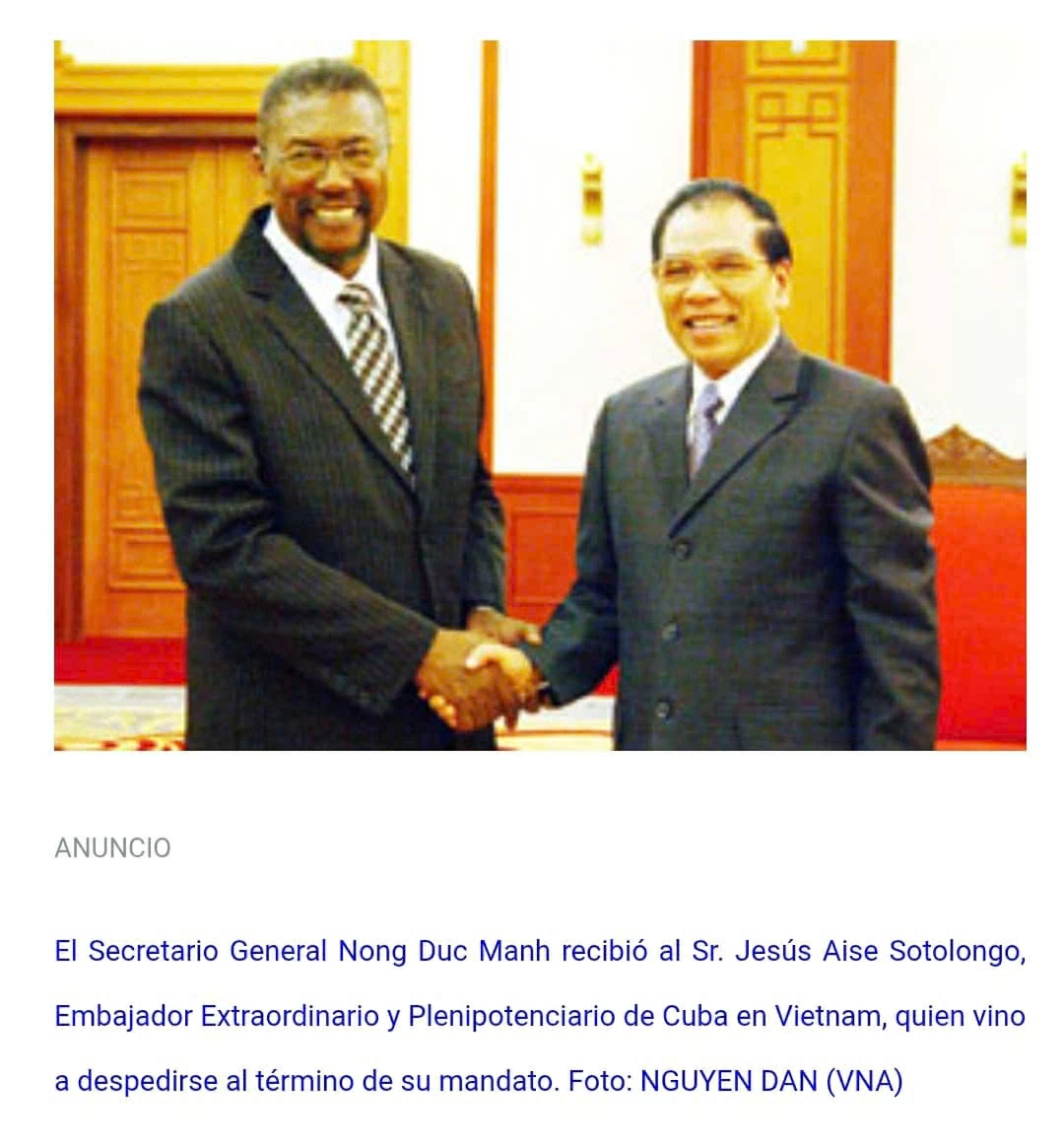 |
| Former General Secretary Nong Duc Manh receives Mr. Jesus Aise Sotolongo for a farewell visit at the end of his term of service in Vietnam. (Source: VNA) |
Entering a new phase
The Joint Statements issued during the visits of General Secretary and President To Lam to Havana, and First Secretary and President Miguel Díaz-Canel Bermúdez to Hanoi in September 2024 and 2025, are vivid evidence of the strengthening of relations between the two countries, clearly demonstrating the will of both sides to promote extensive cooperation in key areas such as agriculture, food processing, pharmaceuticals, biotechnology, health, energy, telecommunications, tourism, construction, transportation, high technology, digital transformation, and many other fields. Both sides also intensified exchanges of high-level delegations from the Party, Government, defense, security, Parliament, and Ministry of Foreign Affairs.
Having withstood the test of time and overcome the particular difficulties and risks in a complex international context, the relationship between Cuba and Vietnam is entering a new phase, linked to modern bilateral cooperation concepts and innovative cooperation models.
Numerous cooperation agreements are being implemented, bringing tangible benefits to Cuba amidst the country's continued struggles due to the tightening economic, trade, and financial embargo imposed by the United States government.
During the "Cuba-Vietnam Friendship Year," and in the future, it is essential to continue to maximize the advantages from the current positive development phase in bilateral relations, aiming to elevate economic cooperation to the same level as political relations, promote diversification and expansion of cooperation, achieve mutual complementarity between sectors and businesses, and ensure effective cooperation and the sharing of experiences in a comprehensive and sustainable manner.
Dr. Jesús Aise Sotolongo is a Doctor of Economic Sciences, researcher, and professor at the Cuban Center for International Policy Research. From 1993 to 2003, he undertook numerous research visits on the economic components of the Doi Moi (Renovation) period, and from 2004 to 2008, he served as the Cuban Ambassador to Vietnam.
Source: https://baoquocte.vn/viet-nam-trong-toi-la-355857.html
![[Photo] National Assembly Chairman Tran Thanh Man arrives in Türkiye to attend IPU-152](https://vphoto.vietnam.vn/thumb/1200x675/vietnam/resource/IMAGE/2026/04/15/1776261003665_tnk10-jpg.webp)
![[Photo] My Son at night: A thousand-year-old heritage site amidst the Milky Way](https://vphoto.vietnam.vn/thumb/1200x675/vietnam/resource/IMAGE/2026/04/15/1776261039184_ndo_br_chon6-jpg.webp)
![[Photo] The General Secretary, President and his wife meet with Vietnamese-Chinese friendship leaders.](https://vphoto.vietnam.vn/thumb/1200x675/vietnam/resource/IMAGE/2026/04/15/1776264829725_vna-potal-tong-bi-thu-chu-tich-nuoc-to-lam-gap-mat-nhan-sy-huu-nghi-viet-nam-trung-quoc-8703641-3130-jpg.webp)
![[Photo] National Assembly Chairman Tran Thanh Man attends the opening session of IPU-152](https://vphoto.vietnam.vn/thumb/1200x675/vietnam/resource/IMAGE/2026/04/16/1776277863731_ctqh5-jpg.webp)
![[Photo] Mrs. Ngo Phuong Ly meets and exchanges views with Mrs. Peng Li Yuan](https://vphoto.vietnam.vn/thumb/1200x675/vietnam/resource/IMAGE/2026/04/16/1776277858080_phu-nhan-1-jpg.webp)



































Comment (0)