|
Investors rushed to sell off shares on a large scale. Photo: Phuong Lam |
The Vietnamese stock market experienced one of its sharpest declines since the beginning of the year as selling pressure intensified across the board on June 8th. Concerns about international geopolitical developments, particularly escalating tensions in the Middle East, negatively impacted investor sentiment, driving capital into a cautious state and triggering selling activity across many stock groups.
From the opening minutes, the VN-Index plunged into the red, falling by more than 20 points. However, selling pressure not only failed to subside but intensified sharply towards the end of the session. Bottom-buying demand proved weak in the face of widespread selling, causing the decline to widen continuously.
Notably, the decline was not limited to speculative stocks but spread to large-cap companies, which typically support the index. Even stocks within the Vingroup ecosystem – which have repeatedly served as a pillar of support for the market during recent corrections – were not immune to strong selling pressure.
The simultaneous weakening of key stocks caused the VN-Index to lose almost all its support, closing at its lowest point of the day.
At the close of trading, the VN-Index fell 48.37 points (-2.6%) to 1,790.53 points. In contrast to the HoSE, the HNX-Index rose 4.57 points (+1.6%) to 298.36 points, while the UPCoM-Index fell 0.36 points (-0.3%) to 124.73 points.
Market liquidity surged to approximately 20,300 billion VND , significantly higher than in recent sessions. This development indicates that sellers are actively offloading their holdings, while demand is not yet strong enough to balance supply and demand.


The electronic board was dominated by red, with 509 stocks declining (including 10 that hit the floor price), 837 stocks remaining unchanged, and 208 stocks rising (including 29 that hit the ceiling price).
The selling pressure continued to be concentrated in the large-cap group. The VN30 basket recorded 27 declining stocks, with only 2 rising and STB maintaining its reference price. As a result, the VN30 index fell nearly 50 points to 1,936 points.
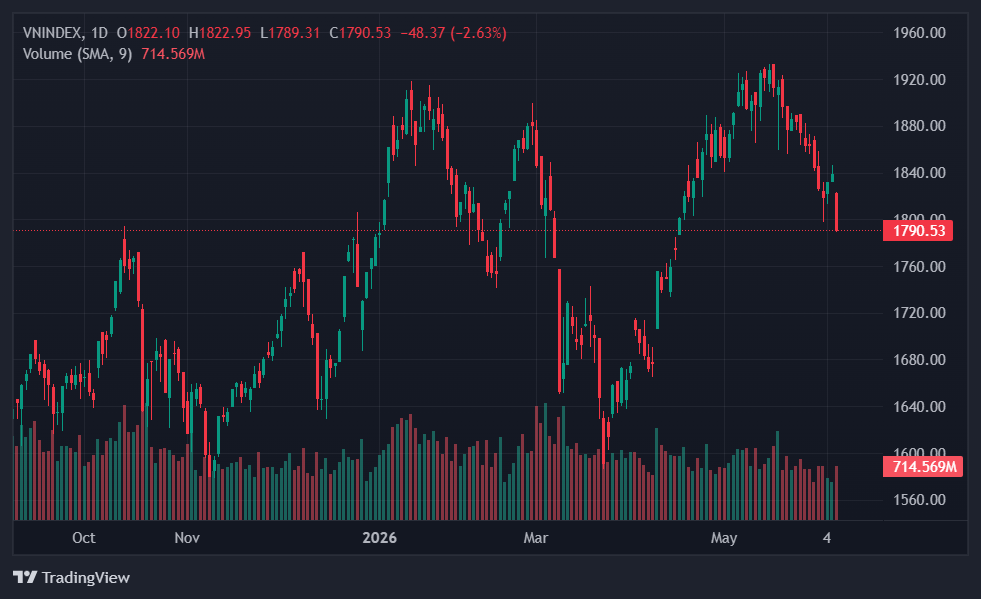 |
The VN-Index fell nearly 50 points at the beginning of the week. Photo: TradingView. |
Among the stocks with the most negative impact on the market, VIC fell 5.8%, becoming the stock that deducted the most points from the VN-Index. Following closely behind were VHM (-3.5%), BID (-2.4%), VPB (-3.2%), TCB (-2.7%), GVR (-3.7%), CTG (-1.9%),ACB (-3.4%), VJC (-4.2%), and VPL (-2.3%).
Conversely, some stocks maintained their upward momentum, such as LPB (+1.4%), VCK (+1.1%), NVL (+2.2%), BSR (+0.4%), HCM (+1.3%), KDH (+1.3%), CII (+2.2%), EVF (+2.3%), PC1 (+2.1%), and HQC, which hit the ceiling price. However, due to their insufficient market capitalization, these stocks only contributed minimally to narrowing the market's decline.
Foreign investor activity also became a negative point, as foreign investors returned to net selling of nearly 700 billion VND after several previous positive trading sessions.
Selling pressure was mainly concentrated in FPT ( -121 billion VND ), VHM ( -113 billion VND ), and MSN ( -93 billion VND ). On the buying side, foreign capital continued to show interest in the banking sector, with strong disbursements into VCB (net purchase value of 98 billion VND), ACB (+97 billion VND ), and STB (+42 billion VND ).



Source: https://znews.vn/vn-index-bi-thoi-bay-gan-50-diem-post1658002.html



![[Photo] Strengthening character and expertise: Intense training for artillery soldiers.](https://vphoto.vietnam.vn/thumb/1200x675/vietnam/resource/IMAGE/2026/06/30/1782815602541_lu-368-1875-4571-jpg.webp)












































































![[Photo] The search and rescue team of the Vietnamese Ministry of Public Security begins deploying search and rescue operations in Venezuela.](https://vphoto.vietnam.vn/thumb/402x226/vietnam/resource/IMAGE/2026/06/30/1782812458643_anh-man-hinh-2026-06-30-luc-16-40-09.png)