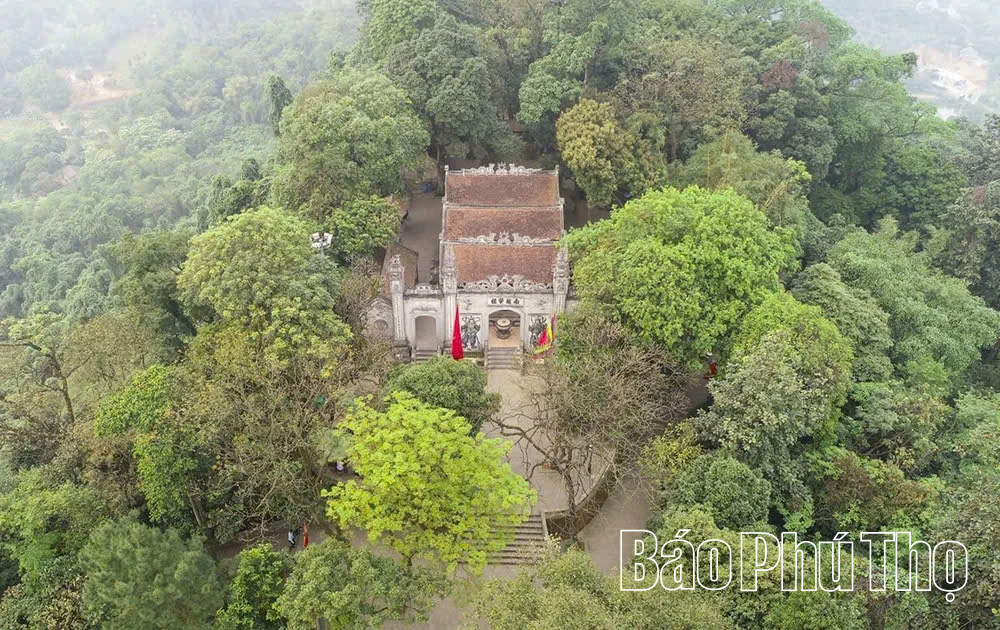
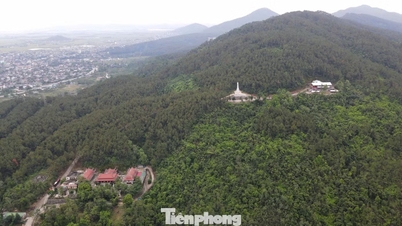
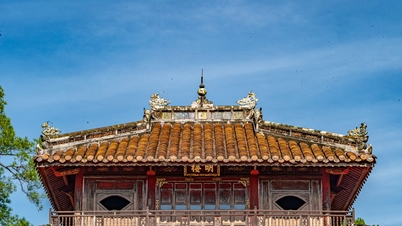
The Upper Temple was built on the summit of Hung Mountain.
Legend has it that King Hung traveled for a long time without finding a suitable place to establish his capital. He arrived at a region where three rivers (the Red River, the Lo River, and the Da River) converged, flanked by the Tan and Ba Vi mountains. The King praised this land as a place where all people could gather, with sufficient defenses and strategic advantages for expansion; a land so stable that it could sustain a nation for generations. King Hung established his capital, naming it Phong Chau. The capital of Van Lang stretched from the confluence of the Bach Hac River to Nghia Linh Mountain. On the summit of Nghia Linh Mountain, the people erected the Hung Vuong Ancestral Temple for generations to come.
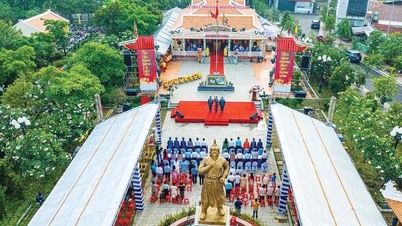
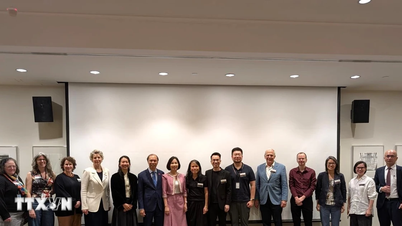
The most concentrated worship area is Hung Temple, which includes: Lower Temple, Middle Temple, Upper Temple, Thien Quang Pagoda, the tomb of the 6th Hung King, the Well Temple, the Mother Au Co Temple, and the Lac Long Quan Temple. Before ascending to the temple to respectfully light incense in remembrance of their ancestors' merits, a delegation of 50 overseas Vietnamese from 20 countries and territories lingered for a long time, gazing at the large inscription "Cao Son Canh Hanh" (High Mountain Scenery) affixed to the main gate leading to the temple. Mr. Tran Quang Hien, representing overseas Vietnamese from Thailand, said: "Coming here, the words 'origin' truly feel sacred, and we fully understand the meaning of brotherhood. We – overseas Vietnamese far from our homeland – pledge to wholeheartedly join the people at home in building and preserving our country."
In each residential area such as Trung Vuong, Tien Cat, Duu Lau... traces of the King's workplace still remain; Lau Ha village where the King's wife and children resided; where the 18th Hung King built a pavilion to choose a husband for Princess Ngoc Hoa; the King's vast, lush betel garden... Each place name and relic reminds us of the stories and figures from the early period of nation-building under the Hung Kings. Every spring, the homeland of the Ancestors resounds with spring songs and crowds of people flock to the Hung Temple and other historical sites dedicated to the ancestors who contributed to the nation's founding. Lai Len Temple is the birthplace of Xoan singing. Through many historical ups and downs, the Xoan singing festival in the Xoan singing villages has been preserved and passed down by the community with the intention of always honoring their ancestors and preserving these intangible cultural values.
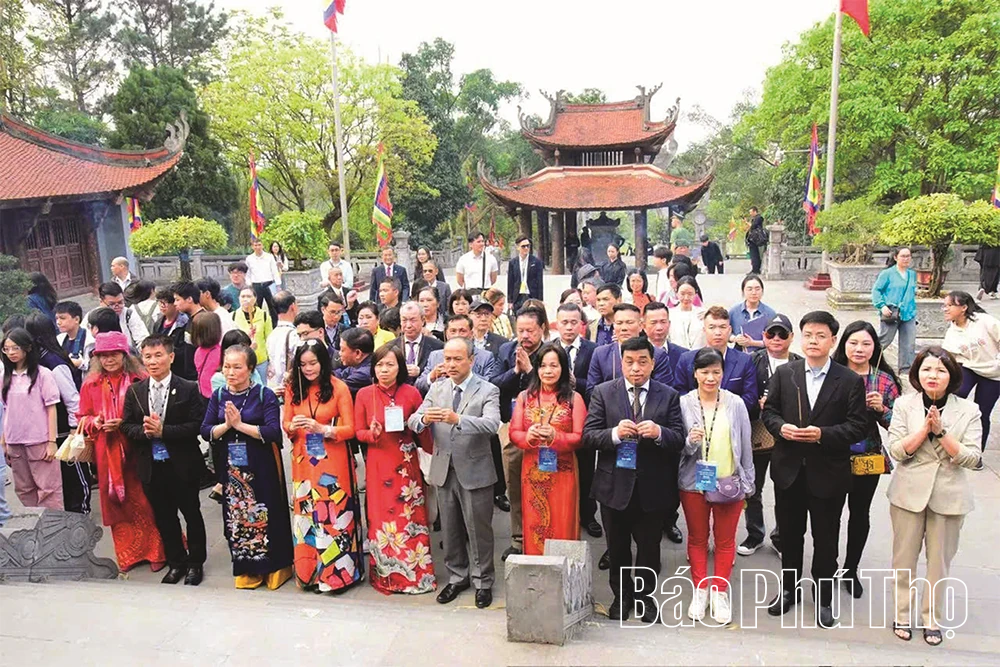
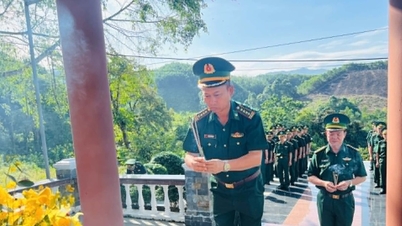
Delegations of overseas Vietnamese from 20 countries and territories offered incense to commemorate the Hung Kings at the Hung Temple historical site.
The ancient land of Hung Lo was also known as Kha Lam Trang or An Lao. Here lies a complex of architectural structures including: an ancient temple, Hung Lo communal house (Xom communal house), An Lao pagoda, the altar of the God of Agriculture, the Confucian temple, and the Yen Lao temple. Legend says, "King Hung and his princess, riding red horses, along with their courtiers, often toured the area, sightseeing and hunting. They stopped to rest at Kha Lam Trang. The King found the land fertile and imbued with sacred energy. He ordered the people to reclaim and cultivate the land to build their homeland..." To commemorate the benevolence of King Hung, the people erected a temple and a horizontal plaque inscribed "Tham Thien Tan Hoa" (meaning King Hung participated in the affairs of Heaven to help the people), so that generations of the royal family could offer incense and prayers.
The village of Bạch Hạc, also known as Bạch Hạc Tam Giang, Bạch Hạc Từ, or Bạch Hạc Phong Châu, has its origins in ancient times. The name Bạch Hạc (White Crane) originated from a large, thousand-foot-tall sandalwood tree in the area, whose branches and leaves were lush and abundant. White cranes flew to the tree to build their nests, covering the entire area in white. The Tam Giang Temple and Đại Bi Pagoda are located at the confluence of the three rivers Thao Giang, Đà Giang, and Lô Giang. The Tam Giang Temple is dedicated to the legendary historical figure of the Hùng Vương era, Vũ Phụ Trung Dực Uy Hiển Vương, whose given name was Lệnh Thổ. It is also the site of some of the most significant festivals in the ancestral land: the boat racing competition, the "Cướp Còn" (a traditional game involving snatching a ball), and the rice cooking competition.
Tien Temple is a sacred temple dedicated to the Ancestral Mother, also known as Bach To Mau, the Queen of King Kinh Duong Vuong, the mother and foster mother of King Lac Long Quan, and the grandmother of the Hung Kings, born from a hundred eggs. After Lac Long Quan inherited the throne from his father, the Dragon Mother was taken to heaven by her two sworn sisters. Lac Long Quan, remembering his mother's kindness, instructed the people to build a temple in her honor at Tien Cat Palace. The Trung Vuong region still bears the legends of the Lau Thuong and Lau Ha palaces of the Hung Kings during the founding of the Van Lang kingdom. Lau Thuong Temple is dedicated to Tan Vien Son Thanh, the Trung Sisters, and Mr. Ly Hong Lien, who contributed to education and taught the people the art of mulberry cultivation and silkworm rearing. Besides Lau Thuong Temple, there is also Lan Huong Temple dedicated to the three Do Chau Dai Vuong; Thien Co Temple dedicated to the teacher couple Vu The Lang, entrusted by the 18th Hung King with the education of the two princesses Tien Dung and Ngoc Hoa; and the tombs of the three scholars of the Hung Due Vuong era, sons of the teacher couple who served the Hung Kings. Every year on the 16th day of the first lunar month, the people of Minh Nong district eagerly celebrate the "Going Down to the Fields" ceremony - a festival commemorating King Hung teaching the people how to plant rice. In Van Phu district, they witness the "Cotton Snatching" and "Net Throwing" festivals, held to remember Saint Tan, reenacting scenes of military training, hunting, and physical conditioning for production and the defense of their homeland...
Throughout thousands of years of history, along with thousands of stories associated with landmarks, proverbs, poems, and songs praising the homeland, all serve as evidence of the "thousand-year-old civilization" of the Van Lang capital during the nation-building period. With its unique and distinctive values, in 2012, UNESCO officially inscribed the Hung King worshiping belief in Phu Tho as a representative intangible cultural heritage of humanity.
Thuy Hang
Source: https://baophutho.vn/vung-dat-ngan-nam-van-hien-245072.htm


![[Image] "Journey of Hope" promotes the organ and tissue donation movement in Vietnam.](https://vphoto.vietnam.vn/thumb/1200x675/vietnam/resource/IMAGE/2026/05/20/1779294400833_1-8910-jpg.webp)
![[Photo] National Assembly Chairman Tran Thanh Man working with the Standing Committee of the National Assembly's Delegation Affairs Committee.](https://vphoto.vietnam.vn/thumb/1200x675/vietnam/resource/IMAGE/2026/05/20/1779294340023_ndo_br_1-1691-jpg.webp)
![[Photo] General Secretary and President To Lam works with the Party Committee of the Ministry of Health on the work of Vietnamese traditional medicine.](https://vphoto.vietnam.vn/thumb/1200x675/vietnam/resource/IMAGE/2026/05/20/1779294323718_a1-bnd-2978-3319-jpg.webp)


















































Comment (0)