

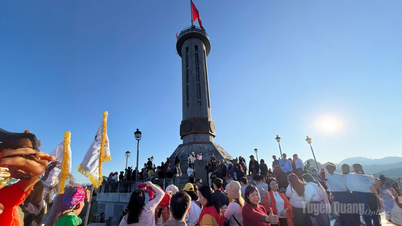
In the late afternoon sun, looking down from the Lung Cu Flagpole, Lo Lo Chai village appeared before our eyes. Giang Mi Po – our enthusiastic guide – pointed towards the Vietnam-China border, just a short distance from the village. A small "dot" on the S-shaped map, a small village at the northernmost point of the country, holding so much sacredness mixed with pride.
"Living Heritage" at the Border
"The Lo Lo Chai Cultural Village (coordinates: 23°09'49"N - 105°24'14.6"E) emerges as a peaceful highlight of the gray rocky landscape of Ha Giang . Right at the entrance, tourists eagerly line up to check in at the sign with the QR code."
The village is home to the Lo Lo people, an ethnic minority group that has lived there for generations, currently comprising over a hundred households, nestled at the foot of the legendary Dragon Mountain, which averages 1,470 meters above sea level. Lo Lo Chai village is located in Lung Cu commune, Tuyen Quang province; formerly Lung Cu commune, Dong Van district, Ha Giang province.
We strolled leisurely, captivated by the visually striking traditional houses: their roofs covered with dark gray tiles, and their earthen walls a yellow hue like corn or pumpkins.
Lo Lo Chai is a "living heritage," having preserved these houses through the vicissitudes of time and transformed them into unique homestays. A spacious courtyard is embraced by a meticulously handcrafted stone fence, reaching waist height and covered in moss.
Lo Lo Chai village is truly resplendent with flags and flowers. Every house proudly displays the five-pointed red star flag, and strings of national and Party flags flutter in the breeze. Some houses even hang the slogan "Independence - Freedom - Happiness." Blending with the red of the flags, throughout the village, peach, pear, and plum trees joyfully burst into bloom, their white and pink blossoms stirring the air, awakening an eternal spring.
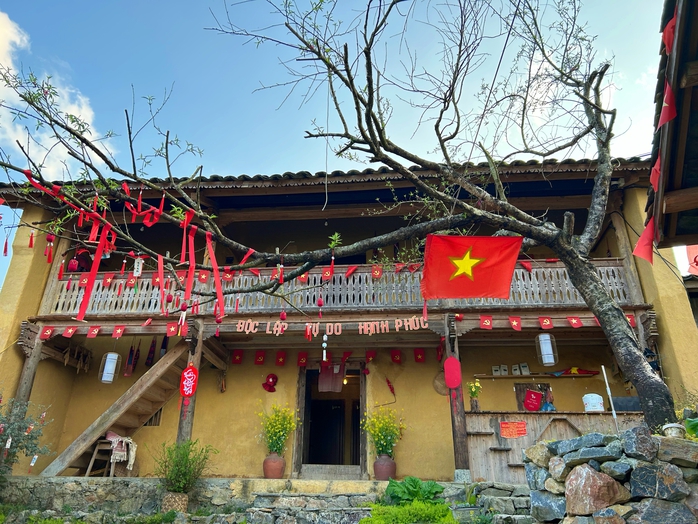
The national flag and the Party flag on a traditional earthen house in Lo Lo Chai.
After a decade of community collaboration in tourism development, Lo Lo Chai has transformed, escaping its past livelihoods based on rice and corn fields on the harsh, gray mountain slopes and jagged, cat-ear-shaped rocks.
Visitors from all over the world come not just to see, but to experience the rich, emotionally resonant, and profound culture. Leaving the village, they carry with them truly memorable experiences, becoming "ambassadors" who help spread the image of Vietnam's borderlands as peaceful, friendly, cooperative, and developing to the world, transcending geographical boundaries and digital space.

Tourists experience wearing the traditional Lo Lo ethnic costume when visiting Lo Lo Chai.
Lo Lo Chai has become a shining example of the new rural development program, elevating its position on the global map as it was named "World's Best Tourist Village" in 2025 by UN Tourism, in line with the United Nations Sustainable Development Goals (SDGs).
Lo Lo Chai and Lung Cu Flagpole are not isolated landmarks, but rather integral components within the overall system of destinations in the Dong Van Karst Plateau – Vietnam's first global geopark, recognized by UNESCO in 2010. Honored as the "World's Leading Cultural Destination" 2025 by the World Travel Awards, the park spans 2,354 km2 across four districts: Yen Minh, Quan Ba, Dong Van, and Meo Vac in the former Ha Giang province.
Eating together, living together, working together.
From almost any vantage point in Lo Lo Chai, one can see the majestic Lung Cu National Flagpole standing tall atop Dragon Mountain. The 54-square-meter flag proudly flies, symbolizing the strength of national unity among the 54 ethnic groups.
Lung Cu is not only a tourist destination but also a sacred symbol of territorial sovereignty. The journey up the 839 steps to the flagpole is a journey that touches upon a sense of pride.
Lung Cu is a place of symbolic significance, a sacred location embodying national pride in territorial sovereignty. To reach the base of the flagpole, one must climb 839 steps. Reaching the flagpole offers a breathtaking panoramic view of the vast landscape.
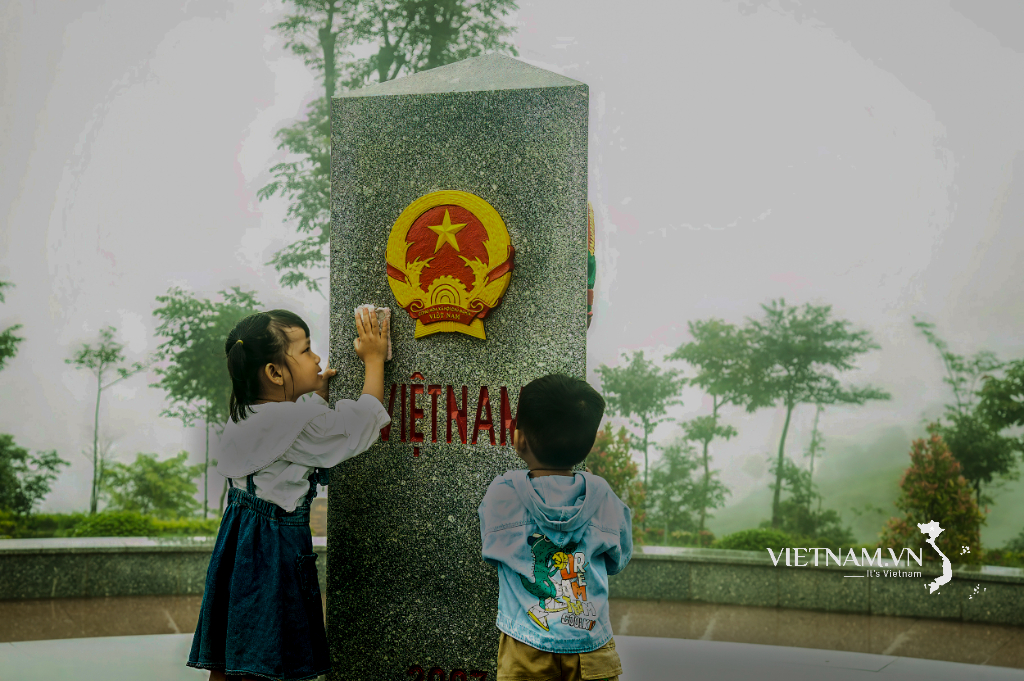
Following its merger with Ha Giang province, Tuyen Quang province holds a particularly crucial position with a border strip of over 277 km bordering China, marked by more than 440 border markers, spanning 17 communes and 122 villages along the border. This border region, which once experienced fierce battles, is now opening up many new opportunities for development.
Like other border regions across the country, Tuyen Quang province is constantly building and strengthening the "people's support" and the all-people national defense and people's security posture, making it "as solid as a rock" right from the grassroots level, the foundation for the cause of protecting the Fatherland.
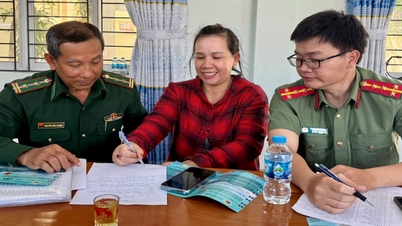
Giàng Mí Pó told us that the current development of tourism in this border region is thanks to the border guards' firm grip on their weapons, maintaining peace and security, ensuring that the Đồng Văn Karst Plateau – Vietnam's first UNESCO Global Geopark recognized in 2010 – remains a safe destination for tourists from near and far. Their persistent patrols and close relationship with the local people, sharing meals, living, and working together, have created a strong bond between the military and the people.
Along the Lo Lo Chai borderland, each villager and each traditional house stands as a "living landmark" of sovereignty. The deeply rooted and enduring cultural identity, with the long-term and continuous presence of the ethnic communities, serves as a "silent declaration of sovereignty" at this frontier.
Culture is now a driving force for development. Community-based tourism in Lo Lo Chai contributes to poverty reduction, combating social evils, and encouraging young people to start businesses in their own hometowns. This is vivid evidence of the efforts to build a prosperous border region like Lo Lo Chai, with a strong economy, stable security and defense, and progress in cultural and social aspects.
From Lo Lo Chai, one can believe that as long as the culture is preserved, as long as the people remain attached to their homeland, and as long as the close-knit solidarity between the military and the people is always upheld, that border region will always remain secure.

Source: https://nld.com.vn/vung-vang-noi-dai-bien-cuong-196260411203655604.htm
![[Photo] General Secretary and President To Lam visits and delivers a policy speech at Tsinghua University.](https://vphoto.vietnam.vn/thumb/1200x675/vietnam/resource/IMAGE/2026/04/14/1776164592318_vna-potal-tong-bi-thu-chu-tich-nuoc-tham-va-phat-bieu-chinh-sach-tai-dai-hoc-thanh-hoa-trung-quoc-8700658-5437-jpg.webp)
![[Image] Expediting land clearance at Alley 310 Nghi Tam to facilitate the construction of Tu Lien Bridge](https://vphoto.vietnam.vn/thumb/1200x675/vietnam/resource/IMAGE/2026/04/14/1776160406551_ndo_br_z7724148990408-9e5d4777e3c4504998b4286178b2e66e-jpg.webp)
![[Photo] General Secretary and President To Lam and his wife begin their state visit to China.](https://vphoto.vietnam.vn/thumb/1200x675/vietnam/resource/IMAGE/2026/04/14/1776133794926_z7723148772587-ffefa3c4b1e54e100de1554593a862c6-jpg.webp)














![[Photo] General Secretary and President To Lam receives Slovak Prime Minister Robert Fico](https://vphoto.vietnam.vn/thumb/1200x675/vietnam/resource/IMAGE/2026/04/13/1776080592076_a1-bnd-8227-6002-jpg.webp)










































Comment (0)