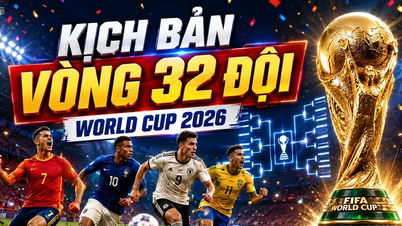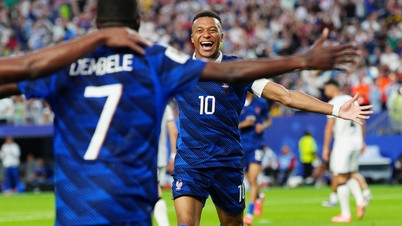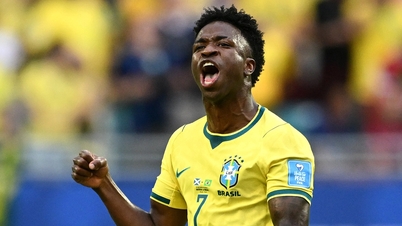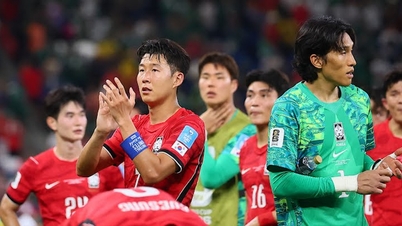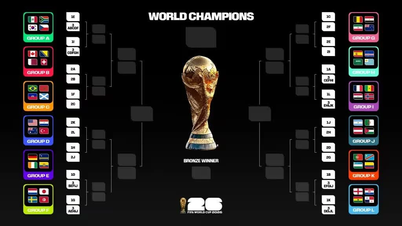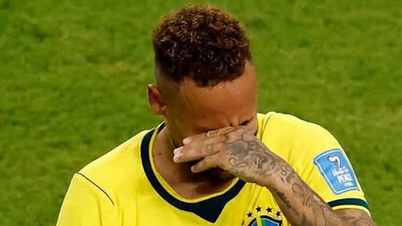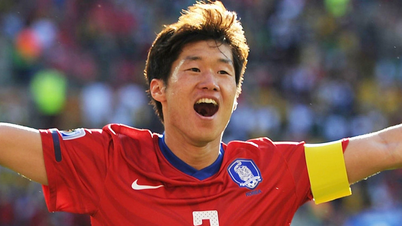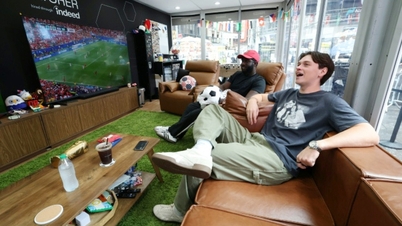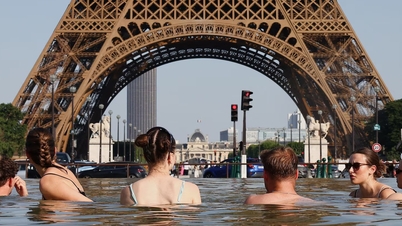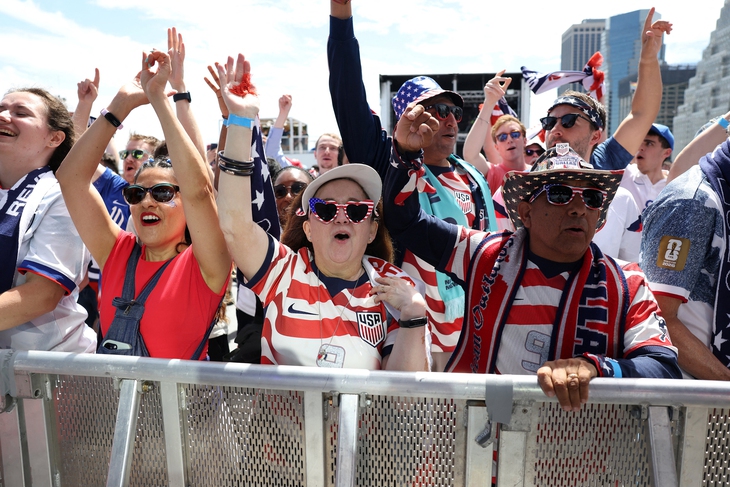
The world has changed a lot, and so has the World Cup. The global football festival is still fun, but it's no longer the same as in our memories of the 1980s, 1990s, and 2000s. - Photo: AFP
Never before has the World Cup been so vast, with 48 teams spread across three different countries (USA, Canada, Mexico). But never before has the planet's number one football festival been mired in doubt, controversy, and instability.
The initial skepticism stemmed from the Americans' own passion for soccer. American sports commentators have a popular saying: "Americans are always the best in the world at every sport except the one that the whole world plays."
Americans aren't just not good at soccer, they're not even passionate about it, at least not compared to American football, basketball, baseball, tennis... Over the past 20 years, David Beckham and then Lionel Messi have come and stirred up the atmosphere in Major League Soccer (MLS).
The results are certainly positive, but still not enough to propel MLS into the billion-dollar arena like the NBA (basketball) or NFL (American football).
But there's also a fact that football fans should know: when it comes to attendance at World Cups, the United States usually ranks first, excluding the host nation.
The most striking example is the 2018 World Cup – a tournament where the US national team didn't even qualify.

But then in Russia, a total of nearly 89,000 out of 2.4 million tickets sold in the group stage were bought by Americans, ranking second only to the home fans. Brazil, a football-obsessed nation, came in third with 72,500 tickets, followed by Germany, Argentina, and others. This statistic only accounts for the group stage, where each team played three matches.
Americans aren't usually football fans, but why are they leading the way in ticket purchases for the world's biggest sporting event? The answer is simple: because Americans are... rich.
At the 2022 World Cup, Forbes magazine reported that the minimum cost for a 5-day trip to Qatar to enjoy the World Cup was approximately $5,000.
Americans may not be huge soccer fans – even with Messi playing weekly in MLS – but at a multi-billion dollar economic extravagance, Americans certainly can't be absent.
And when FIFA wanted to expand the World Cup to 48 teams, the United States – along with the alliance of Canada and Mexico – was the ideal location.
The United States – a superpower in economics, technology, and entertainment – is expected by FIFA to successfully host this historic World Cup. Furthermore, fans are promised a truly "American-style World Cup," similar to how the world's number one superpower organizes its billion-dollar sporting events.
But the World Cup is more than just that. When FIFA increased the size to 48 teams, their calculations went beyond a five-week football festival; they aimed for a comprehensive competition spanning three to four years.
It's a qualifying race – where even a footballing nation like Indonesia can experience the anticipation, excitement, and drama right up to the very last minute of the qualifying phase.


In FIFA's strategy, the "World Cup" today is a four-year competitive cycle where 200 football nations worldwide participate.
For Jordan, Uzbekistan, or Curacao, simply being in the World Cup is a victory in itself.
The world has changed a lot, and so has the World Cup. The global football festival is still fun, but it's no longer the same as it was in our memories of the 1980s, 1990s, and 2000s...
Source: https://tuoitre.vn/world-cup-co-con-vui-20260611082412679.htm
![[Image] Schools organize meetings and introduce teaching models to students admitted to grade 10.](https://vphoto.vietnam.vn/thumb/1200x675/vietnam/resource/IMAGE/2026/06/25/1782368077271_ndo_br_z7970052192242-1ec8daeb77a6eed1a4e9f58c564ddd3e-jpg.webp)
![[Photo] General Secretary and President To Lam receives Palestinian Ambassador Saadi Salama](https://vphoto.vietnam.vn/thumb/1200x675/vietnam/resource/IMAGE/2026/06/25/1782365384740_a1-bnd-9423-8322-jpg.webp)
![[Photo] General Secretary and President To Lam attends the 13th National Congress of the Ho Chi Minh Communist Youth Union](https://vphoto.vietnam.vn/thumb/1200x675/vietnam/resource/IMAGE/2026/06/25/1782356968989_ndo_br_1-jpg.webp)