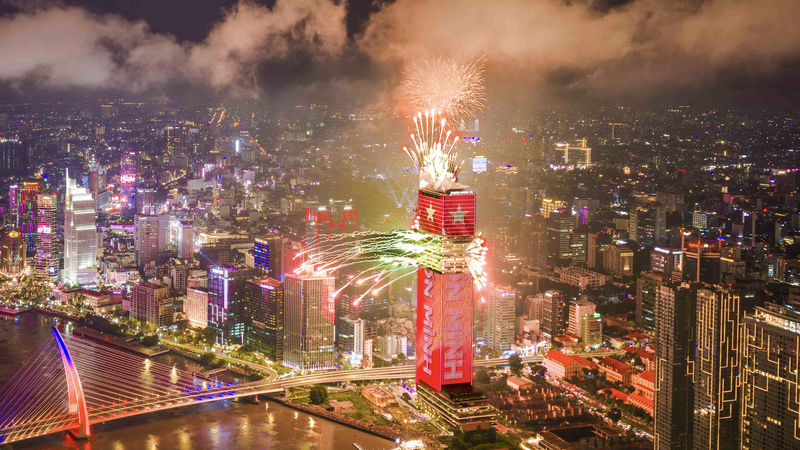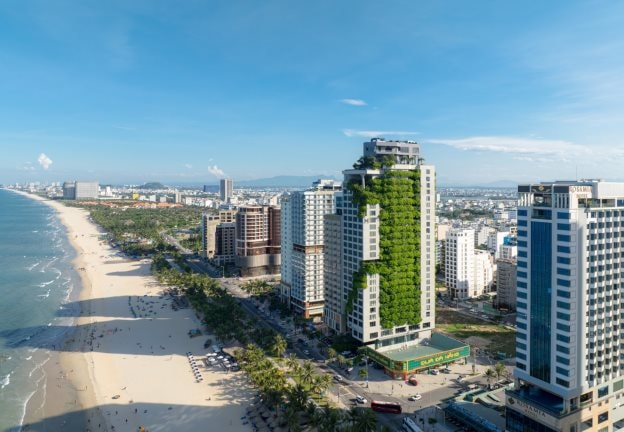
Inspired by green architecture, M Hotel stands out with its design featuring lush vegetation gently winding around the building, creating a natural beauty that harmonizes with the coastal landscape. Photo: Provided by the company.
However, the implementation of "green" elements in construction is currently limited and mostly spontaneous.
What is the path to developing green buildings as a cornerstone of sustainable urban development strategies? To address this issue, we spoke with Associate Professor Dr. Nguyen Anh Tuan, Senior Lecturer (Faculty of Technology, University of Da Nang ).
* Sir, what role do green buildings play in the quality of life and sustainable development of a city like Da Nang?
MR. NGUYEN ANH TUAN:
Green buildings are not just an architectural trend, but a comprehensive solution aimed at improving the quality of life for people.
In terms of functionality, these buildings significantly improve the comfort and health of users through better control of microclimate, air quality, lighting, and noise…
From a natural perspective, they contribute to the construction sector's resource conservation, reducing energy and water consumption, limiting greenhouse gas emissions, and utilizing environmentally friendly materials that have minimal impact during operation or dismantling.
For Da Nang – a city oriented towards developing as an environmentally friendly city – green buildings play a pivotal role in realizing this strategy.
With its diverse landscapes and sustainable tourism development orientation, green buildings contribute to perfecting the natural landscape, becoming an important component of green tourism, and simultaneously reinforcing Da Nang's image as a "livable city" in the long term.
* How do you assess the current development of green buildings in Da Nang?
MR. NGUYEN ANH TUAN:
You may also like

Ms. Nguyen Thi Thu Lan holds the position of Standing Vice Chairperson of the Vietnam Fatherland Front Committee of Da Nang City, term I.DNO - On the morning of July 6th, the 3rd Conference of the Vietnam Fatherland Front Committee of Da Nang City, term I, 2025-2030, elected Ms. Nguyen Thi Thu Lan, Member of the Standing Committee of the City Party Committee, former Secretary of the Party Committee and Chairwoman of the People's Council of Tam Ky Ward, as a Member of the Vietnam Fatherland Front Committee of Da Nang City, term I, and to hold the position of Permanent Vice Chairwoman of the Vietnam Fatherland Front Committee of Da Nang City. In Da Nang, the green trend in architecture and construction is beginning to take shape with several notable projects such as Phi Long Plaza, Chicland Hotel, M Hotel,FPT Complex, and Hoa Xuan ecological urban area.
Many resorts are implementing sustainable design solutions and using renewable energy; innovative townhouses with green roofs and walls, and recycled materials also contribute to improving the microclimate and reducing environmental impact.
However, in reality, the majority of current constructions only apply green solutions, without pursuing the title of "green building" due to various obstacles.
Compared to the rapid pace of urban development, the number of green building projects remains modest. Many projects still prioritize functionality and short-term profits. This poses a challenge to the city's goal of sustainable construction and development.
* What are the obstacles preventing green building from becoming a widespread movement in Da Nang, sir?
MR. NGUYEN ANH TUAN:
The reasons are numerous and multifaceted. First is the initial investment cost. A building with international green building certification like LEED Platinum can increase costs by 10-15%. With LOTUS – the certification system of the Vietnam Green Building Council – costs can also increase by 5-10% compared to a standard building. Although it offers many long-term benefits, most investors, who are very sensitive to costs, are still hesitant due to the burden of the initial investment.
Secondly, there are limitations in terms of technology and human resources. Designing and constructing green buildings requires a high level of expertise, but the number of consultants, designers, and contractors knowledgeable in this field is still not widespread in Vietnam in general and Da Nang in particular.
Thirdly, the legal framework and incentive mechanisms are lacking. Currently, green building initiatives are only at the voluntary encouragement stage; there are no mandatory regulations or sufficiently strong incentives in terms of taxes, credit, or administrative procedures to promote the movement.
Furthermore, market demand remains weak. Except for a few sectors requiring green certification such as industrial production and commercial housing, neither investors nor users are truly committed to green building requirements. Therefore, the growth rate of the green building market is still slow and does not match the expectations set by a city like Da Nang.
* In your opinion, what specific steps are needed to promote the green building trend in Da Nang?
MR. NGUYEN ANH TUAN:
This must be a process requiring coordinated efforts from many parties.
From the government's perspective, it is necessary to concretize the supportive stance into clear legal regulations and supportive policies. Projects using budget funds should be prioritized for development in line with green trends. When public investment becomes the "locomotive," the private sector will have direction and motivation to follow.
Strengthening the friendship between Vietnam and the United States.On July 3rd, as part of the Pacific Partnership - Friends of the Pacific 2026 program, the U.S. Army Pacific delegation, led by Lieutenant General Joel Vowell, Deputy Commander of the U.S. Army Pacific, paid a courtesy visit to the Quang Tri Provincial Military Command. City authorities should emphasize green requirements and environmental protection in investment proposals, and issue specific incentives to encourage investors.
Urban planning management must also prioritize green criteria, from controlling low building density, improving land use efficiency, ensuring green space targets, protecting open spaces, prioritizing green transportation, to parking infrastructure, in order to create the foundation for a green built environment.
From the investor's perspective, I hope for an adjustment in strategic thinking, not just focusing on short-term profits, but viewing green buildings as a solution to reduce operating costs, increase customer appeal, and enhance long-term project value, especially in a context where "green and sustainable" have become priority choices.
From the designers' perspective, creativity is needed in applying green solutions that are suitable for Da Nang's climate and socio-cultural conditions, instead of simply copying models from other places. They need to convince investors through solutions that ensure technical efficiency, environmental friendliness, and reasonable costs.
In parallel, raising public awareness is also crucial; only when people develop a need for and prioritize green buildings will the green construction market have a chance to thrive.
Source: https://baodanang.vn/xanh-hoa-kien-truc-3302786.html







![[Photo] General Secretary and President To Lam working with the Technical and Professional Center, Ministry of Public Security](https://vphoto.vietnam.vn/thumb/1200x675/vietnam/resource/IMAGE/2026/07/06/1783318005842_a1-bnd-1129-2263-jpg.webp)