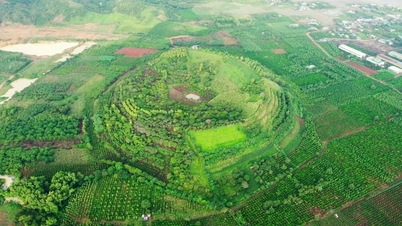
With a total investment of over 44 billion VND from the provincial budget, the project to build a conservation shelter covering an area of over 8,880 m² is being implemented in three key areas: Go Linh Son Bac, Go Sau Thuan, and Go Giong Cat. These sites preserve valuable architectural remains and archaeological artifacts, vivid evidence of a brilliant civilization from the 1st to the 7th centuries. Mr. Pham Ngoc Vu, Deputy Director of the Provincial Project Management Board, stated: “The entire design plan strictly adheres to the Law on Cultural Heritage. The highest goal is to absolutely avoid distorting the archaeological pits and to protect the original elements intact from the effects of weather.”

Construction of a protective roofing system to preserve the archaeological pits at the Oc Eo - Ba The archaeological site. Photo: Phuong Lan
Given the current situation, investing in the construction of a protective roof system for the archaeological pits at the Oc Eo - Ba The site is an urgent task and also a crucial step in introducing the value of the Oc Eo heritage to the world. The ruins, buried underground for centuries, face the risk of rapid deterioration upon excavation if not properly protected. The new roofs will provide stable conditions for scientists to continue their research, while also allowing visitors to admire the heritage in a modern and accessible way.



During a site inspection and visit to encourage officials and workers constructing a protective roof system for archaeological pits at the Oc Eo - Ba The historical site, Vice Chairman of the Provincial People's Committee Le Trung Ho affirmed that the roof system and technical infrastructure here are of special importance. This is not just ordinary construction work, but a task to protect the valuable ruins of the Oc Eo - Ba The National Special Monument.
According to the plan, a UNESCO delegation is expected to conduct a site survey in June or July 2026. Mr. Le Trung Ho noted that one of the important criteria for evaluation is the preservation of excavated relics; therefore, this project must ensure both timely progress and technical quality to demonstrate to the international community the local efforts to protect heritage. Construction units must regularly review and closely monitor the work volume according to the plan. During construction, utmost caution must be exercised, and absolutely no artifacts or relics buried underground must be encroached upon or damaged. "The workers need to cherish historical value and preserve the ruins intact to serve the heritage recognition process," Mr. Le Trung Ho emphasized.
The vitality of the Oc Eo heritage lies not only in its artifacts and ruins but also in the understanding and appreciation of the local people. As a local resident, Mr. Nguyen Van Nho, residing in Oc Eo commune, affirms that the Oc Eo - Ba The archaeological site has long been closely intertwined with the spiritual life of the people here. The archaeological remains here not only hold immense historical and cultural value but are also a source of pride for everyone. “We deeply understand that preserving heritage is not only the responsibility of the State but also the duty of every citizen. Investing in the construction of protective coverings for the excavation pits is essential to safeguard the original value of the site against the effects of time, while also opening up opportunities for tourism development and improving the lives of the local people,” Mr. Nho shared.
Recognizing the immense value of the relics, many local residents have actively responded to the movement of donating discovered artifacts and participating in maintaining security and order at the Oc Eo - Ba The historical site. "I regularly encourage the people to work together to protect the environment and preserve each artifact buried underground. We do all this because we want to preserve these core values so that future generations can understand their origins," Mr. Nho confided.
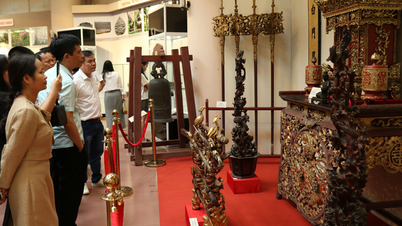
| The Oc Eo - Ba The cultural relic site was classified as a Special National Monument by the Prime Minister in 2012. This is an important trace of the Oc Eo civilization, which flourished in the Southern region of Vietnam from the 1st to the 7th centuries; it was one of the major trading centers of the ancient Funan kingdom, with its system of canals and waterways, architecture, and archaeological artifacts reflecting a high level of economic , cultural, and religious development. Over the past period, An Giang province has focused all its resources, along with ministries, agencies, and domestic and international scientists, to complete the dossier with the goal of having the Oc Eo culture inscribed as a World Cultural Heritage site by UNESCO in 2027. |



PHUONG LAN
Source: https://baoangiang.com.vn/xay-dung-mai-che-bao-ton-di-san-oc-eo-a475827.html


![[Image] National conference summarizing one year of operation of the overall organizational model of the political system, the three-tiered government model.](https://vphoto.vietnam.vn/thumb/1200x675/vietnam/resource/IMAGE/2026/07/01/1782882811691_ndo_br_1-jpg.webp)