

Happiness comes from simple things.
The International Day of Happiness originated from Bhutan – a country that chose to measure development by "Gross National Happiness," emphasizing health, well-being, the environment, and quality of life rather than solely relying on economic growth. In June 2012, the United Nations officially designated March 20th as the International Day of Happiness. This is also the time of the spring equinox, when the sun is directly above the equator, making the length of day and night almost equal. The balance of nature on this day is seen as a symbol of the key to happiness: only when people find balance and harmony between material and spiritual aspects, between the individual and the community, between humanity and nature, can happiness truly exist. Along with more than 190 countries, Vietnam has committed to celebrating the International Day of Happiness through efforts to improve the quality of life, build a just society, and achieve sustainable development, aiming to bring happiness to its people.
For Vietnamese people, the value of happiness has long been deeply embodied in the word "family." The family is not only a social unit but also the cradle that nurtures love, unity, and sharing. Despite the increasingly fast pace of modern life, the family remains the "anchor" preserving enduring values. Traditional family values, cultivated over generations, become an invisible yet strong bond connecting family members. These include respect for elders, filial piety towards grandparents and parents, and marital fidelity. Folk songs like "When husband and wife are in harmony, they can drain the East Sea," and "Brothers and sisters are like hands and feet" have long served as guiding principles in family conduct. It is this harmony and close bond between generations that creates a solid foundation, making the family a spiritual anchor for each individual.

Preserving family traditions – the foundation of a happy modern family.
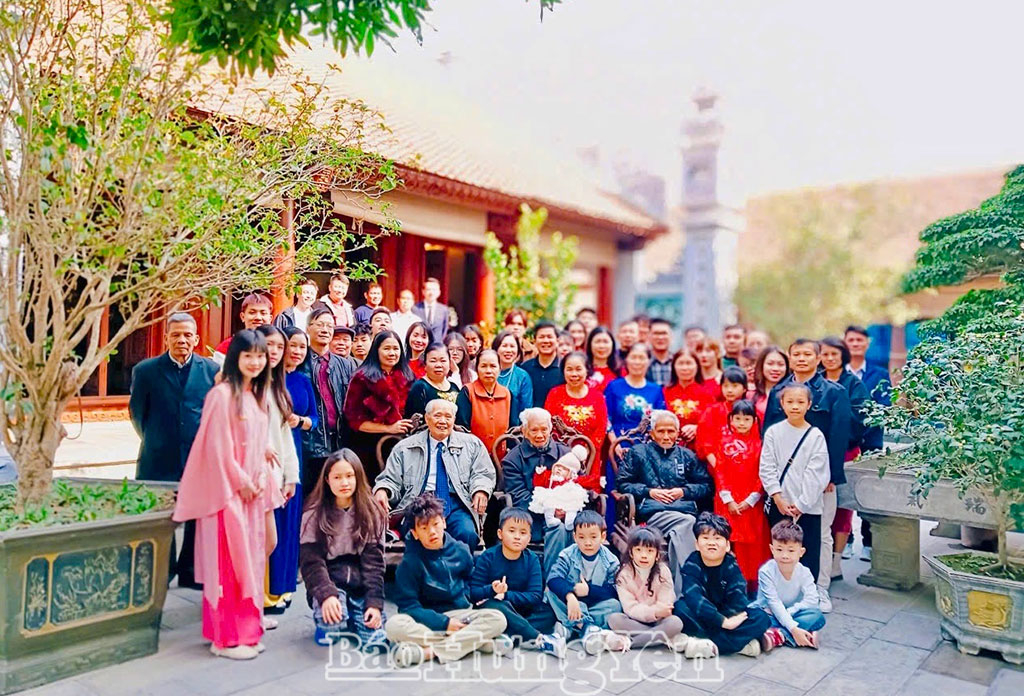
The family of Mr. Nguyen Ngoc Giao in Me So commune is one of the exemplary traditional families in the locality. In a house where four generations live together, Mr. Giao is always respected by his children and grandchildren as a "tall and mighty tree." What he frequently advises his descendants is not grand principles, but rather how to behave within the family: showing respect to elders, showing consideration to younger generations, and loving, supporting, and helping one another. Mr. Nguyen Xuan Nham, Mr. Giao's son, said: In a multi-generational family living together, differences in work, age, and interests, if not harmonized, can easily lead to conflict. Therefore, only respect for elders, consideration for younger generations, and mutual love and support can help preserve the family traditions through the years.
In the digital age and with an increasingly fast-paced lifestyle, many families face considerable pressure: the demands of making a living, changes in communication styles, and lifestyles that create a growing generation gap. If not recognized and addressed promptly, these factors can weaken the bonds between family members. Therefore, building a happy family in this new era requires not only love but also effort and a conscious commitment from each individual. While older generations play a guiding role in preserving family traditions, in daily life, family members need to share responsibilities, care for, and understand each other, thereby creating strong bonds. Ms. Nguyen Thi Huong from Dong Tien Hai commune believes that women play a crucial role in connecting family members and fostering closeness within the home. "I always try to keep the family hearth burning. Family meals are precious, especially when everyone is busy. But it's a time for family members to get closer, share, and bond more," Ms. Huong shared.
According to Dr. Dinh Doan, a psychologist: In the context of modern society with its rapid changes in digital technology, maintaining family happiness requires adaptation from each member. Parents need to care for and support their children throughout their growth, while also improving their understanding of technology and the psychology of different age groups to develop appropriate educational methods.
| "Building a happy family in the new era is not about returning to old patterns, but about a harmonious blend of tradition and modernity; in which values such as filial piety, loyalty, faithfulness, exemplary behavior, love, and sharing among family members are the solid foundation of the family" - Dr. Dinh Doan, a psychologist. | |
International Happiness Day is an opportunity for everyone to reflect on their lives and appreciate the simple things around them: a family meal, a sincere greeting, or sharing under one roof. When the "family bond" is preserved and love is spread, each person will have more motivation to work, create, and contribute.
Source: https://baohungyen.vn/xay-hanh-phuc-tu-nep-nha-3192876.html
![[Photo] Memorable moments at the 10th Vietnam-China Border Defense Friendship Exchange](https://vphoto.vietnam.vn/thumb/1200x675/vietnam/resource/IMAGE/2026/03/20/1773986226876_giao-luu-bien-gioi-vntq-lan-10-ben-tq-9737-4225-jpg.webp)




















































Comment (0)