

Ellen Berends, former Deputy Ambassador of the Netherlands to Vietnam, was immediately captivated by two paintings by artist Phung Pham. The work "Pride" depicts a woman from Northern Vietnam in traditional attire, while "Kisses of Love" is a large four-panel screen.
"I was overwhelmed by the boldness, passion, and uniqueness of the work. It turned out to be a painting by Phung Pham. As with 'Pride ,' I decided to use all my savings to buy the painting. This is truly a work of art that I want to enjoy every day," Ellen Berends said about the moment she bought 'Kiss of Love.'
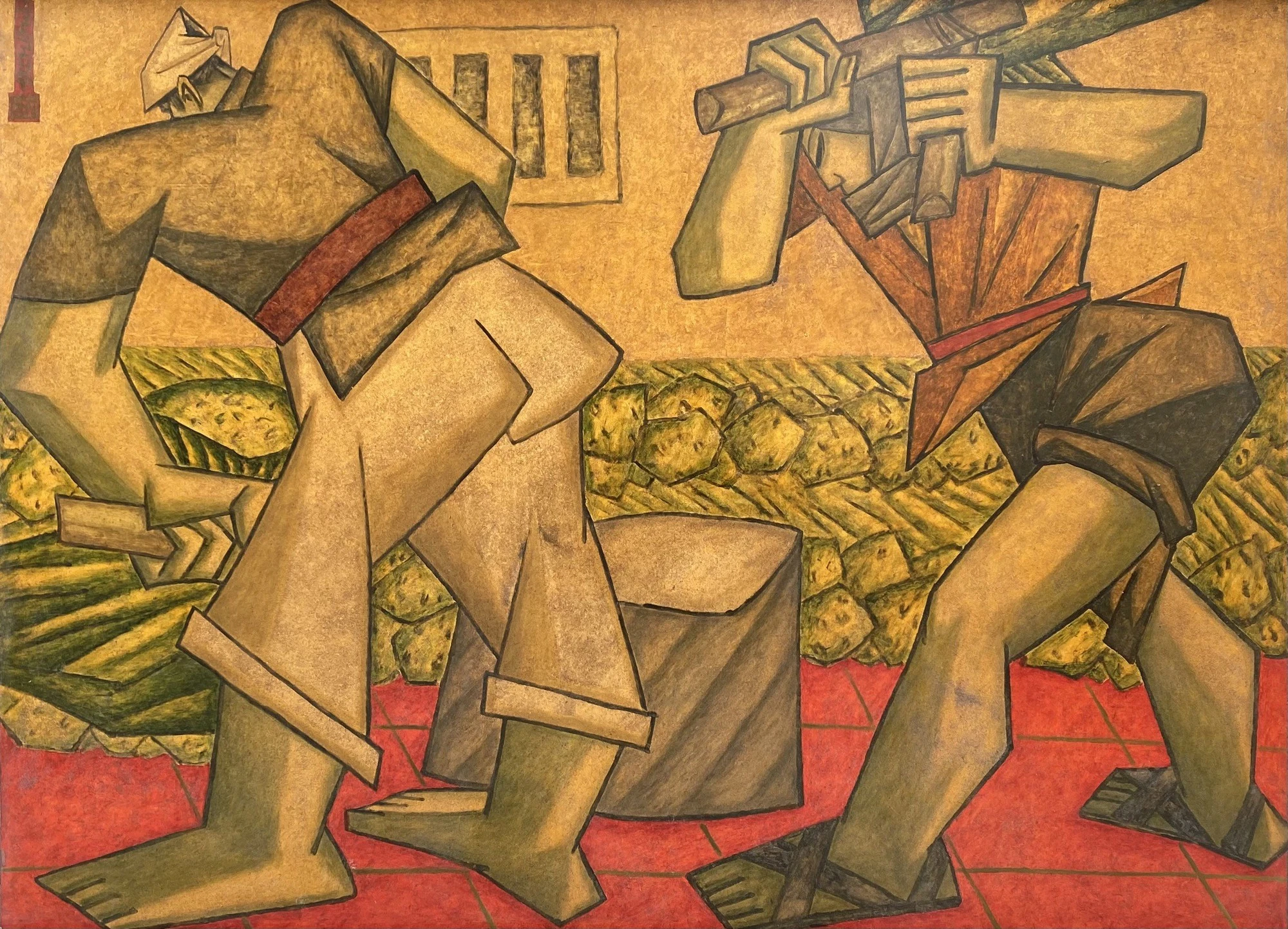
The work " On the Warehouse Yard"
It's understandable that Ellen Berends isn't familiar with Phung Pham. Phung Pham is an almost reclusive author, despite having won several awards domestically and internationally. Throughout his creative life, especially during Ellen's time in Vietnam, he never had a solo exhibition. In fact, it wasn't until now, at the age of 91, that Phung Pham had his first solo exhibition and his first book introducing his work.
Mr. Phùng Phẩm was a classmate of a generation of talented artists such as Hoàng Trầm, Kim Bạch, Mộng Bích, Đường Ngọc Cảnh… at the Vietnam College of Fine Arts. They had great teachers like Trần Văn Cẩn, Sỹ Ngọc, Lương Xuân Nhị… However, Mr. Phẩm stopped studying painting in the 9th class of the Vietnam College of Fine Arts for unknown reasons, at a time when creative individuals outside of socialist realism could be stopped from studying at any time. He worked at the Vietnam Animation Film Studio until his retirement.

Mr. Phung Pham has some very beautiful woodblock prints.
Art researcher Bui Nhu Huong believes that Phung Pham had already produced some very beautiful woodblock prints since the 1970s. "With only two pure, simple colors, black and white, the lines create a melody. Here, the lines are dominant. The lines create the melody, rhythm, movement, light, waves, and decorative details that intertwine in the composition, background, and areas. The lines create everything. The colors follow along," Ms. Huong assessed.
Ms. Bui Nhu Huong also observed the creative process, which is also the process of "cubism" in his work. According to her, Phung Pham's creative process consistently follows his own visual language, which can be tentatively called "modernization" or "cubism." This process is divided into two stages.
In the early stages, during the 1970s and 1980s, his works were still close to realism, following traditional folk aesthetics, such as "Fighting Drought , " "Silver Water, Golden Rice ," etc. "It was an unavoidable psychological tendency when the mainstream, orthodox, and exclusive art style at that time was still socialist realism. But during this period, the artist quietly created works that were predictive, ahead of the curve with modern graphic language, far different from traditional folk aesthetics," Ms. Huong said.
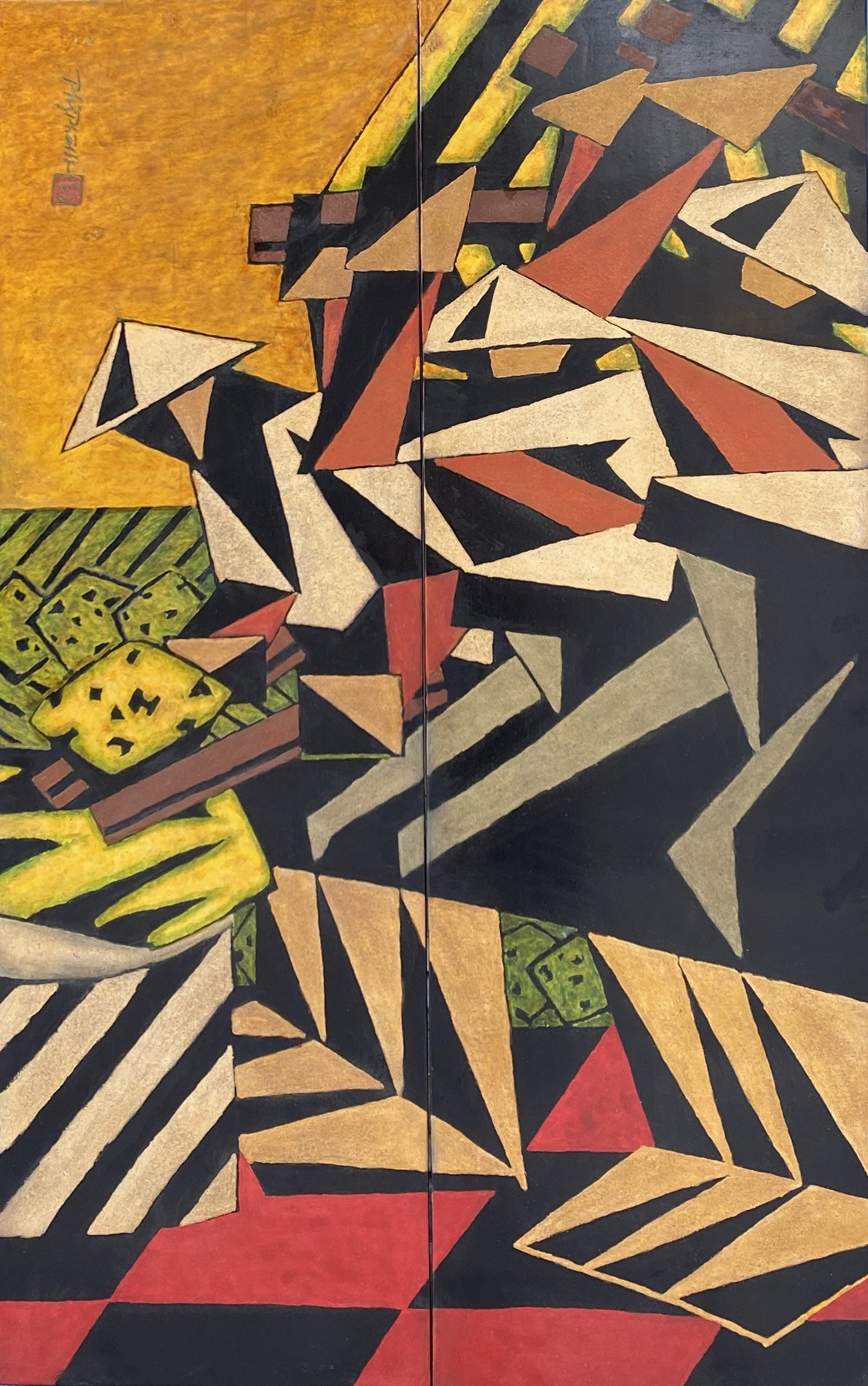
Thresh
In the second phase, when the reforms arrived in 1986, amidst the general trend of creative freedom in the national arts, Mr. Phung Pham already had his own path, and he continued to pursue it, moving on to the next stage… "In that period, Phung Pham made the most drastic and decisive changes and transformations in both language and artistic viewpoints," Ms. Huong assessed.
In Phung Pham's solo exhibition, one can see many themes he pursues in his works. These themes move away from realistic depictions and towards the fluidity of form. Squares, circles, and triangles are placed close together, from which a powerful rhythm emerges. This makes his paintings of labor and production irresistibly appealing.
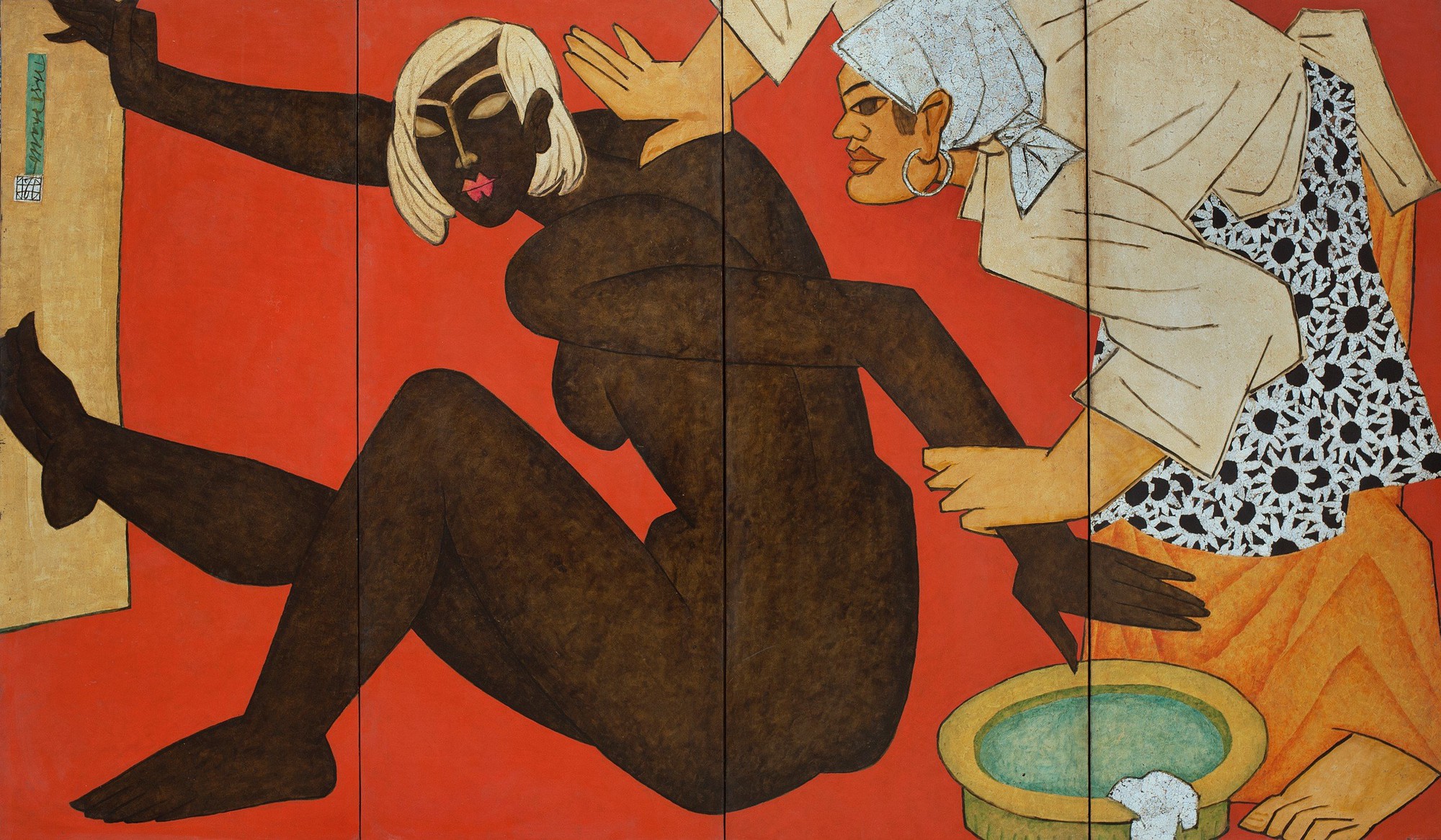
The work The Illegitimate Child
In works depicting farming activities such as "Rice Planting I ," "Rice Planting II," "Night Planting ," etc., the leaf raincoats are described as large rectangles, assembled from rows of closely spaced triangles representing leaves. The hands are depicted as square, like a large comb. The hat and leg wraps are also rhythmic, like the raincoat... This creates a robust and modern image of the rice planters.
There are also works in the exhibition that leave viewers speechless because of the desire to portray the identity that Phung Pham wants to convey. The work "The Illegitimate Child" depicts a Black girl, a mixed-race child from the Vietnam War, being bathed by her mother. He portrays her using strong, dark brown and black blocks of color. Only sadness remains somewhere in her tightly closed eyes.
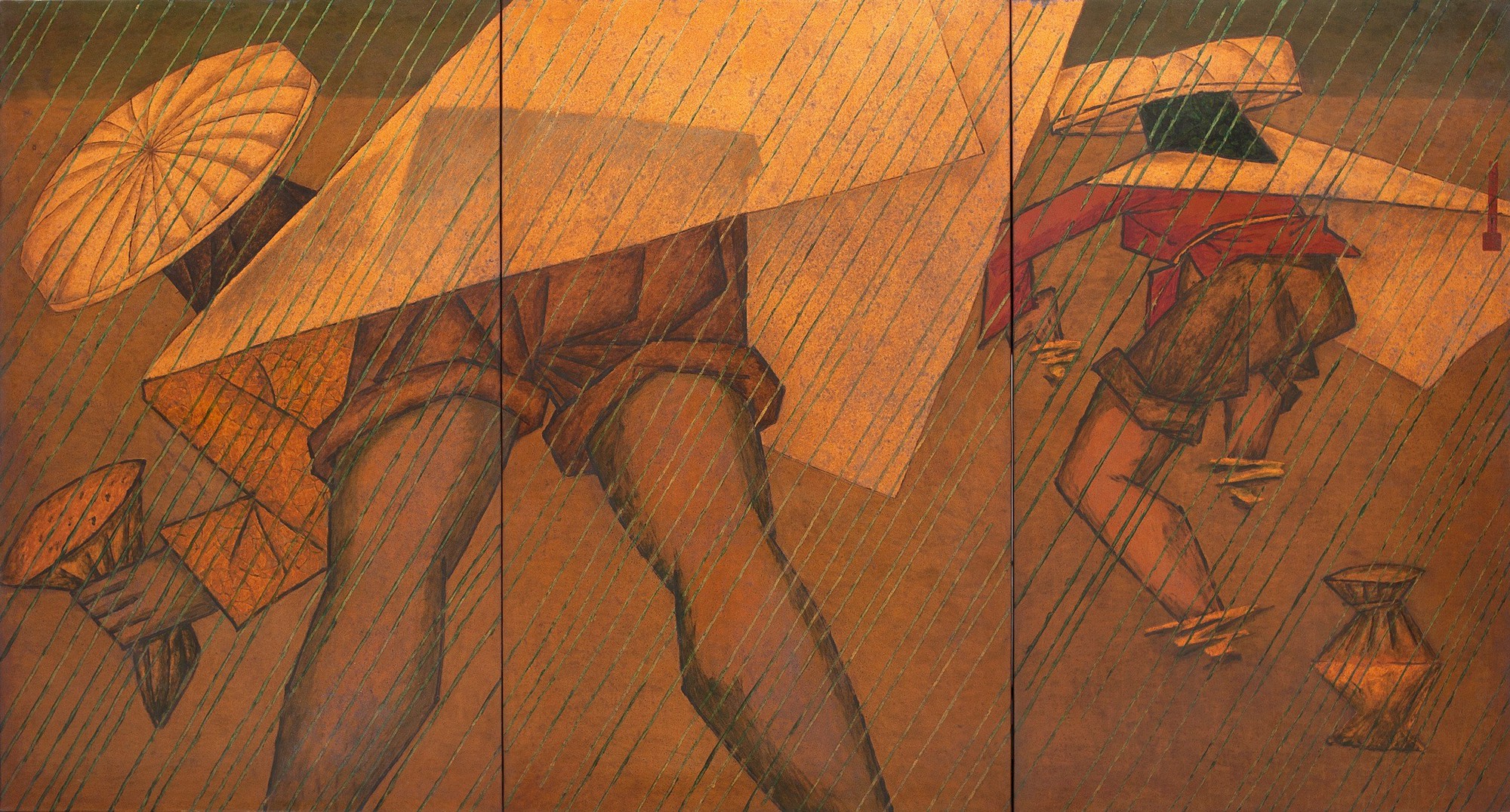
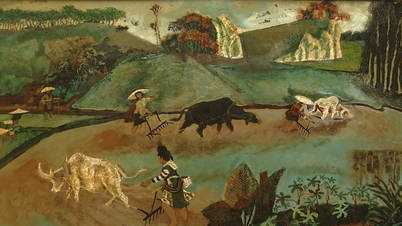
The work " Cultivating Rice"
Another highly evocative work is "Cấy chiêm" (Planting Rice ). In it, Phùng Phẩm chooses a perspective from behind… the character's buttocks. The character's figure is fully captured in the beauty of these rounded curves. A daring perspective.
Despite his late debut, Phùng Phẩm's solo exhibition still managed to showcase an artist who is both courageous and modern, with a compassionate perspective. In an increasingly interconnected world , his artistic voice is unique and easily resonates with the public.
Source link























































Comment (0)