

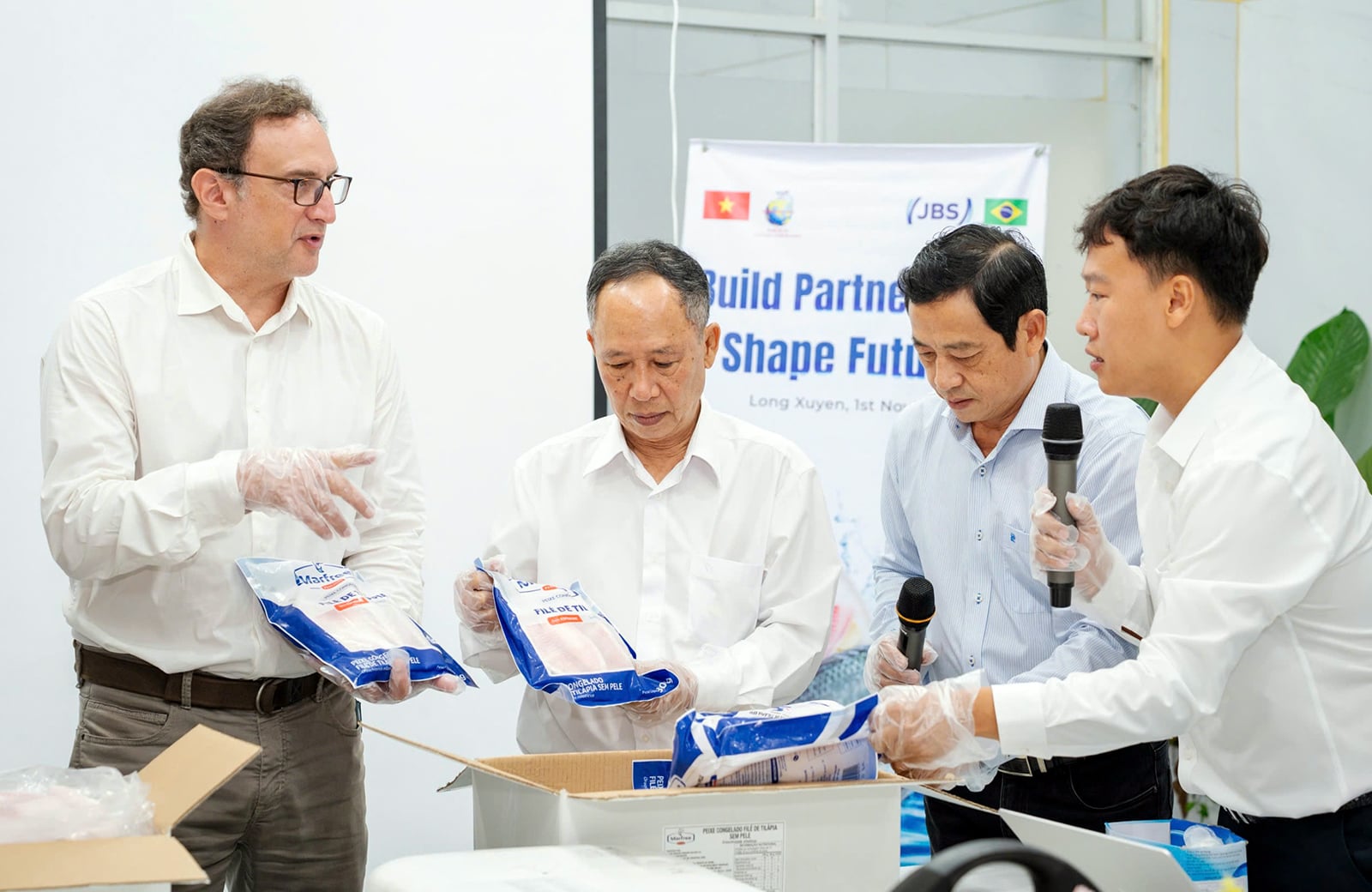
Businesses market their products to foreign partners. Photo: MINH HIEN
Market expansion
In recent times, pangasius businesses have expanded their presence in key markets such as the US, China, Hong Kong, and the EU, while also actively pursuing access to new markets, niche markets, and markets with Free Trade Agreements (FTAs) with Vietnam. This is considered a proactive and necessary approach in the context of a highly polarized global economy and the adoption of new regulations by many markets related to green standards, emissions, and traceability.
A significant advantage is the reduction in inventory levels in major markets, the recovery of the US economy, and some trade fluctuations such as many US importers shifting to Vietnamese pangasius as tariffs on Chinese tilapia increased. Businesses quickly seized this "market gap" to maintain export volumes and increase orders.
Among the pioneering businesses opening up new markets, Nam Viet Joint Stock Company (NAVICO) has made a significant mark in the South American region. On July 5, 2025, in Brasília, Brazil, NAVICO officially signed a strategic cooperation agreement with AV09 Comercio Exporter Ltda - one of Brazil's largest food importers. The event took place within the framework of the Vietnam-Brazil business forum, witnessed by Prime Minister Pham Minh Chinh and high-ranking leaders from both countries.
At the forum, NAVICO became the first Vietnamese enterprise to supply a shipment of pangasius, basa, and tilapia to the Brazilian market through official channels. This is not just a typical export transaction, but a strategic first step, marking the presence of Vietnamese seafood in a market of over 215 million people – considered the gateway to all of South America. Mr. Doan Toi, General Director of Nam Viet Group, commented: “Conquering JBS is proof of the processing capacity, product quality, and position of Vietnamese enterprises on the world seafood map.”
The presence of Vietnamese pangasius and tilapia products in the distribution system of JBS – a major food retail chain in South America – demonstrates that Vietnamese products are penetrating the global market, reducing dependence on traditional markets. Alongside market liberalization, many businesses are focusing on developing value-added products such as breaded pangasius, canned pangasius, gelatin, and collagen from by-products… aiming to increase profit margins, mitigate the impact of tariffs, and enhance competitiveness in the context of increasingly stringent importer requirements.
Improve product quality
Along with the efforts of businesses, management agencies are coordinating the implementation of many solutions to improve the value chain of pangasius fish, from breeding to processing. The focus is on improving breeding quality, controlling biosecurity, and meeting the technical requirements of import markets. “With guidance from scientists, breeding facilities continue to select and breed to improve the quality of breeding stock, increase disease resistance, and better adapt to climate change. This is a key factor in reducing risks in farming, stabilizing supply, and ensuring the quality of the final product,” shared Ms. Trinh Thi Lan, a pangasius fish breeder in Chau Phu commune.
In terms of production linkages, businesses and farmers are gradually perfecting a closed-loop production-processing-consumption chain towards industrial-scale operations, minimizing disruption risks and optimizing costs. Many businesses are researching replacing expensive input materials (fishmeal, fish oil) with plant-based or microalgae sources to reduce feed costs – the largest expense in pangasius farming.
In terms of technology, some businesses have piloted the RAS (Recirculating Aquaculture System) model, which helps save water, control the farming environment, and reduce emissions. Mr. Tran Van On, a resident of Vinh Xuong commune, shared: "The initial application of RAS has been effective, contributing to lowering input costs for the product." To meet new requirements from import markets, businesses must also comply with standards on emissions, food safety, and traceability according to international commitments such as COP26. This is a barrier, but also a driving force for the pangasius value chain to transform into a greener system more quickly and systematically.
The collaboration between businesses and regulatory agencies, from removing technical barriers and leveraging FTAs to strengthening processing capacity and expanding markets, is creating a crucial foundation for the pangasius industry to achieve its export target of $2 billion by 2025.
| “Although Brazil is not yet a traditional market for Vietnam's pangasius industry, the country is considered a strategic gateway to gain deeper access to the MERCOSUR market – an economic bloc comprising Argentina, Brazil, Paraguay, and Uruguay. With strategic vision and strong implementation capabilities, NAVICO has proactively seized opportunities to expand its market, gradually achieving the goal of diversifying its output and reducing dependence on traditional export markets,” said Mr. Duong Nghia Quoc, Chairman of the Vietnam Pangasius Association. |
Source: https://baoangiang.com.vn/xuat-khau-ca-tra-no-luc-ve-dich-a469731.html























































































Comment (0)