

During the period 2021-2025, the economy went through several major shocks, but still maintained stability, recovered, and accumulated momentum for a new growth cycle.
"From August until now, almost every meeting has started with a request for a price reduction from our partners. If we don't lower the price, they will leave," said Cao Huu Hieu, General Director of Vietnam Textile and Garment Group (Vinatex), in the final days of 2025.
Even partners who have been with Vinatex for 20-30 years are requesting a 20% reduction in unit prices. "After each negotiation, a new, lower price level is established, at least 5% cheaper than before," he shared.
Vinatex's story reflects the overall picture of Vietnamese businesses last year: the struggle to maintain profit margins amidst pressure from US tariff policies, geopolitical conflicts, and shifts in orders.
But 2025 is not the only year of "testing" for the business community. Looking back at the period from 2021-2025, businesses were impacted by the pandemic, supply chain disruptions, geopolitical conflicts, and inflation in major export markets. In the textile and garment industry alone, export turnover decreased by 11% in 2023, to nearly $40 billion, due to plummeting purchasing power in major markets (US, EU). Mr. Hieu, speaking about Vinatex's 30th anniversary, said, "the company has never faced such difficulties."
However, in the face of challenging circumstances, Vinatex still closed 2025 with a consolidated profit of VND 1,355 billion, exceeding the plan by 50%. "No unit incurred losses, only profits varied," Mr. Hieu said, attributing the results to lean management and the willingness to make short-term sacrifices to protect the market.
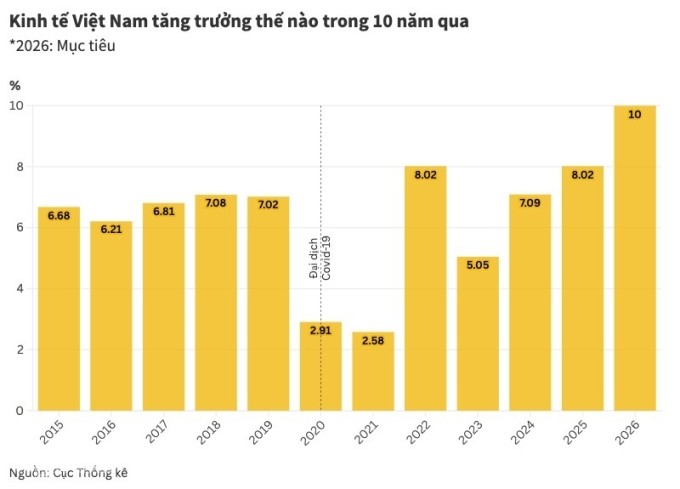
The resilience of the business community is one of the factors contributing to economic recovery and regaining growth momentum. In the final year of the 2021-2025 term, Vietnam completed and exceeded all 15 socio-economic targets.
GDP growth in 2025 is estimated at approximately 8.02%, more than three times the growth rate of the first year of the term in 2021, placing it among the highest in ASEAN and the world . Overall, GDP growth has averaged around 6.3% per year over the past five years, higher than the previous term.
The size of the Vietnamese economy is estimated to reach approximately $510 billion in 2025, with GDP per capita reaching $5,026, making Vietnam an upper-middle-income country. The economy's ranking on the global charts is also projected to improve by about 4-5 positions, reaching 32nd place worldwide.
Dr. Le Duy Binh, Director of Economica Vietnam, believes that a crucial foundation for a rapid economic recovery is the government's unwavering commitment to macroeconomic stability, while flexibly utilizing fiscal, monetary, trade, and investment tools.
"The strong involvement of the entire political system, along with the adaptability of businesses and the people, has created considerable resilience for the economy," Mr. Binh shared.
In fact, after the Covid-19 pandemic, Vietnam chose a recovery model based on three pillars: the domestic market, exports, and public investment. Public investment plays a leading role, activating private capital and FDI flows, and boosting production and business. This funding helps increase total social investment, supporting rapid and sustainable growth. According to calculations, a 1% increase in disbursed public investment during the 2021-2025 period could add 0.058 percentage points to GDP.
According to Dr. Tran Du Lich, this approach helps the economy recover amidst many global uncertainties.

From a business perspective, Mr. Dang Thanh Tam, Chairman of the Board of Directors of Kinh Bac Urban Development Corporation (KBC), believes that the economic restructuring process is clearly underway. "Never before have investment decisions at ministries, departments, and localities been implemented as quickly as they are now," he said.
Another pillar pointed out by Mr. Tam is the achievement of economic diplomacy. Establishing Comprehensive Strategic Partnerships with most major countries has helped expand development opportunities and attract high-quality FDI flows.
Businesses have more opportunities to diversify export markets and strengthen their position in the global supply chain thanks to the completion of new-generation free trade agreements (FTAs) such as RCEP..., or the signing of bilateral FTAs (Vietnam - UAE, Vietnam - Israel).
"Foreign investors are targeting the US market and are beginning to shift their export structure towards Europe right here in Vietnam," Mr. Tam said.
Vietnam aims for double-digit growth by 2026. This is also a pivotal year in its five-year economic development plan, paving the way to become an upper-middle-income country by 2030 and a high-income country by 2045.
According to Ms. Nguyen Thi Thu Hien, General Director of Techcom Securities (TCBS), the main drivers of growth come from the continued strengthening of public investment and the clearer recovery of the private sector. These are important factors that help consolidate the foundation of production and business.
Mr. Dang Thanh Tam commented that the core issue is improving capital absorption capacity, policy implementation, and project deployment through unified planning. "Vietnam's GDP could enter the top 10 in the world in the next decade," he expected.
However, achieving double-digit GDP growth remains a significant challenge, given the increasing strategic competition among major powers and the continued restructuring of global supply chains.
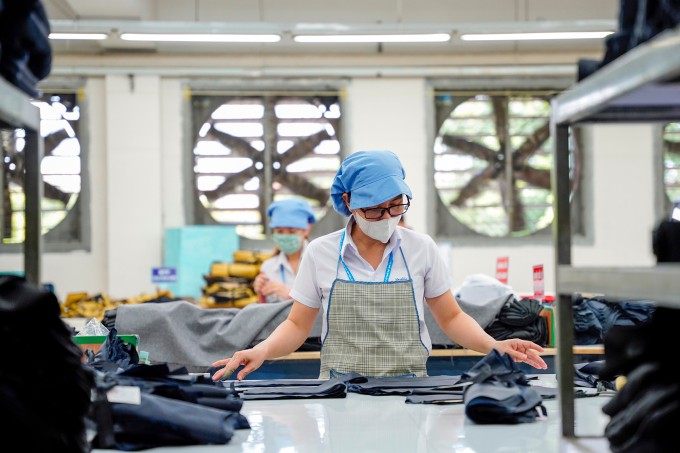
Vinatex leaders say the company no longer expects orders of "a few million products" - which were once the "backbone" of the industry. Vietnamese textiles are now positioned in the mid-to-high-end segment, requiring high skill levels, flexible production, and the ability to handle complex orders and constantly switch product codes in a short time. "Sometimes, the production line has to switch to a new product code in just 2-3 days; we no longer work on one code for weeks," Mr. Hieu shared.
To adapt, businesses are forced to change their strategies. Mr. Dang Thanh Tam cited the example of businesses participating in the development of social housing for workers, which has low profit margins but in return provides workforce stability for sustainable production. Furthermore, he likened proactively preparing high-tech infrastructure and clean energy to building a "smart port to welcome large ships."
For manufacturing businesses, Vinatex leaders say they are forced to constantly restructure and increase productivity to optimize costs, while simultaneously retaining jobs for workers and ensuring profitability. They also optimize resources by focusing on high-value products, instead of mass-produced, low-profit margin orders that are gradually shifting to countries with cheaper labor costs.
Mr. Nguyen Duc Hung Linh, Deputy General Director of AgriS Investment Division, recognizes that green standards (ESG) and traceability requirements are becoming key factors determining the competitiveness of Vietnamese goods.
"Businesses can only escape the 'low scale - low profit trap' if they move up the value chain or participate directly in the global production chain," Mr. Linh noted.
In this respect, Mr. Dang Thanh Tam said that green transformation will be a mandatory "passport" for businesses. Although costly, he believes this is a necessary sacrifice for businesses to contribute to the common goal as Vietnam has committed to achieving Net Zero by 2050.
Source: https://baolaocai.vn/5-nam-lua-thu-vang-cua-kinh-te-viet-nam-post891670.html














































































Comment (0)