

"Approximately 70-80% of lung cancer cases in Vietnam are detected when the disease is already in an advanced or metastatic stage, reducing the chances of curative treatment and increasing the financial burden on patients, their families, and the healthcare system."
At the Oncology Center of Bach Mai Hospital, about 10% of lung cancer patients are detected at an early stage, when the tumor is small, 2-3 mm in size, which is the time when surgery is possible and may not require chemotherapy after surgery," Associate Professor, Doctor Pham Cam Phuong, Director of the Oncology and Nuclear Medicine Center, Bach Mai Hospital, said at a free lung cancer screening organized by the center on May 10.
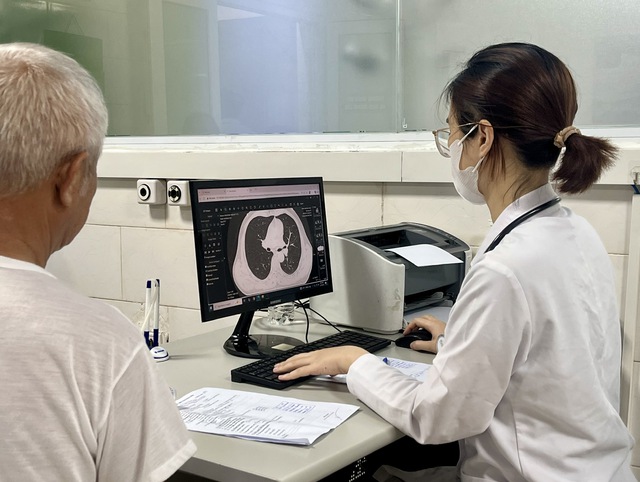
People aged 50 and over with risk factors should proactively get screened for lung cancer.
PHOTO: LIEN CHAU
On the morning of May 10th alone, out of 50 people screened, 4 were found to have lung nodules. Two of these four cases, who have risk factors, will be referred for further diagnosis, using AI to interpret results and assist doctors in making a diagnosis.
Dr. Phuong shared that early detection of lung cancer is very important because in the early stages, patients can receive radical treatment, contributing to improved treatment outcomes and reduced treatment and care costs.
When the tumor is small, after surgical removal, many cases do not require adjuvant treatment (chemotherapy, targeted therapy, etc.).
For advanced lung cancer cases, many are now under long-term control thanks to new drugs, treatments, and accurate diagnostic tests that help doctors develop optimal treatment plans.
However, for optimal treatment and to minimize costs, Dr. Phuong emphasized the role of early lung cancer screening, especially in high-risk groups.
These are individuals over 50 years old who have one of the following risk factors: long-term smoking of cigarettes or pipe tobacco (20 packs/year or more); exposure to smoke, dust, occupational pollution, or living in a radiation-contaminated environment; a family history of lung cancer (first-generation relative); chronic lung disease (COPD or pulmonary fibrosis); or passive smoking.
"We hope to maintain this program and, in the long term, have a national-scale lung cancer screening program in the country, helping to increase the rate of early detection of lung cancer," Associate Professor Phuong shared.
Detection when effective intervention is possible.
According to the Center for Nuclear Medicine and Oncology, low-dose computed tomography (CT) screening for lung cancer in high-risk groups has been shown to reduce the risk of death from lung cancer compared to conventional chest X-rays. Therefore, proactive screening in individuals with risk factors is a crucial step towards moving from "detection when symptoms appear" to "detection when effective intervention is still possible."
Lung cancer is currently one of the biggest challenges facing global health. According to the 2022 Global Cancer Data (GLOBOCAN), the world recorded approximately 2.5 million new cases and 1.8 million deaths from lung cancer, making it the leading cause of cancer death.
In Vietnam, the healthcare system records approximately 24,426 new cases and 22,597 deaths from lung cancer annually (in 2022). It is the second most common type of cancer and one of the leading causes of cancer-related deaths. Currently, most patients are diagnosed at a late stage of the disease.
The free lung cancer screening program was organized by the Center for Nuclear Medicine and Oncology, Bach Mai Hospital, over three days: May 10, 17, and 24, for 240 patients.
Through the program, individuals receive advice from oncology specialists on lung health care and monitoring, especially when risk factors are present. Cases with benign lung nodules will be advised to have regular follow-up appointments to assess any changes.
Source: https://thanhnien.vn/5-truong-hop-can-tam-soat-ung-thu-phoi-185260510143106558.htm



































































































Comment (0)