

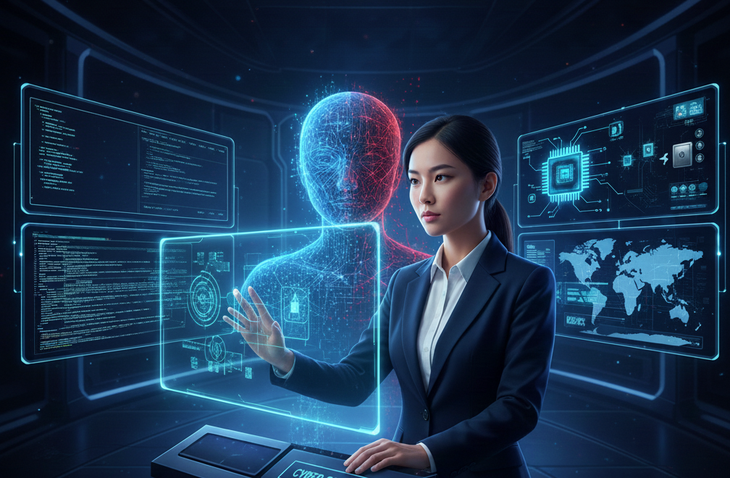
Illustrative image
Last week, during a coffee meeting, a colleague of mine, a translation lecturer at a university in Vietnam, sighed: "I used to love teaching translation. But now, every time I'm assigned a task, students just paste the question into ChatGPT and submit the result. I can barely give any feedback anymore."
Paradox: Knowledge and skills are no longer scarce, yet tuition fees are rising.
This story is not unique to translation education. It reflects the growing unease in the education sector as AI tools like ChatGPT and DeepL are disrupting many training models, especially in universities, that have existed for decades.
For centuries, universities operated on a very simple assumption: knowledge and skills were scarce. To acquire knowledge and skills, students had to pay tuition, attend classes, read books, complete assignments, and ultimately receive a degree.
A degree serves as both a source of knowledge and a certification of competence for the job market.
But today, AI can explain, synthesize, translate, and write in seconds at virtually zero cost. Paradoxically, while knowledge and skills are no longer scarce and are becoming cheaper, university tuition is steadily increasing.
The job market is reacting faster than universities. In the UK, the number of jobs available to recent graduates has fallen by around 33% over the past year, the lowest level in seven years, largely due to businesses using AI to automate entry-level positions. (Job level for those with little or no experience) and cost reduction.
In the US, more than 27 states have eliminated or reduced college degree requirements for a range of public service positions, aiming to expand the talent pool and address labor shortages as well as "degree inflation" (the trend of requiring higher educational qualifications for jobs that previously only required lower qualifications).
Businesses are re-evaluating labor as AI increasingly replaces repetitive, code-based jobs that were once the domain of young graduates.
In Vietnam, the shift driven by AI is evident in customer service and marketing, with chatbots and AI tools gradually replacing fundamental roles.
While many university programs still teach manual skills like content writing or community management, businesses have rapidly replaced interns and new employees with AI systems, prioritizing hiring those who can operate AI to improve performance.
However, not all types of knowledge and skills are depreciating at the same rate. Fields that can be standardized and streamlined, such as law, accounting, administration, operations engineering, and translation, are being most severely impacted.
I and many of my colleagues in the translation industry have experienced this firsthand. I've lost many international clients who used to translate contracts and sample documents because AI now handles those tasks faster and cheaper.
But I still have other projects, such as proofreading translations from Chat GPT, searching for and analyzing patient groups to test AI-translated health questionnaires, comparing responses between groups, and adapting language to suit different cultural contexts.
These are jobs that require judgment, experience, and empathy—qualities that AI, at least for now, cannot replace.
A friend of mine who works in architecture had a similar experience. Software and AI can quickly assist with standard drawings. But when a project has to balance people, landscape, culture, budget, and legal requirements, the architect's role becomes crucial. No algorithm can "read" people and context like a seasoned professional.
AI is getting closer to being "human".
These stories reveal an increasingly clear line: AI is a good replacement for repetitive, standardized tasks; but the closer it gets to humans, to context, emotions, ethics, and social responsibility, the more irreplaceable the role of humans becomes.
And it is here that the story no longer revolves solely around translation or architecture, but directly touches upon a central institution of the knowledge society: the university.
If even AI can score high on an exam, then continuing to teach and test in the old way only devalues the university. The value of universities today no longer lies primarily in imparting knowledge, but in helping students develop critical thinking, judgment, and intellectual prowess.
However, the reality in Vietnam shows that, while not all, many programs are still teaching and assessing in the old way: note-taking - rote learning - doing assignments according to a template - testing based on "sample answers".
In the context of AI, that teaching method reveals its limitations very clearly. A group report can be completed in an evening with AI; a presentation can be created in minutes; even arguments and evidence can be "prepared for you." If assessment only measures the ability to reproduce content, then the more technology learners have, the less they have to think using their own abilities.
Of course, there have also been positive developments. In some advanced programs, students are required to analyze AI output, compare viewpoints, defend arguments against counterarguments, work on real-world projects, and take responsibility for their choices.
These schools are leading the way in integrating AI into teaching, organizing AI teacher training, and developing curricula that emphasize AI tool usage skills. However, these approaches remain scattered, varying from one instructor or school to another, and have not yet become a consistent system direction.
The crucial question is not whether AI will "hinder" universities, but rather: are Vietnamese universities moving quickly enough to shift from teaching knowledge to nurturing human thinking and character – with AI as a powerful tool to support learners and workers?
Source: https://tuoitre.vn/ai-co-dang-lam-kho-dai-hoc-20251231112540395.htm

























































































Comment (0)