

New data suggests this may just be the calm before the storm. According to a survey by the World Economic Forum (WEF), 40% of employers expect to cut staff between 2025 and 2030 in positions that could be automated.
A previous report by Goldman Sachs also predicted that AI could replace the equivalent of 300 million full-time jobs. The International Monetary Fund (IMF) added that nearly 40% of global jobs are affected by AI, while Brookings estimates that over 30% of the workforce could see at least half of their jobs replaced by AI.
In reality, the number of jobs lost due to AI remains relatively small. A Challenger report from October 2024 showed that between May 2023 and September 2024, only about 17,000 jobs in the US were replaced by AI.
This might seem to contradict pessimistic predictions, but this could simply be a period of quiet accumulation before a sudden shift occurs. History shows that technological breakthroughs don't happen gradually; they usually build up before exploding.
In an interview, AI expert Kai-Fu Lee once stated that 40% of jobs worldwide could be replaced by AI within the next 15 years. The way technology impacts jobs could be like the quote from Ernest Hemingway's * The Sun Also Rises* : "Gradually, then suddenly."
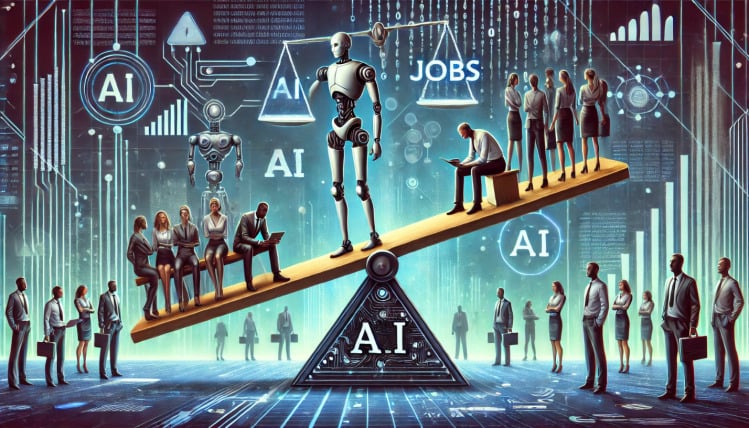
Illustration: Grossman/Dall-E
AI is infiltrating every field.
Although the impact of AI on jobs is still limited, its adoption is rapidly increasing. A McKinsey survey shows that 78% of organizations are using AI in at least one department, up more than 40% from the previous year. Many business leaders now trust AI more than their colleagues, with 38% even delegating business decision-making power to AI.
However, the vast majority of businesses have yet to integrate AI into their core operations. Only 1% of leaders describe their AI deployment as complete. This means that as economic pressures mount, companies may be forced to accelerate automation to save costs.
Programmers: The first profession group to be affected?
One of the fields most vulnerable to AI replacement is software development. Dario Amodei, CEO of Anthropic, believes that within the next 3-6 months, AI could write 90% of programming code, and within a year, it could handle the entire task.
This trend is already evident in startups. According to Y Combinator partner Jared Friedman, 25% of startups in the winter 2025 cohort have AI writing up to 95% of their source code. Large programming languages like Claude, Gemini, Grok, Llama, and ChatGPT are increasingly achieving high scores in professional tests, making the prospect of AI replacing programmers no longer a distant one.
Breakthroughs in AI, such as OpenAI's GPT-4.5, demonstrate an increasing ability to process information, closely resembling human intelligence. Some experts suggest this could be a sign that AI is nearing general artificial intelligence (AGI) – a stage where AI can perform most intellectual tasks like humans.
The AI tipping point: When will it happen?
Beyond programming, other professions such as financial analysis, customer service, and research are also at risk of being replaced by AI. The question is: When will this happen on a large scale?
History shows that economic downturns often accelerate technology adoption. During the Great Recession of 2007-2009, businesses were forced to cut staff and invest heavily in automation to maintain efficiency. If the global economy falls into recession in 2025 or 2026, companies may accelerate workforce reductions and shift to AI as a necessary solution.
Forecasts for a 2025 recession remain controversial. JP Morgan estimates a 40% chance, former US Treasury Secretary Larry Summers puts it at 50%, while betting markets are predicting odds of over 40%. If a recession does occur, AI may not only be a supporting tool but also become a necessity for businesses to survive.
Salesforce CEO Marc Benioff once said, "We are the last generation of CEOs who only manage people. From now on, every CEO will have to manage both people and AI."
At its current pace, 2025 could not only be the year AI boosts productivity, but also the year it begins to replace humans: gradually, then abruptly.
Hoai Phuong (according to VB, Forbes)
Source: https://www.congluan.vn/ai-se-dan-dan-roi-dot-ngot-thay-the-con-nguoi-post339807.html

![[Image] National Assembly discusses the implementation of the socio-economic development plan.](https://vphoto.vietnam.vn/thumb/1200x675/vietnam/resource/IMAGE/2026/04/20/1776696707422_ndo_br_img-20260420-185419-jpg.webp)


![[Photo] General Secretary and President To Lam meets with National Assembly delegates from ethnic minorities.](https://vphoto.vietnam.vn/thumb/1200x675/vietnam/resource/IMAGE/2026/04/20/1776696701056_a1-bnd-8331-3342-jpg.webp)

























































































Comment (0)