


Students in Hoa Binh ward learn about ancient bronze drums.
According to researchers, the Muong people are an indigenous ethnic group that separated from the Viet-Muong bloc, with ancestors from the Lac Viet people, the creators of the brilliant Dong Son culture. After the Common Era, Hoa Binh was also one of the important centers in the continuation and creation of the Dong Son culture, notably the bronze drums that the Muong people have preserved and passed down through many generations.
Ms. Nguyen Thi Hai Ly, Deputy Director of the Hung Vuong Museum, stated: “Bronze drums are ancient musical instruments dating back to the time of King Hung's founding of the nation, closely associated with the cultural life, activities, and beliefs of the ancient Vietnamese people. Over time, the role of bronze drums has become increasingly less prominent in the daily lives of the Kinh people, but in the Muong regions, bronze drums were still used in religious ceremonies until the early 19th century. Notably, the Song Da bronze drum – the first drum discovered in Hoa Binh in 1887 – marked the beginning of large-scale excavations and research on bronze drums.”
To date, more than 100 ancient bronze drums have been discovered in Hoa Binh, including 11 Type I Heger drums and over 90 Type II Heger drums. The Hung Vuong Museum, Branch 3, currently houses 78 ancient bronze drums, while the rest are preserved in various localities within the province and in museums both domestically and internationally.
If the Heger Type I drum, also known as the Dong Son bronze drum, is a cultural and civilizational symbol of the ancient Vietnamese people, then the Heger Type II bronze drum is considered a cultural symbol of the Muong people in Vietnam. When studying bronze drums, scientists believe that the Muong people were among the owners of these drums, especially the Heger Type II bronze drum.

Type II bronze drums are characterized by their prominent patterns, primarily geometric motifs with a repetitive nature. The star in the center of the drum usually has 8 or 12 small points, unlike the star on the Dong Son bronze drums. The edges of the drum feature toad figures – an image associated with the ancient folk belief that "the toad is the nephew of the God of Heaven." The sound of the toad's croak was associated by the ancients with the deep, majestic sound of the drum, so during droughts, they would bring out the drums to beat, hoping for favorable weather and a bountiful harvest. Some drums also depict pairs of toads mating, adding a meaning of fertility and expressing the desire for many children and grandchildren.
With sophisticated printing and embossing techniques, the diamond-shaped patterns have transformed the surface of the bronze drum into a tapestry woven with intricate designs, reminiscent of the brocade fabrics of the Muong ethnic group in Hoa Binh.
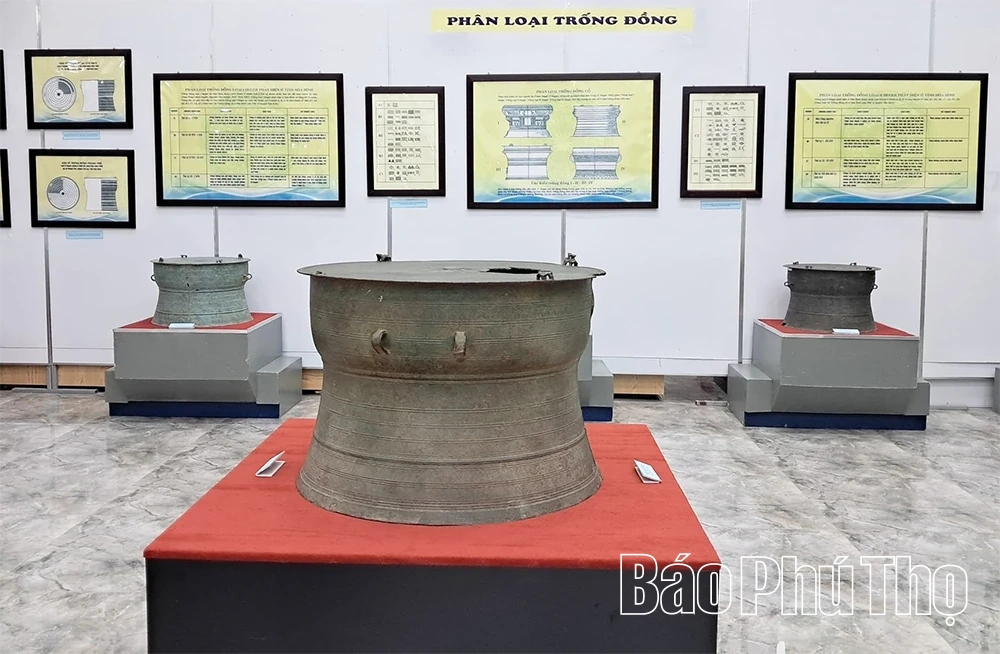
Ancient bronze drums are on display at the Hung Vuong Museum, facility 3.
Bronze drums arrived in the Muong villages primarily through gifts bestowed by feudal dynasties upon local chieftains, reflecting the political unity between Vietnam and the Muong people. Additionally, bronze drums were exchanged through trade and commerce. Most bronze drums were discovered accidentally when people dug canals, built houses, or constructed roads; some were found in ancient Muong tombs...
In ancient Muong society, bronze drums were sacred artifacts, symbolizing power and wealth. Only high-ranking officials and nobles were allowed to use them. Beyond their function as musical instruments used in important community rituals, bronze drums also served as communication and signaling tools. Drums resonated during funerals to guide the deceased to their ancestors; during festivals to connect people with the divine; and in battles to rally the community and encourage unity. The sound of the drums was therefore both sacred and majestic, a link between the past and the present, between humanity and heaven and earth.

Deputy Director of the Hung Vuong Museum, Nguyen Thi Hai Ly, added: “Bronze drums hold an important place in the consciousness and life of the Vietnamese ethnic communities in general and the Muong people in Hoa Binh in particular. They are precious assets left by our ancestors to their descendants, and symbols of Vietnamese civilization and culture during the nation-building period. Preserving and promoting the value of bronze drums contributes to preserving the traditional cultural identity of the nation. The Hung Vuong Museum, Branch 3 in Hoa Binh, has organized many exhibitions to widely introduce the precious cultural value of bronze drums to the people and tourists. Through this, it helps future generations understand the humanistic values, lifestyle, way of thinking, soul, customs, and fine traditions of the Muong people in particular and of the Vietnamese ethnic communities in general.”
Willow
Source: https://baophutho.vn/am-vang-trong-muong-248257.htm


































![[Video] Sunset at Lap An Lagoon – Where the sun sets over the fishing nets](https://vphoto.vietnam.vn/thumb/1200x675/vietnam/resource/IMAGE/2026/05/31/1780192137701_beach-landscape-sea-water-nature-grass-745871-pxhere-com.jpeg)

















Comment (0)