The rich flavor of freshwater eel, a taste deeply rooted in the soul of our homeland.
Many people say that to understand the "essence" of the people of Nghe An, just try a bowl of eel soup or eel porridge. The spicy, pungent flavor, the golden color of turmeric like the sunshine of Central Vietnam, and the rich, genuine taste reflect the heart of the people of this land.
This year, eel soup and eel porridge are no longer simply a special dish served to guests, but have officially been given a new status: National Intangible Cultural Heritage.
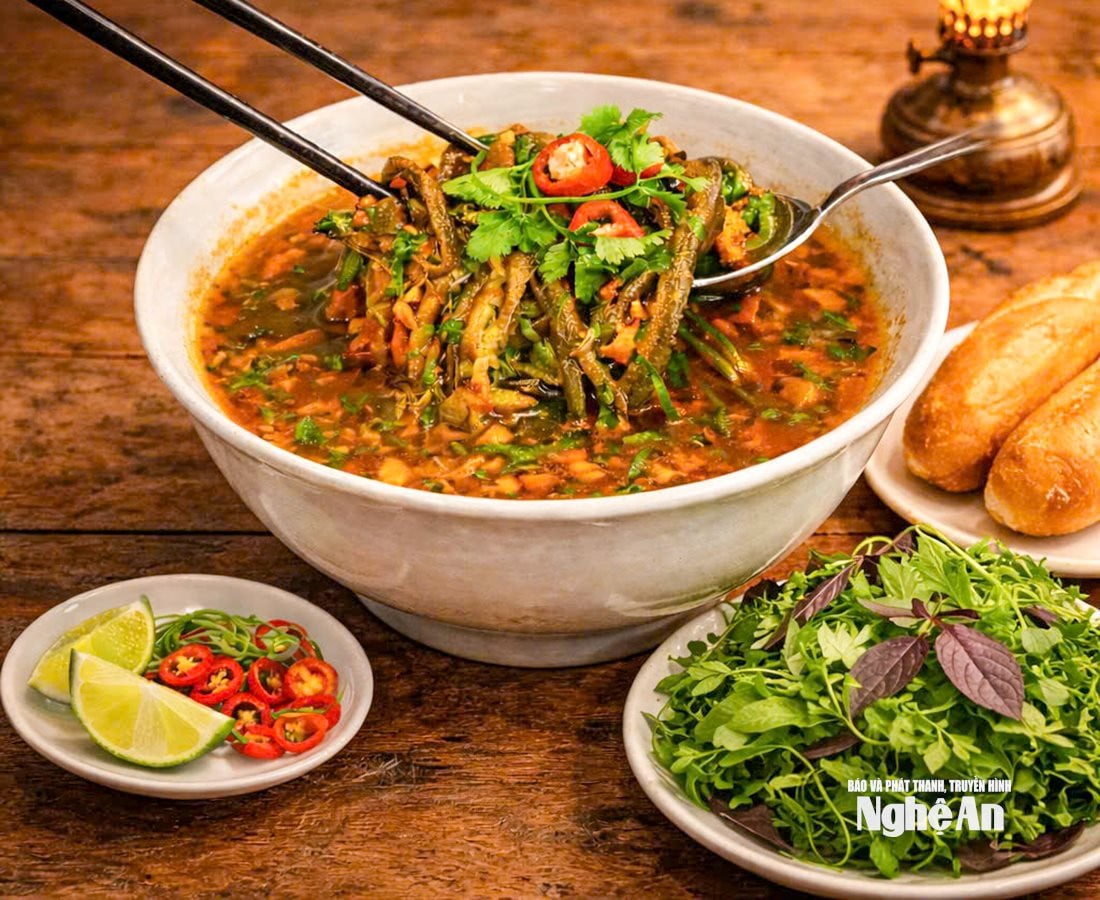
Eel soup from Nghe An . (Photo courtesy)
This is a historic milestone for the province's cultural sector, as it is the first type of folk knowledge heritage related to cuisine from Nghe An to be honored at the national level. Unlike tangible relics, culinary heritage lies in the skillful hands, the refined senses of smell and taste, and the generations-old memories of mothers and sisters.
To make an authentic bowl of eel soup or eel porridge from Nghe An, it's a journey steeped in centuries of folk knowledge. From selecting the golden, firm-fleshed field eels to preparing them using sharp bamboo sticks instead of iron knives to preserve their distinctive sweetness, the people of Nghe An don't overuse exotic spices. They only use what they carefully gather from the soil of their homeland: tiny but fragrant shallots, slices of mature, golden turmeric, and a few refreshing sprigs of Vietnamese coriander...

The decision recognizes "Knowledge of preparing eel dishes in Nghe An" as a national intangible cultural heritage.
The recognition of eel processing as a heritage not only celebrates a delicious dish but also honors the creativity of generations of agricultural people. On the Tet (Lunar New Year) feast table, a steaming bowl of eel soup served with a pristine white rice cake or a crispy slice of bread not only satisfies the taste buds but also connects memories. This heritage reminds us that culture is not something distant; it is embodied in every grain of rice, every eel, and in the love that people have for their local produce.
Sacred spirits gather at the foot of the waves.
Leaving the rice paddies in their prime, we journey south to Cua Lo Bay to respectfully offer incense at Mai Bang Temple. This spring, the joy of the local people is doubled as the Mai Bang Temple Festival has officially been recognized as a National Intangible Cultural Heritage.
Following the Yen Luong Temple Festival (also known as the Phuc Luc Ngoat Festival), this is the second traditional festival in the "coastal tourist city" of Cua Lo to receive this honor. If eel farming is the soul of the countryside, then the Mai Bang Temple Festival is the salty identity of the fishing community. This ancient temple worships deities who contributed to protecting the nation and ensuring peace for the people, especially generals from the Tran and Le dynasties such as Chieu Trung Vuong Le Khoi, along with ancestors who contributed to the founding and development of the area.

Ritual ceremony at Mai Bang Temple Festival. Photo: CSCC
The recognition of the Mai Bang Temple Festival as a national heritage carries profound symbolic significance. It affirms that, alongside a modern Cua Lo with its high-rise hotels and bustling services, there remains a persistent flow of spiritual culture, a pillar of support for the people who depend on the sea for their livelihood. The festival is not only an occasion for rituals, processions, or folk games, but also a solemn vow between people and the sea, praying for a year of calm seas and abundant catches of shrimp and fish.
This event also opens up a new direction for tourism in Cua Lo. Now, tourists come to this coastal town not only to swim or enjoy seafood, but also to immerse themselves in the heritage space, learn more about the history of the land through solemn rituals and simple folk songs by the sea.
Weaving brocade from the source of heritage.
Looking back at the cultural landscape of Nghe An today, we cannot help but feel proud that the "treasure" of national intangible cultural heritage has reached 15. Each heritage is a brilliant piece weaving together the tapestry of culture of President Ho Chi Minh's homeland.
Before the eel processing industry and the Mai Bang Temple Festival were recognized, Nghe An had already made its mark with a diverse system of heritage, stretching from the lowlands to the highlands. This includes the exquisite beauty of the traditional brocade weaving of the Thai people; the unique cultural features of the O Du people's Thunder-Welcoming Ceremony; the solemnity of the Yen Thanh sacrificial drum art; and the intellectual depth of the ancient Thai script of Nghe An.

Mai Bang Temple in Cua Lo ward. Photo: CSCC
We also cannot fail to mention the festivals that have become spiritual symbols of this land, such as: the Cờn Temple Festival (Quỳnh Mai ward), Quả Sơn Temple (Bạch Ngọc commune), Chín Gian Temple (Quế Phong commune), Bạch Mã Temple (Kim Bảng commune), Thanh Liệt Temple (Hưng Nguyên Nam commune), Ông Hoàng Mười Temple (Hưng Nguyên commune), Yên Lương Temple (Cửa Lò ward), Nguyễn Cảnh Hoan Temple (Lương Sơn commune), and the Xăng Khan ritual, imbued with the life and human feelings of the people of the Western region...
For these heritage sites to truly become a driving force for development, we need a conservation strategy that is closely linked to contemporary trends. Conservation doesn't mean "freezing" heritage in museums, but rather bringing it to life and providing livelihoods for the community. For the eel processing industry, it's about building a value chain from the craft village to the dinner table, applying technology to standardize processes while preserving the folk essence. For traditional festivals, it's about elevating their organization, transforming each festival into a unique cultural tourism product with year-round appeal.

Throwing the palanquin to pray for a good fishing season (running and vomiting) - a unique ritual at the Cờn Temple Festival - a national intangible cultural heritage. Photo: Hồ Xuân Thành.
In the vibrant atmosphere of the Lunar New Year, as crowds flock to spring festivals and celebrations, pride in newly acquired heritage permeates every story at the beginning of the year. The legacy left by our ancestors is an invaluable treasure, and cherishing and allowing these values to flourish in today's life is our way of showing gratitude to our roots and continuing the proud song of the people of Nghe An. May this cultural stream continue to flow, like the Lam River, tirelessly nourishing souls and giving wings to the aspirations of our homeland to reach new heights in this new era.
AD Advertising
Source: https://baonghean.vn/vi-que-tinh-dat-hoa-di-san-10324511.html


![[Photo] The heat at the fireworks display site on the opening night of the Da Nang International Fireworks Festival 2026](https://vphoto.vietnam.vn/thumb/1200x675/vietnam/resource/IMAGE/2026/05/27/1779889741485_ndo_br_z7872039145157-fecaba5112f39e8352544099d7ef4738-5140-jpg.webp)
![[Photo] Life on both banks of the river returns to its bustling pace on the day the Long Bien Bridge opens to traffic.](https://vphoto.vietnam.vn/thumb/1200x675/vietnam/resource/IMAGE/2026/05/28/1779949763708_cau-long-bien-minh-duy-7-3610-jpg.webp)
![[Image] Checking the security conditions at the exam site, ready for the 10th grade exam.](https://vphoto.vietnam.vn/thumb/1200x675/vietnam/resource/IMAGE/2026/05/28/1779943458889_z7872507660648-d764421a26e8cd7b61d70d142a48a685-jpg.webp)


























































Comment (0)