

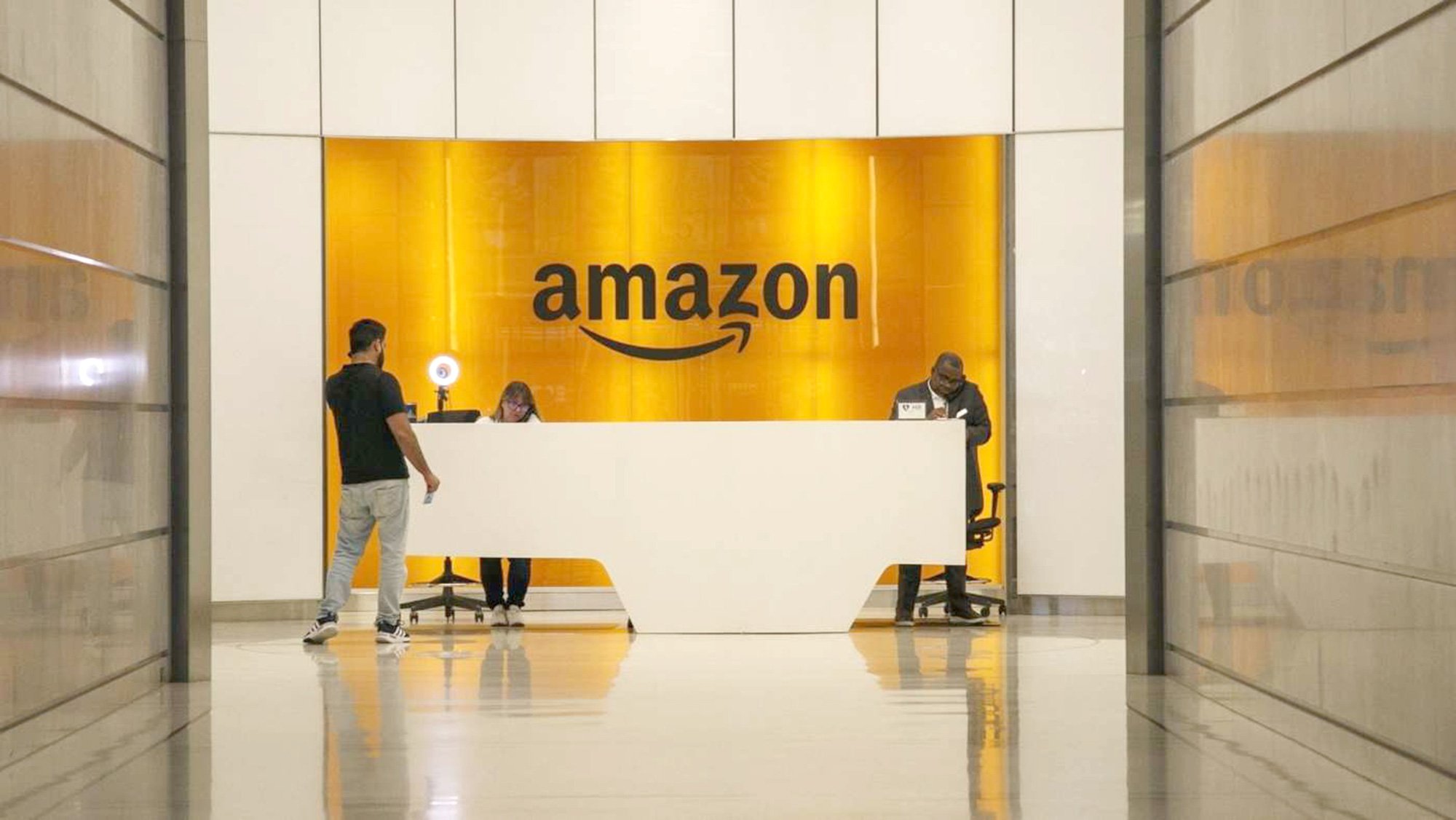
The reception area of Amazon's New York office - Photo: SHUTTERSTOCK
The regulation, announced in an internal memo sent to all employees by CEO Andy Jassy on September 16th, will take effect on January 2nd, 2025. It quickly sparked controversy, with some advocating for in-person meetings to increase productivity and others prioritizing flexibility and work-life balance.
Business trends
Currently, Amazon employees work a hybrid system consisting of three days at the office and two days working from home each week. This system has been in place since the beginning of 2023, replacing the remote work arrangement implemented during the COVID-19 pandemic.
Jassy shared his thoughts on the new decision: "Looking back over the past five years, we can be confident that the benefits of working together are immense. We've found that it makes it easier for colleagues to learn, lead, practice, and strengthen the company culture. Collaboration, brainstorming, and innovation are simpler and more efficient. Mutual learning happens smoothly, while the ability to connect between teams is enhanced."
The New York Times , citing internal Amazon sources, confirmed that employee attendance will be recorded by swiping employee ID cards. All employees must come to the office, even if most team members work in other offices. Amazon will invest in building additional meeting rooms and approximately 3,500 phone booths to accommodate employee needs.
With this decision, Amazon becomes the first leading global technology company to completely abandon remote work or hybrid work arrangements. Other tech giants like Google and Meta still maintain a policy of working in the office only three days a week and show no signs of changing it.
However, looking at the broader picture, the wave of returning to the workplace has been quietly spreading across most industries in the US over the past two years. In mid-December 2023, Boeing's commercial aircraft business implemented a five-day-a-week work week policy, starting after the Christmas holidays. By February 2024, the multinational freight forwarding service UPS also required its employees to come to the office every day of the week.
Even Zoom – the online meeting app and a symbol of remote work during the COVID-19 pandemic – required employees to come to the office.
Other prominent businesses that have abandoned remote work include entertainment giant Disney, leading financial firm Goldman Sachs, and top investment bank Bank of America… In their announcements requesting a return to work, most companies have presented arguments similar to Mr. Jassy's recent announcement.
Remote work ends: Employees complain.
While popular with business leaders, the requirement to return to the office full-time has been criticized by the majority of employees. After nearly four years of working remotely, many have built their personal lives around this work model. Therefore, having to return to the office will undoubtedly cause considerable disruption to their lives.
Immediately after Mr. Jassy's announcement was made, Amazon's communication channels were flooded with mixed reactions.
Tamia Reed, a data center engineer in Amazon Web Services' cloud computing division, shared on social media: "For many of us, working remotely is not just a convenience, but a necessary condition for a more flexible and balanced work-life."
This abrupt change goes against our efforts to respect diverse work styles and accommodate different individual needs. I hope Amazon will reconsider and find a way to support both the business needs and the diverse work preferences of its employees."
Professor Prithwiraj Choudhury of Harvard Business School (Harvard University) asserts that decisions like Amazon's will inevitably have consequences. He points out that when a company abandons flexible working policies, it often loses top talent or misses out on promising employees or candidates. Choudhury commented, "This is a step backward, a regression in leadership."
Some analysts even suggest that Amazon and other companies are actually looking to cut staff. They understand the risk of losing employees if they force them to stay in the office all week, but they will still pursue this policy to subtly pressure workers to voluntarily quit.
Mixed work does not affect productivity.
Data from the Flex Index shows that in Q3 2024, 33% of US businesses required employees to come to the office every week. In the technology sector, as many as 79% of companies maintained flexible working policies, while only 3% required employees to be in the office full-time.
Meanwhile, a recent study in the journal Nature found that working three days at the office and two days at home did not affect employee productivity. Professor Nicholas Bloom of Stanford University, one of the researchers involved in the study, stated: "Hybrid work is a form of work that balances productivity, efficiency, and employee retention."
Source: https://tuoitre.vn/amazon-cham-dut-ky-nguyen-lam-viec-tu-xa-20240918223110311.htm














































































































Comment (0)