

Prime Minister Narendra Modi aspires to make India a developed economy by 2047. Analysts say Modi's coalition will not derail India's economy and development, but the government needs to do four things to ensure the dream can be realized.
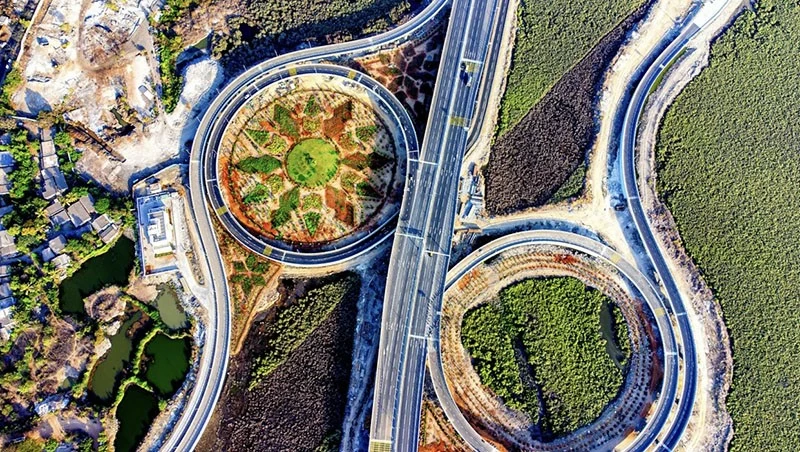 |
| India has undertaken a major infrastructure boost and has made significant strides in connecting and modernizing highways, railways, and airports. Puneet Vikram Singh, Nature and Concept Photographer, | Moments | Getty Images |
Over the past two years, Prime Minister Narendra Modi has confidently spoken about his ambitious goal of making India a developed economy by 2047.
All eyes will now be on Modi and the Bharatiya Janata Party-led coalition to see if they can maintain economic momentum and continue to improve the lives of millions during their third consecutive term.
Analysts predict these four areas will be at the top of the agenda.
1. Boost infrastructure
India has undertaken a major infrastructure boost and has made significant progress in connecting and modernizing highways, railways, and airports.
Last year, the consulting firm EY predicted that India would become a $26 trillion economy by 2047 and stressed that building the country's infrastructure capacity would be key to making this a reality.
“Since Modi took office, he has worked hard to build ports, railways and all kinds of hard infrastructure to keep business running smoothly. He will double that effort,” said Samir Kapadia, CEO of India Index and managing director at Vogel Group.
India still lags behind China in this area and needs to make more effort if it wants to achieve a high growth trajectory to continue attracting foreign investors.
In the interim budget released in February, Finance Minister Nirmala Sitharaman estimated that capital spending would increase by 11.1% to $133.9 billion in fiscal year 2025, primarily focused on railway and airport construction.
But Santanu Sengupta, an Indian economist at Goldman Sachs, notes that improving connectivity between cities shouldn't be the sole focus.
Sengupta said, “Along with building physical infrastructure, India needs to consistently implement structural reforms... Land acquisition and land clearance are needed to build more factory infrastructure,” adding that this will boost job growth in the sector.
However, analysts emphasize that the government may face opposition because Modi's weakening could make it more difficult to acquire land for projects.
Richard Rossow, senior adviser and chair of US-India policy research at the Center for Strategic and International Studies, said: “Such goals may be harder to achieve if state parties have temporary veto power due to the coalition structure.”
2. Increase production
Over the past decade, Modi has actively promoted India's self-reliance and its rise to surpass China as Asia's largest manufacturing powerhouse – particularly in the chip manufacturing sector.
Major US tech companies are increasingly moving parts of their supply chains to India. The Financial Times reported in December that Apple had told component suppliers it would source batteries from Indian factories for the upcoming iPhone 16. Google is also reportedly set to begin manufacturing Pixel phones in India this quarter.
Apple's supplier Foxconn has announced it will increase investment in India, while Micron Technology is expected to produce its first Indian-made semiconductor chip by early 2025.
According to forecasts by Counterpoint Research and the Indian Semiconductor and Electronics Association, India's semiconductor industry will reach a value of $64 billion by 2026, tripling from the $23 billion of 2019.
“This will probably be India’s biggest source of income in the next 5 to 10 years,” Kapadia said. “Prime Minister Modi is convinced that if India can get involved in semiconductor manufacturing and if he does it right, India can become an unaffected economy.”
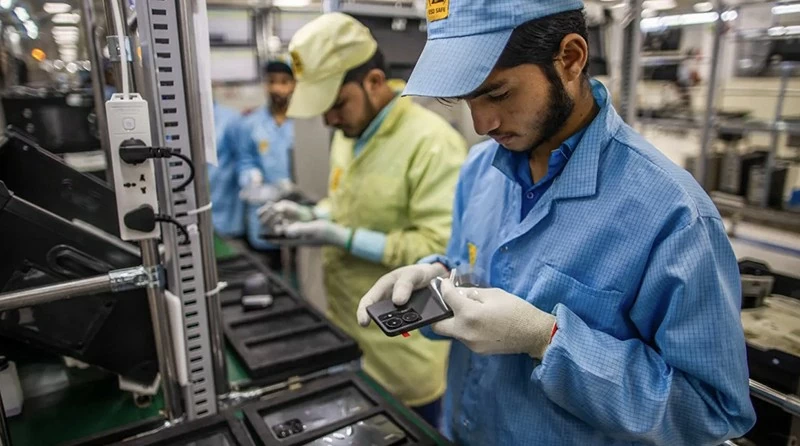 |
| Workers labor on a mobile phone assembly line at Padget Electronics, a subsidiary of Dixon Technologies, in Noida, India. Bloomberg | Getty Images. |
3. Control high unemployment rates.
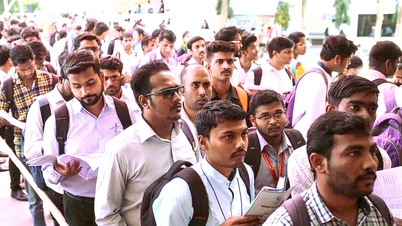
Sumedha Dasgupta, a senior analyst at The Economist Intelligence Unit, said that unemployment is currently one of the biggest problems facing the world's most populous nation, and a skills mismatch is exacerbating the issue.
"There has been a mismatch between the skill levels of the domestic workforce and the high demand for innovation from employers. This will certainly continue this decade, and possibly even into the 2030s," she told CNBC.
According to the Centre for Monitoring Indian Economy, the unemployment rate in India rose to 8.1% in April from 7.4% in March.
A survey conducted by the Centre for Development Social Research in April, ahead of the election, showed that unemployment was the top concern for 27% of the 10,000 people surveyed. More than half (62%) of those surveyed said that finding a job had become more difficult in the past five years during Modi's second term.
Analysts emphasize that the new coalition government must now improve local education standards and skills training to ensure people have stable jobs in relevant fields.
Vivek Prasad, Head of Markets at PwC India, said: “While highly educated individuals with practical experience can secure jobs in this sector, creating broad and equitable employment opportunities requires a more holistic approach.”
Prasad told CNBC that new education and vocational training policies will “engage individuals at every level of the production value chain, ensuring the benefits of economic progress are shared across society,” adding that boosting employment for women is paramount to driving India’s growth.
4. Increase foreign investment.
From veteran emerging markets investor Mark Mobius to global strategist David Roche, market experts remain optimistic about India.
India's national stock exchange has a total market capitalization of $4.9 trillion — the third largest in the Asia-Pacific region, according to data from the World Federation of Stock Exchanges. India's market capitalization is projected to increase to $40 trillion in the next two decades.
According to LSEG data, the Nifty 50 and Sensex benchmark indices have outperformed this year — up 8% and 7% year-to-date, respectively.
However, analysts say that foreign direct investment in the country needs to accelerate to further boost economic growth and development.
According to Sengupta of Goldman Sachs, foreign direct investment in India last year was relatively weak due to a challenging private financing environment caused by high interest rates in the United States.
According to Sengupta, "India is likely to attract more FDI from the US as interest rates fall and the financing environment becomes easier."
Prabhat Ojha, partner and head of Asia client services at Cambridge Associates, noted that investment in India “still has a lot of work to do” to continue attracting foreign capital.
He recommended that investors pay more attention to India's banking sector – a sector currently experiencing quality growth and sound capital allocation.
Ojha told CNBC: “From 2017 to 2019, there was a purge of Indian banks and now they are in very good shape.”
Source: https://baoquocte.vn/tro-thanh-quoc-gia-phat-trien-vao-nam-2047-an-do-can-uu-tien-4-viec-sau-284460.html





![[Photo] Prime Minister Pham Minh Chinh receives the Chinese Ambassador to Vietnam](https://vphoto.vietnam.vn/thumb/1200x675/vietnam/resource/IMAGE/2026/04/05/1775397481797_ndo_br_dsc-5512-jpg.webp)



































































































Comment (0)