


Stabilizing gold and USD prices will help stabilize the sentiment of those depositing VND in banks - Photo: PHUONG QUYEN
Since the beginning of the year, exchange rate pressure has been quite intense. The selling price of the US dollar remains pegged at 25,471 VND (according to the Vietcombank exchange rate on June 17). At its mid-June meeting, the US Federal Reserve (Fed) maintained the high interest rate on the US dollar (5.25 - 5.50%).
With several supporting factors, the exchange rate will cool down.
Speaking to Tuoi Tre newspaper, Mr. Truong Van Phuoc, former acting chairman of the National Financial Supervisory Commission, said that the Fed has raised interest rates at the fastest pace in 40 years to combat inflation and has maintained them at high levels for the past three years.
Although US inflation has begun to cool down, the situation is not yet stable, and there are many differing predictions regarding the possibility of interest rate adjustments by the Fed.
According to Mr. Phuoc, the Fed's interest rate cut, sooner or later, within a few months, will have an impact on the market. But more importantly, there is the market's strong expectation that the US dollar will depreciate.
In fact, the Dollar Index has been rising for a long time and has remained at its peak due to interest rate differentials. "It has climbed to the top, now it's just a matter of time before it slowly descends," Mr. Phuoc commented.
Furthermore, according to Mr. Phuoc, the likelihood of a significant depreciation of the VND in the second half of this year will no longer be high due to the gradual increase in VND deposit interest rates at banks.
"The gradual increase in interest rates stems from the growing demand for credit. Credit growth is better, but deposit growth is low, which puts pressure on banks to raise savings interest rates," Mr. Phuoc affirmed.
Ms. Tran Thi Khanh Hien, Director of Research at MB Securities (MBS), also believes that pressure on the exchange rate will soon ease as the USD tends to weaken. After the Fed's meeting on June 12th, although the USD interest rate remained pegged at its current level, the more "dovish" stance led to a cooling of the dollar's strength. Many experts predict that the Fed is likely to cut interest rates at least once this year.
According to Ms. Hien, from July and August onwards, import demand will decrease, which will reduce the demand for foreign currency. "In addition, Vietnam is still maintaining a positive balance of payments, foreign exchange reserves are expected to reach 110 billion USD in 2024, and FDI disbursement remains strong."
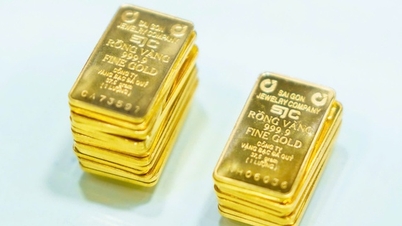
"In particular, the government is very determined to stabilize gold prices and narrow the gap with world prices, which will consequently cool down domestic demand for USD," Ms. Hien said.

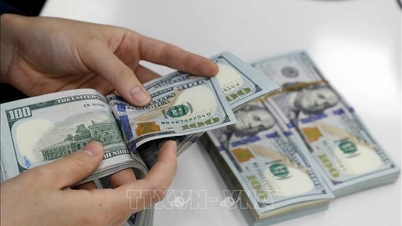
Customers conducting transactions at a bank in District 1, Ho Chi Minh City - Photo: Q. Dinh
Remain vigilant about inflation.
With the US dollar strengthening, some central banks in the region have had to take various measures to intervene and stabilize the exchange rate, and some have had to postpone interest rate cuts.
Just as the Indonesian central bank had to raise interest rates this year due to the depreciation of its currency, does Vietnam need to raise its policy interest rate?
Economist Le Duy Binh, director of Economica Vietnam, believes that the State Bank of Vietnam still has the tools to manage the exchange rate without needing to raise interest rates.
"Many major central banks around the world are signaling that inflation has peaked and are trending toward lowering interest rates. The Fed hasn't lowered interest rates yet, but it also won't raise them anytime soon," Mr. Binh said.
According to Mr. Binh, Vietnam's monetary policy began to be eased last year to support business recovery. If the State Bank of Vietnam raises the policy interest rate again, it would send a strong signal of a shift from easing to tightening.
Nevertheless, commercial banks have proactively raised deposit interest rates to stimulate demand for deposits, contributing to exchange rate stability...
"The exchange rate has many supporting factors, but whether or not to raise the policy interest rate currently depends on both inflation and system liquidity. If there are signs of rising inflation and a shortage of system liquidity, the State Bank of Vietnam also needs to have flexible and proactive solutions regarding the policy interest rate," Mr. Binh said.
With deposit interest rates starting to rise, many are concerned that lending interest rates will also increase, hindering economic recovery. However, according to Mr. Truong Van Phuoc, there is no need to be overly concerned about this issue because lending interest rates cannot immediately increase after deposit interest rates rise.
Even in the current sluggish credit environment, banks wanting to increase loan balances have to lower lending interest rates to stimulate credit demand.
"Ultimately, exchange rates and interest rates remain crucial to macroeconomic stability. Inflation is a key aspect of this," Mr. Phuoc said. Global inflation is beginning to decline, with average global inflation projected to fall from nearly 6% this year to just over 3% in the next few years. For a country with a deep economic opening like Vietnam, rising global commodity prices will put pressure on domestic price levels, and vice versa.
"However, Vietnam must remain vigilant because even though world prices are not rising significantly, the increase in exchange rates and the depreciation of the VND will add to the pressure on domestic prices."
"This needs to be considered when managing exchange rate policy," Mr. Phuoc advised. Furthermore, many people domestically are worried that the salary increase from July 1st will put pressure on inflation. However, according to Mr. Phuoc, the scale of the new salary adjustment is not too large, so inflation around 4% this year is feasible.
What are the currencies of the countries in the region like?
The downward trend of the VND against the USD remains quite similar to other currencies in the region. For example, the Thai baht has fallen nearly 7% since the beginning of the year, the Malaysian ringgit has fallen nearly 3%, the Japanese yen has fallen 11%, the Chinese yuan has fallen nearly 2.3%, and the Singapore dollar has depreciated by 2.61%...
According to Ms. Tran Khanh Hien, Director of Research at MBS, the weakening of the VND will affect the flow of foreign investment capital, especially foreign indirect investment (FII) in the stock market, putting pressure on USD-denominated debt obligations of both the private sector and the government.
At the same time, it will push up the prices of imported goods sharply, indirectly affecting inflation targets... Conversely, a weak VND will be a favorable factor supporting net exporting businesses.
 'Rumors about a change in exchange rate management are inaccurate.'
Source: https://tuoitre.vn/ap-luc-ti-gia-dan-ha-nhiet-20240618082142378.htm




![[Photo] Prime Minister Pham Minh Chinh receives the Chinese Ambassador to Vietnam](https://vphoto.vietnam.vn/thumb/1200x675/vietnam/resource/IMAGE/2026/04/05/1775397481797_ndo_br_dsc-5512-jpg.webp)




















































































Comment (0)