

Lower the maximum tax rate from 35% to 25%.
In the latest draft of the amended Personal Income Tax Law, the Ministry of Finance submitted Option 2 to the Government, proposing a minimum tax rate of 5% for taxable income of 10 million VND per month (after deducting personal allowances and other taxable expenses). The maximum tax rate would be 35% for taxable income exceeding 100 million VND per month. The progressive tax brackets would be simplified from 7 to 5.
According to calculations by the Ministry of Finance, adjusting the tax schedule according to the above plan will result in a reduction of 8,740 billion VND in budget revenue.
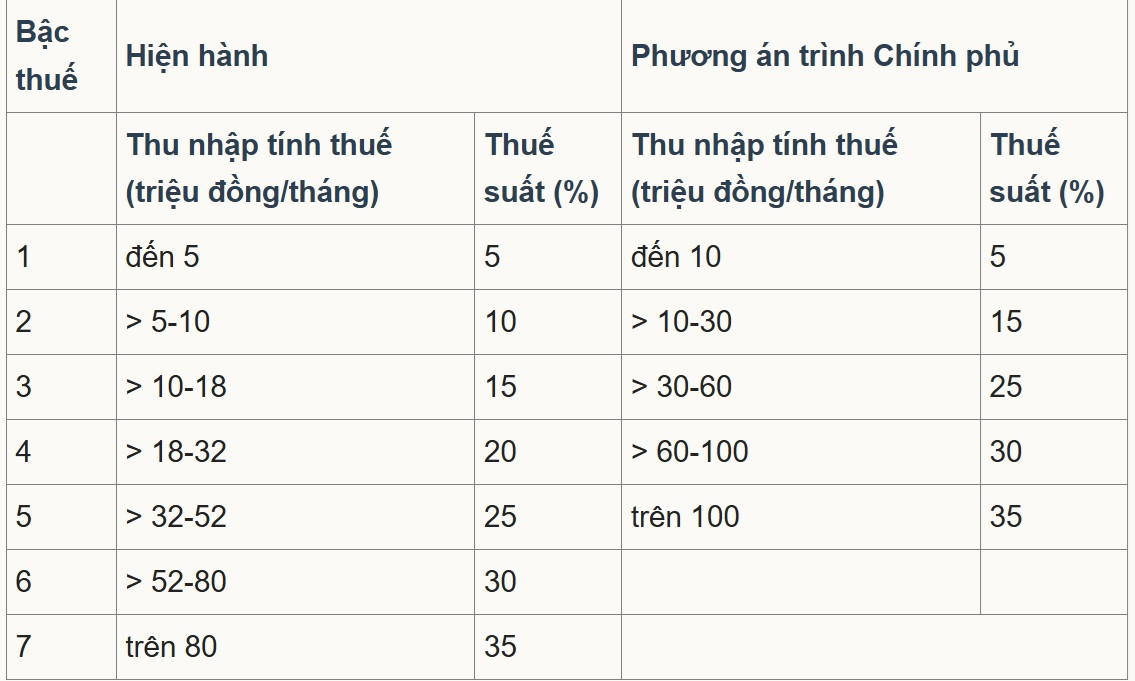
The tax brackets according to current regulations and the proposed adjustments by the Ministry of Finance.
Speaking to VietNamNet reporters , Associate Professor Pham Manh Hung, Deputy Director of the Institute of Banking Science Research, Banking Academy, assessed that reducing the number of tax brackets from 7 to 5 simplifies the tax system and reduces the "jump" at intermediate levels.
The highest tax threshold has also been raised from over 80 million VND to 100 million VND per month, meaning only very high-income earners will be subject to the 35% rate. This is considered an improvement that is friendly to investors and skilled workers, as it reduces the number of people falling into the highest tax bracket.
However, according to Mr. Hung, the 35% ceiling is still significantly higher than in other competitive labor markets like Singapore (currently the highest rate is 24% for residents, with many incentives and deductions). Therefore, with very high salary packages, marginal tax rates could affect the ability to attract and retain high-level personnel.
The expert suggested solutions, such as raising the 35% tax threshold above 100 million VND or expanding targeted deduction and incentive policies (R&D, technology experts, green finance) to increase competitiveness compared to other centers in the region.
Among the comments on the draft Law on Personal Income Tax (amended) published by the Ministry of Finance, there was a proposal to further lower the maximum tax rate from 35% to 25%, while widening the gap between tax brackets and adjusting the tax threshold.
Specifically, the National Assembly delegation of Nghe An province agreed with the five tax brackets as in option 2, but suggested studying a reduction in the tax rates at each bracket to ensure the highest rate remains at 25% to encourage and motivate taxpayers.
Meanwhile, the Son La Provincial National Assembly Delegation proposed a continued review and assessment of the impact of each progressive tax rate, especially the 30% and 35% rates. The delegates argued that these rates are quite high after deducting personal allowances and that an assessment of their impact on taxpayers' income and behavior is necessary to minimize tax evasion and avoidance.
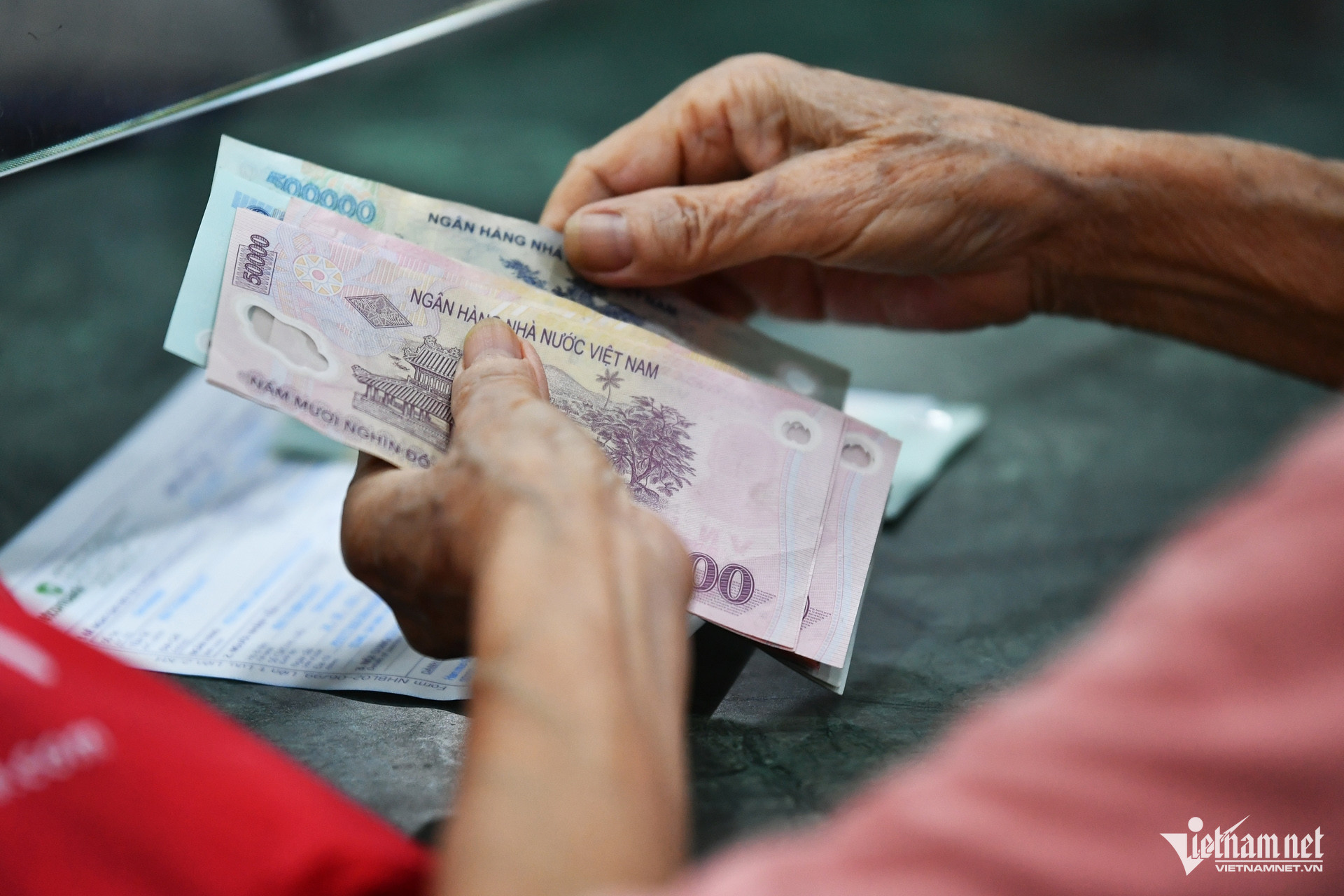
Some opinions suggest that the highest personal income tax rate should be only 25%. Photo: Nam Khanh
The Ho Chi Minh City Tax Consulting and Tax Agents Association stated that the majority of opinions agreed and suggested abolishing the 35% tax rate, maintaining a tax rate of 30% or less to create a competitive advantage in the workplace, attracting and retaining talent.
At the same time, it encourages and incentivizes legitimate wealth creation, limits fraud and transfer pricing, and increases the ability to attract foreign labor.
Regarding tax brackets, the Ho Chi Minh City Tax Consulting and Tax Agents Association agrees with Option 2 as proposed by the Ministry of Finance, but suggests adjusting the tax brackets to have wider gaps, increasing them by 10-15 million VND compared to the draft.
Proposal to raise the taxable income threshold.
Notably, Deloitte Vietnam Tax Consulting Co., Ltd. stated that Vietnam's current tax schedule places it among the countries with high personal income tax rates compared to other Southeast Asian countries. Vietnam's maximum tax rate is currently 35%, equivalent to Thailand and the Philippines. The highest tax rate in Singapore is only 24%, while in Malaysia and Myanmar it is 30%.
Meanwhile, the taxable income levels at each bracket in Vietnam are quite low compared to the region.
Therefore, Deloitte suggests that the Ministry of Finance should not only adjust the progressive tax rate schedule as drafted but also consider increasing the taxable income threshold, especially at the highest level, to match the pace of economic development, ensure increased competitiveness, and attract high-quality human resources.
Meanwhile, Vietnam Foreign Trade Commercial Bank (Vietcombank) proposed raising the tax thresholds in brackets 2 and 3 to accurately reflect the inflation rate in recent years.
Specifically, Vietcombank proposed a tax bracket of 15-45 million VND/month (or rounded to 50 million VND) for bracket 2, and 45-75 million VND/month (or rounded to 80 million VND) for bracket 3. For higher brackets (brackets 4 and 5), the bank believes adjustments are needed to raise the tax threshold, aiming to effectively target high and very high income groups.
Regarding tax rate design, Vietcombank proposes a clearer differentiation between low-income and high-income groups, instead of a uniform 5% gap as in the draft.
Specifically, by merging the old tax brackets 2 and 3 into two new brackets, the bank proposes applying the same tax rate as the old bracket 2 (10% or lower), instead of 15%. Similarly, when merging the old tax brackets 4 and 5 into the new bracket 3, the tax rate should remain the same as the old bracket 4 (20% or lower), instead of 25%.
Vietcombank stated that in some Southeast Asian countries, the threshold for applying the highest tax rate is often set very high relative to GDP per capita. For example, in the Philippines it is 17 times, and in Malaysia it is 36 times. Therefore, the bank suggested that Vietnam should choose an intermediate level, around 20-25 times GDP per capita. If calculated at a ratio of 20 times, the starting threshold for tax bracket 5 would be approximately 200 million VND per month.
Vietnamnet.vn
Source: https://vietnamnet.vn/ap-thue-thu-nhap-ca-nhan-cao-nhat-chi-nen-25-2443957.html
![[Photo] General Secretary and President To Lam meets with National Assembly delegates from ethnic minorities.](https://vphoto.vietnam.vn/thumb/1200x675/vietnam/resource/IMAGE/2026/04/20/1776696701056_a1-bnd-8331-3342-jpg.webp)
![[Image] National Assembly discusses the implementation of the socio-economic development plan.](https://vphoto.vietnam.vn/thumb/1200x675/vietnam/resource/IMAGE/2026/04/20/1776696707422_ndo_br_img-20260420-185419-jpg.webp)















































































Comment (0)