

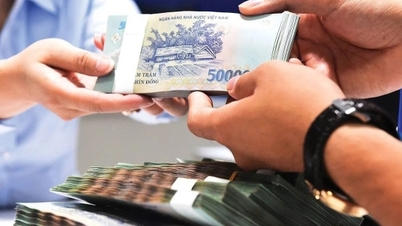
This is a positive sign for individual businesses and household businesses – a group facing significant pressure due to rising input costs, declining purchasing power, and shrinking profit margins.
According to the drafting agency, in the context of a volatile economy , studying and adjusting tax policies is necessary. The goal is not only to ensure strict, transparent, and accurate tax collection, but also to make the policy more suitable to the realities of production and business.
In reality, the business environment has changed significantly in a short period. When input costs increase, nominal revenue may rise, but the real income of business households may not necessarily improve, and may even decrease. In this context, a fixed revenue threshold, even if recently adjusted, risks quickly becoming outdated, and if rigidly applied, could inadvertently create further pressure on already vulnerable entities.
Therefore, adjusting the threshold according to socio-economic developments is a logical approach. Policies need to "breathe" with reality, capable of responding promptly to changes, instead of waiting for lengthy cycles of law revisions. For the household business sector, which accounts for a large proportion of the economy, creates tens of millions of jobs, and is vulnerable, "reducing pressure in the right places" not only helps maintain operations but also contributes to stabilizing livelihoods and employment.
This proposal also closely follows the directives of General Secretary and President To Lam at the National Conference on studying, understanding, and implementing the Resolution of the 2nd Plenum of the 14th Central Committee. Accordingly, genuine growth must begin from each "cell" of the economy. Household businesses and individual businesses are such "cells." When operating in a stable and transparent policy environment with reasonable compliance costs, they will have the conditions to invest, expand, and contribute more to growth.
However, this "good news" is only truly complete when accompanied by a sound policy design. Entrusting the government with specifying the revenue threshold for tax exemption has the advantage of giving the government flexibility in its operations. However, this directly affects the rights and obligations of taxpayers, which need to be clearly defined in law to ensure stability and uphold the authority of the National Assembly .
When presented to the National Assembly, this issue will certainly be carefully considered to ensure both flexibility in administration and the stability of policies, as well as predictability for citizens and businesses. The National Assembly may stipulate the principles, criteria, and regulatory framework in the law, while the Government decides on the specific levels within that scope. This approach ensures the role of the legislative body while creating room for policies to closely reflect reality.
More importantly, the new tax threshold must truly reflect reality. It should not only reflect the revenue level but also take into account the specific costs, profit margins of each industry, and the resilience of household businesses at each stage. A threshold that is too low could increase pressure and reduce the motivation to maintain operations; but if it is too high, it could easily affect tax discipline and create a gap with the corporate sector.
To achieve this balance, determining the threshold requires a comprehensive database, clear quantitative analysis, and updates based on economic fluctuations. Simultaneously, the policy needs to be designed with reasonable stability, allowing businesses to proactively plan and strategize, rather than constantly adjusting to unpredictable changes.
Like businesses, individual entrepreneurs and household businesses often know how to overcome difficulties to survive and find ways to develop. With a generally stable institutional environment and tax policies in particular, and reasonable compliance costs, they will certainly feel secure in their businesses, strive to improve, and simultaneously build a livelihood, nurture income, and make a practical contribution to the country's double-digit growth targets.
Source: https://daibieunhandan.vn/tin-vui-voi-ho-kinh-doanh-10414041.html


![[Photo] General Secretary and President To Lam presides over a meeting on preparations for the review of one year of operation of the three-tiered government system.](https://vphoto.vietnam.vn/thumb/1200x675/vietnam/resource/IMAGE/2026/06/02/1780391821195_a1-bnd-4595-9717-jpg.webp)






![[Video] Prime Minister Le Minh Hung: Completing breakthrough mechanisms to develop an international financial center](https://vphoto.vietnam.vn/thumb/402x226/vietnam/resource/IMAGE/2026/06/02/1780416130959_tt-jpg.webp)

![[Video] General Secretary and President To Lam: Shifting from completing the restructuring of the apparatus to ensuring its smooth operation.](https://vphoto.vietnam.vn/thumb/402x226/vietnam/resource/IMAGE/2026/06/02/1780415840629_tbt-jpg.webp)














































Comment (0)