

 |
The iPhone 17 Pro lineup is displayed at an Apple store. Photo: Bloomberg . |
According to data from research firm Counterpoint Research , iPhone sales in China increased by 20% in the first quarter. This was the strongest increase among leading manufacturers, despite a market downturn due to rising memory chip prices.
Overall, smartphone sales in China in the first quarter fell 4% compared to the same period last year. The main reasons were supply chain disruptions and rising chip prices.
"Due to persistently sluggish demand, the government's subsidy policy introduced at the beginning of the year has had virtually no impact on the market."
"Although promotions during the Lunar New Year (February) provided a certain boost compared to January, the price reductions could not offset the increased memory costs," said analyst Ivan Lam from Counterpoint Research .
Apple and Huawei bucked the trend with increases of 20% and 2% respectively. According to analyst Ivan Lam, Apple differentiated itself by maintaining product prices while its competitors increased them, and consumers trusted that the company's devices could last at least three years.
The iPhone 17 line continued to contribute significantly to Apple's sales in the most recent quarter, combined with price reductions and government subsidies.
"Apple is considered to be best positioned to weather the global memory crisis, stemming from its premium product portfolio and strong supply chain management capabilities."
"In the short and medium term, Apple is likely to absorb the increased costs itself and expand its market share," said a representative from Counterpoint Research .
Huawei's sales grew thanks to strong demand in both the high-end and budget segments, including the Enjoy 90 series. Supply of the Mate 80 series improved, while reliance on a domestic supply chain gave the company a cost advantage amid rising global memory prices.
In the first quarter, Huawei recorded the highest market share in China (20%). Apple ranked second with 19%, and the remaining representatives in the top 6 were Oppo (16%), Vivo (15%), Honor (13%), and Xiaomi (12%).
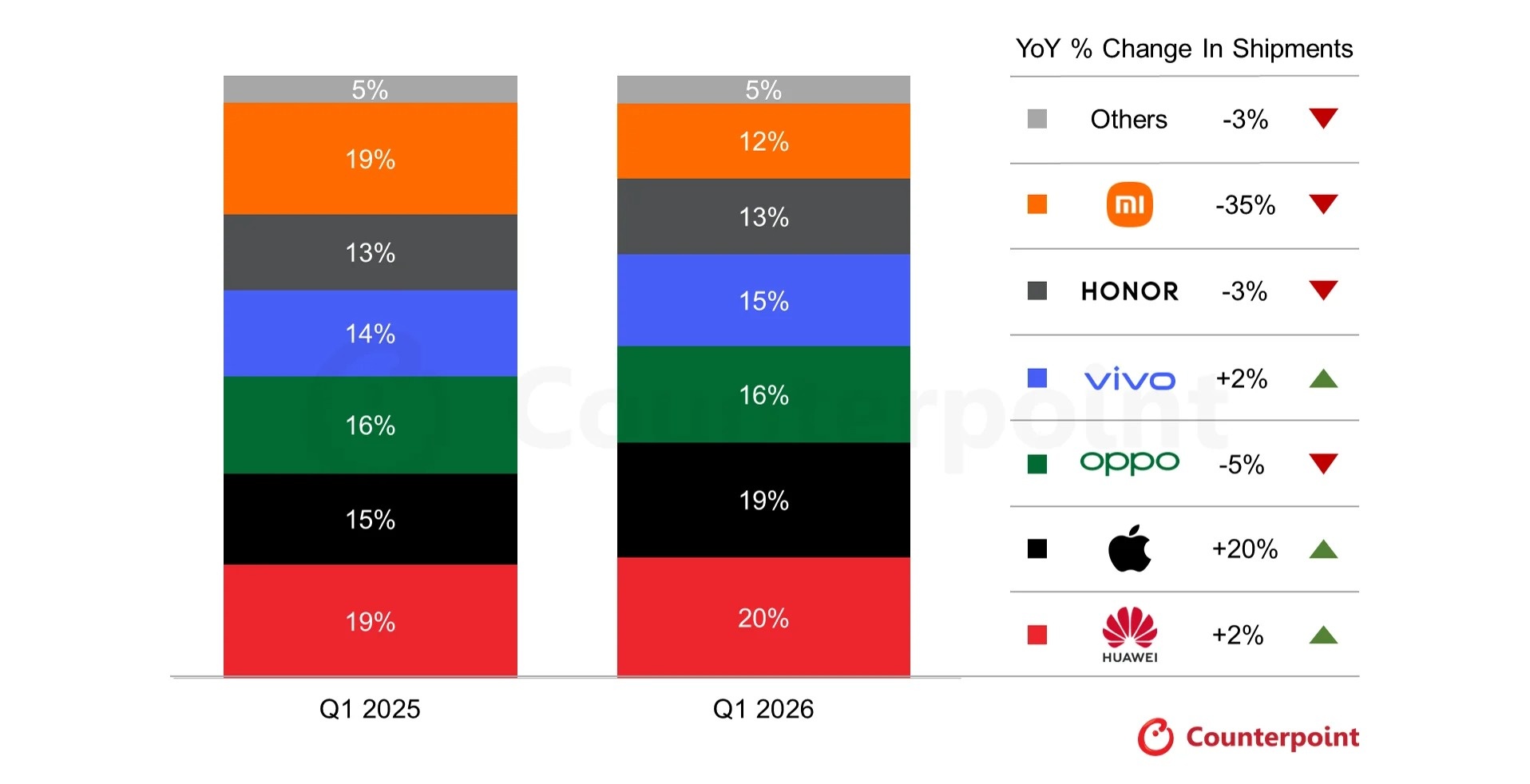 |
Market share of the 6 major smartphone brands in China in Q1 2026 and Q1 2025. Image: Counterpoint Research . |
According to CNBC , smartphone manufacturers in China are having to raise prices, especially for budget models, to protect their profit margins amid rising memory chip costs.
Xiaomi's sales in China in the first quarter fell by 35% compared to the same period last year. According to Lam, the reason is that last year Xiaomi benefited greatly from the government's subsidy program.
Oppo and Honor also saw sales decline during the same period, by 5% and 3% respectively, while Vivo recorded a 2% increase thanks to strong sales during the Lunar New Year holiday.
OnePlus, a sub-brand of Oppo, recorded a 53% increase in first-quarter sales compared to the same period last year, thanks to the Ace 6 and Turbo 6 series. Following its profit-prioritizing strategy, Oppo was the first company to raise prices on some models on March 16th, impacting demand and the incentive to upgrade.
Lam predicts that the Chinese smartphone market will face more difficulties in the second quarter, especially as domestic brands seek to raise prices further.
"However, we anticipate positive outcomes for both Apple and Huawei, with Huawei potentially experiencing stronger growth due to stable demand in the low-end segment," a representative from Counterpoint Research emphasized.
Amid cost pressures, the Chinese smartphone market could shrink by 9% in 2026, but will still outperform the global average.
Source: https://znews.vn/apple-lai-nguoc-dong-post1644520.html

![[Photo] “Red Journey” 2026: Vietnamese Youth Continue Building the Bridge of Friendship Between Vietnam and China](https://vphoto.vietnam.vn/thumb/1200x675/vietnam/resource/IMAGE/2026/04/20/1776629730866_4055880775670638308-9618-4200-jpg.webp)
















































































Comment (0)