

 |
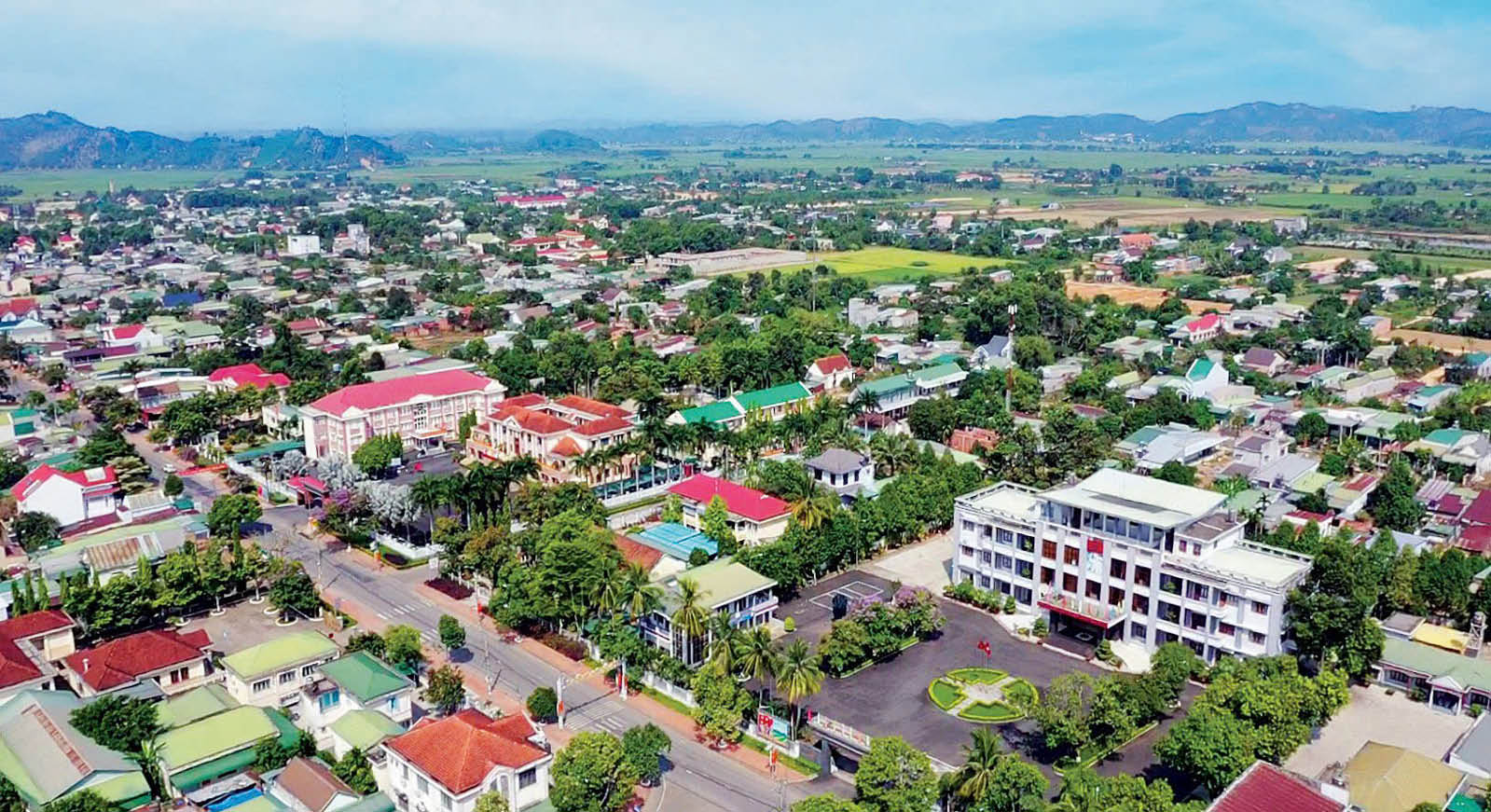
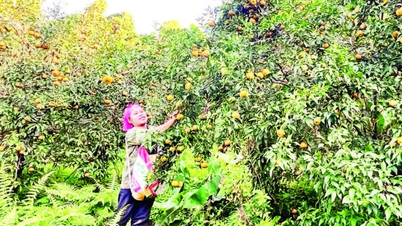
| The once wild and desolate mountains and forests have now become a prosperous countryside. |
In early October 1977, the Hue City Party Committee decided to establish a Youth Volunteer Force and tasked the City Youth Union with mobilizing enthusiastic young people to register and join the force. Within just a few weeks, 1,800 people had signed up and were "organized" into two regiments.
They were young men and women in their late teens and early twenties, born in the city and unfamiliar with machetes and hoes, but their youthful will and determination transformed them into people who achieved miracles. Among the many successes of the two former Youth Volunteer Regiments of Hue City, there was the clearing of wild forests, the construction of roads, the establishment of the new Huong Lam Economic Zone, and the resettlement of 3,000 Hue City households along the Dong Nai River in the majestic southern Central Highlands…
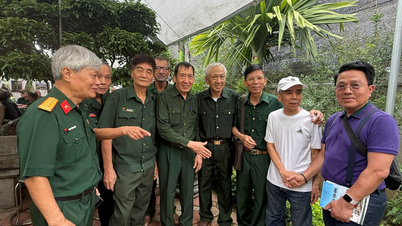
Mr. Do Duc Du, Head of the Liaison Committee of Hue City's Youth Volunteers in Lam Dong , and his comrades reminisced with emotion about those days, each moment deeply etched in their memories. Those were extremely difficult years, filled with countless challenges and dangers, but in the hearts of the young people of Hue City at that time, only the words of President Ho Chi Minh to the Youth Volunteers echoed: "Nothing is difficult/Only fear of a lack of perseverance/Digging mountains and filling seas/With determination, anything can be achieved."
Mr. Du and everyone else recalled: At 8:00 AM on December 15, 1977, at the Thai Hoa Palace courtyard in the Hue Imperial Citadel, in the presence of leaders from Binh Tri Thien province and Hue City, the Ho Chi Minh Communist Youth Union of Hue City solemnly held a departure ceremony. Comrade Hoang Lanh - Provincial Party Committee member, Secretary of the City Party Committee - presented the Victory Flag to Lieutenant Colonel Nguyen Thai Long - Head of the Command Board of the Huong Lam Economic Zone (Lam Dong province) and bid farewell to the two Youth Volunteer Regiments as they left beloved Hue City to head straight into the Central Highlands with the mission of reconnaissance, land reclamation, and welcoming people to build the Huong Lam Economic Zone in Zone 3 of Bao Loc district, southern Lam Dong province…
***
In the midst of the conversation, we all looked towards Ma Oi Slope, a place forever etched in the hearts of the people of Hue from that era. Ma Oi is the name of a slope, not very high but very long, forming a boundary between the Zone 3 agricultural farm in Bao Loc district and the Huong Lam Economic Zone. This hill, formerly known as Point 167, was named Ma Oi in late 1977, when a youth volunteer team, including more than 300 young women from Hue, cleared the way, climbed over the slope to clear the forest, and build houses in preparation for welcoming people from Hue to build their new homeland. Back then, it was still raining, the slope was steep, the road muddy, and they kept climbing up and then sliding down. Tired and hungry, seeing a vast area of bamboo, reeds, and primeval forest teeming with wild animals, snakes, leeches, and snails, many young women couldn't help but exclaim, "Oh, Ma Oi!" The cry of "Oh, Ma Oi!" was almost a plea for help. To forever remember those arduous early days of road construction and land clearing, the people of Hue have preserved the name of this slope to this day, making it a distinctive landmark of the ancient capital amidst the remote highlands…
From the memorable name of Ma Oi slope, we sat together, gathering memories of those days, the bitterly cold winter of 1977. After completing the construction of the Buon Ho Economic Zone (Dak Lak) with over 5,000 compatriots and comrades, Lieutenant Colonel Nguyen Thai Long, Political Commissar of the City Military Command and Standing Committee member of the Hue City Party Committee, was ordered to go with Nguyen Cuu Su, Nguyen Van Huu, and Trinh Hung Cuong, along with a group of Youth Volunteers, to survey the southern region of Lam Dong province, bordering Dong Nai province, in preparation for bringing people to build the fifth Economic Zone of Hue City in the southern provinces. After days of arduous searching through the forest, on November 29, 1977, the survey team arrived at Region 3 (a place name during the resistance war against the US), and there, the team met with several local leaders such as Vu, Ba, and Tam Bich, leaders of the Lam Dong Economic Zone Management Board. On a map with a scale of 1/25,000, Mr. Tam Bich circled a large area of about 40 square kilometers and said: "The area where you comrades came to reclaim land was formerly a resistance base of Zone VI. This land is stained with the blood of many comrades and compatriots, and has a rich tradition. Prosperity is due to the hands and minds of you comrades and the people of Hue..."
The next morning, compass in hand, the seven brothers headed in the same direction, cutting a path towards the unfamiliar land within the 40km² circle marked on the map the day before. Climbing a hill overlooking the surroundings, Nguyen Thai Long happily exclaimed: “Our neighboring province has given us such wonderful land, comrades! Rice, a vast expanse of rice fields stretching out before our eyes! It's truly a plain in the middle of a plateau. Wonderful!” Su, a cautious man, after digging seventy-eight centimeters with a knife and still managing to unearth handfuls of black humus, then confidently said: “It will be a wonderful rice-growing region.” Following the Da Lay stream, deep into the mountain slopes, the brothers suddenly came across mounds of sweet potatoes hidden amidst a dense area of cogon grass and thorny bamboo, yet still bearing tubers; The ancient cassava plants, their trunks as thick as trees, the collapsed bunkers, and a few other items like water canteens, machetes, and rusty pots and pans—these traces were evidence of the indomitable and resilient spirit of a heroic resistance base. All these images instilled in the survey team a surge of emotion, a steadfast spirit, and a firm belief and determination: If our people and army defeated the Americans on this land, they will certainly also conquer poverty and backwardness.
Less than a month after the survey, on December 17, 1977, the Hue City Youth Volunteer Brigade began its march into the new land. Both regiments of the Youth Volunteer Brigade, with nearly 1,800 members, arrived and immediately grabbed their knives to clear the forest, plan residential areas, and cultivate the land. The top priority was farming and agricultural land. Those without houses erected temporary shelters. From dawn until dusk, everyone stayed in the forest, eating and sleeping on the spot. Many companies even mobilized entire units to clear fields under the moonlight. Some young women, upon arriving, trembled and cried at the sound of monkeys howling and tigers roaring, but they gradually adapted, cutting trees, clearing fields, cutting thatch, and building houses like the men. Those with weak nerves, living in the vast forest during those arduous days, often felt their spirits shaken and were overwhelmed with fear. Anh Đủ mused, “Those last days of winter, the jungle rains poured down relentlessly. In the makeshift shelters, the brothers and sisters were soaked to the bone.” The dark night was filled with the sobbing of young girls, mingled with the sound of rain and the boisterous singing of the young men, echoing throughout the primeval forest. It was so sad, our comrades! These city boys and girls, still in school, some never having even held a knife or machete; they climbed mountains and crossed streams, leeches and slugs biting their hands and feet, flies and mosquitoes swarming like chaff, poisonous water, venomous snakes, hunger, malaria, and scabies all over their bodies. Their health was eroded day by day, the girls' hair falling out in clumps and carried away by the streams. Many fell while wielding hoes and knives, like Võ Yên Thế and Lê Cảnh Thị Dạ Hương…
***
Amidst countless harsh challenges, under the leadership of the construction site command and the Party branch, 1,800 young men and women volunteers from Hue City gradually overcame difficulties and successfully completed their tasks. Not a single person gave up. Not a single person succumbed to hardship. All of them matured through labor. Over 500 hectares of old-growth forest, bamboo, thorny bushes, and reeds were cleared and prepared for planting immediately after land preparation. I was truly moved when I reread the heartfelt accounts about the Hue City volunteer youth group. In an article published in the Lam Dong Newspaper in early 1978 by veteran journalist Vu Thuoc, Hue wrote: “When we arrived a year later, those young men had already left. They went to new lands beckoning ahead. They happily embarked on their journey, proud to be tasked with opening roads and establishing villages in these new rural areas. They were ready to accept and overcome all the harsh challenges of the early days. Glory belongs to them – the pioneers!...”
Not all former Youth Volunteers returned to Hue; quite a few volunteered to stay and participate in building the local government and departments. Responding to the call from Lam Dong province, to form a core group to contribute to building and shaping the government apparatus and departments in their new homeland, more than 40 former Youth Volunteers from Hue City volunteered to leave city life and stay in the sunny and windy southern Central Highlands, staying with the people of Hue who had left their ancestral land to settle in this new land. Many of them later became key officials in Da Teh and Da Huoai districts and in Lam Dong province…
(To be continued)
Source: https://huengaynay.vn/chinh-polit-xa-hoi/bai-1-dong-ky-uc-cua-nhung-nguoi-mo-dat-152660.html





































































Comment (0)